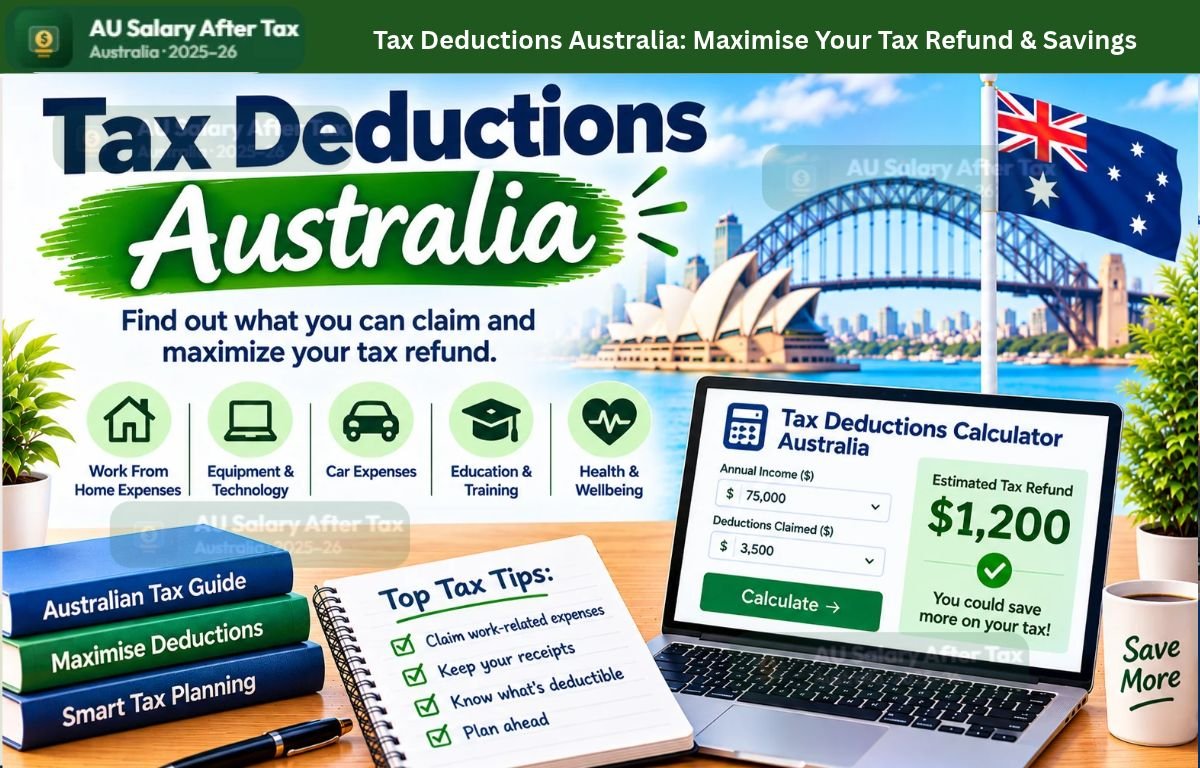
You lodge your tax return, the refund is smaller than you expected, and the reason is usually not your salary — it is the deductions you did not claim. Every dollar of tax deductions Australian workers claim cuts taxable income, and $1,000 is worth $320 in the 30% bracket. For 2026–27 the rules have changed: a new $1,000 standard deduction applies automatically, and the old no-receipts shortcuts are gone.
This Tax Deductions Australia guide explains what you can claim in 2026–27, how the new standard deduction works, which deductions stack on top of it, and what you cannot claim.
Table of Contents
Important: All figures are for 2026–27 (1 July 2026 to 30 June 2027) unless a year is stated. The $1,000 standard deduction applies to the 2026–27 return you lodge from July 2027 — not to the 2025–26 return due by 31 October 2026. A deduction reduces your taxable income, not your tax bill dollar for dollar.
What a Tax Deduction Actually Does
A tax deduction lowers the income the ATO taxes you on. Earn $80,000, claim $2,000 of deductions, and your taxable income becomes $78,000. The saving is the deduction multiplied by your marginal rate, plus the Medicare levy you no longer pay. A $1,000 deduction saves $170 at 15%, $320 at 30%, $390 at 37% and $470 at 45%, each figure including the 2% Medicare levy.
| Taxable income | Tax on this income |
|---|---|
| $0 – $18,200 | Nil |
| $18,201 – $45,000 | 15c for each $1 over $18,200 |
| $45,001 – $135,000 | $4,020 plus 30c for each $1 over $45,000 |
| $135,001 – $190,000 | $31,020 plus 37c for each $1 over $135,000 |
| $190,001 and over | $51,370 plus 45c for each $1 over $190,000 |
The only change from 2025–26 is the second bracket: 16% became 15% on 1 July 2026, saving at most $268 a year. A deduction is not an offset: it comes off your income before the brackets are applied, while an offset such as the Low Income Tax Offset (up to $700 in 2026–27) comes off the tax itself, and the ATO applies it automatically.
The ATO applies three tests to every claim. You spent the money yourself and were not reimbursed. It is directly related to earning your income — a work shirt with your employer’s logo passes; the suit you wear to the office does not. You have a record to prove it — from 2026–27, if you itemise above the standard deduction, you need written evidence for every dollar, kept for five years. If an expense is partly private and partly work, only the work portion counts.
The $1,000 Standard Deduction: What Changed on 1 July 2026
The biggest change to tax deductions Australian workers have seen in years took effect on 1 July 2026: from the 2026–27 income year, eligible workers get a standard deduction of up to $1,000 for work-related expenses — without needing to have spent the money or kept a single receipt. It became law on 26 June 2026 (section 25-130, Income Tax Assessment Act 1997) and is automatic: if you are eligible, the ATO applies it. The ATO’s standard deduction page explains who is eligible and how the reduction works.
It is capped at your labour income: the maximum is the lower of $1,000 or your total assessable labour income. Business and investment income alone do not qualify — you must earn assessable labour income, such as salary and wages. It is reduced dollar for dollar by the work expenses you claim yourself: the $1,000 is a floor, not a bonus. Claim $450, and it falls to $550; claim $2,350, and it falls to nil. The ATO’s own example: a worker on $95,000 with $550 of work expenses is better off taking the full $1,000.
The claims that reduce it are the ordinary work-related ones — stationery, tolls, travel allowance, uniforms and laundry, working from home, car expenses and transport between workplaces. Union fees and professional memberships do not reduce it, and neither do donations, tax agent fees, personal super, income protection premiums or investment expenses. Three old shortcuts were repealed on 1 July 2026 for everyone: the $300 exception, the $150 laundry exception and the award transport exemption — so if you itemise above the standard deduction, you need written evidence for all of them.
Read more: Income Tax Calculator Australia: Complete Guide to Income Tax, Brackets and Take-Home Pay
Tax Deductions Australia: What You Can Claim
These are the tax deductions Australian workers claim most often.
| Category | What it covers | 2026–27 figure |
|---|---|---|
| Standard deduction | Automatic work-related deduction, no receipts | Up to $1,000 |
| Working from home | Fixed rate per hour worked from home | 70c per hour |
| Car expenses | Cents per kilometre, or logbook method | 91c per km, up to 5,000 km |
| Tools and equipment | Items costing $300 or less, or depreciated | Immediate deduction up to $300 |
| Uniforms and laundry | Compulsory uniforms, protective clothing, laundry | $1 per load, 50c mixed |
| Self-education | Courses directly related to your current job | No cap, work portion only |
| Union and professional fees | Union fees, association memberships | No cap, stacks on top |
| Tax agent fees | Cost of having your return prepared | No cap, stacks on top |
| Donations | Gifts of $2 or more to deductible gift recipients | No cap, stacks on top |
| Personal super contributions | Deductible contributions to your fund | Within the $32,500 concessional cap |
| Income protection premiums | Premiums paid outside super | No cap, stacks on top |
The Low Income Tax Offset is an offset, not a deduction: up to $700 if your taxable income is $37,500 or less, phasing out to nil at $66,667. The ATO applies it automatically.
Working From Home: Fixed Rate or Actual Costs
If you work from home, you have two methods, and you must choose one for the year. The fixed rate method is the simple one: 70c for every hour you work from home. It covers energy, internet, phone, stationery, and computer consumables in a single number, so you cannot claim those bills separately on top. The rate comes from the ATO’s guideline PCG 2023/1, has been 70c since 1 July 2024, and the ATO had not published a different 2026–27 rate at the time of writing — so 70c is the rate to use. Two days a week from home across a 48-week year is about 730 hours, worth $511 — well below the $1,000 standard deduction.
The 70c rate is the figure behind most tax deductions for Australian workers’ home-office claims. The actual cost method is the alternative: add up the work portion of each running cost and claim that total. It beats the fixed rate only when your real costs are high. Two traps catch people: the fixed rate already covers your phone and internet, so claiming them again is double-counting.
Car Expenses: Cents per Kilometre and the Logbook
Car expenses are where the largest single work deduction usually sits, and the 2026–27 rate has moved: the cents per kilometre method now pays 91c per kilometre, up from 88c in 2025–26 — an indexed base of 89c plus a one-off 2c uplift for 2026–27 only. You can claim up to 5,000 work kilometres per car each year, which caps the method at $4,550. Most tax deductions: Australian workers who drive for work will use this method. The 91c rate covers all running costs — fuel, registration, insurance, servicing and depreciation — so you cannot claim those separately.
The kilometres must be work travel: driving between two separate workplaces, travelling to a client, or attending a work conference. The ordinary trip from home to your regular workplace is not deductible, even at 3am, even for a call-out. The logbook method wins for heavy drivers: keep a logbook for a continuous 12-week period, work out your business-use percentage, and claim that percentage of every running cost. A car used 60% for work with $8,000 of running costs gives a $4,800 deduction — more than the $4,550 cap. The trip tax deductions Australia workers most often over-claim is the home-to-work drive, and the one they most often under-claim is travel between two jobs.
Tools, Uniforms, Laundry and Self-Education
Tools and equipment. For tools, the tax deductions Australian workers claim depend on what the item costs. An item costing $300 or less can generally be claimed in full in the year you buy it, provided you use it mainly to earn non-business income. A $249 recorder or a $280 hand tool passes; a $1,200 laptop does not — it is depreciated over its effective life, and only the work-use portion counts.
Uniforms and laundry. You can claim a compulsory uniform — one your employer requires you to wear, and that identifies you with the organisation — and protective clothing such as steel-cap boots, hi-vis vests and safety glasses. Conventional clothing is never deductible. For laundry, the ATO accepts $1 per load if you wash only work clothes, and 50c per load if you mix other clothes in.
Self-education. A course is deductible if it directly relates to your current employment. A teacher doing a course in classroom management passes; the same teacher doing a plumbing course does not. Course fees and travel to the course are claimable; a course for a new career is not.
Read more: Salary Sacrifice Calculator Australia: Complete Guide to Salary Sacrificing, Super & Tax
The Deductions That Stack on Top of the $1,000
The standard deduction only replaces the ordinary work-related claims. A second group of tax deductions Australian workers can claim is untouched by it. Donations. Gifts of $2 or more to a deductible gift recipient — a registered charity — are deductible, with no cap. Tax agent fees. The cost of having your return prepared, and of managing your tax affairs generally, is deductible — the ATO’s own example allows a $175 tax agent fee alongside the full standard deduction.
Personal super contributions. You can claim a deduction for contributions to your own super fund, provided you give the fund a valid notice of intent to claim before you lodge. The deduction sits inside the concessional contributions cap of $32,500 for 2026–27, which includes your employer’s 12% super guarantee — so a worker whose employer already contributes $9,600 has $22,900 of cap room left. Contributions inside the cap are taxed at 15% inside the fund instead of your marginal rate. Income protection premiums. Premiums for income protection, personal sickness and accident insurance are deductible when paid outside super. Premiums paid through your super fund are not deductible. Union and professional fees. Union fees and memberships of a trade, business or professional association are deductible and do not reduce your standard deduction. A $520 annual union fee is a $520 deduction on top of the $1,000.
What You Cannot Claim
Your daily commute is not deductible — not the petrol, tolls, train fare or parking. Child care is not deductible, even though you could not work without it. Grooming, conventional clothing and meals on a normal working day are not deductible. Fines are not deductible — a parking fine on a work trip stays yours. Private health insurance premiums are not deductible.
The cost of a driver’s licence is not deductible, even if the job requires one; only the extra cost of a special licence above a standard one may be. Anything your employer reimbursed is not deductible, even if you paid for it first. The tax deductions Australian workers lose most often are the ones they never thought to check: the $1,000 standard deduction itself. If your work expenses are under $1,000 and you spend hours gathering receipts to itemise them, you have done the work for nothing — the standard deduction gives you the same $1,000 with no records.
Tax Deductions Australia: Worked Examples
These worked examples use the tax deductions Australian workers claim most often. Tax is worked out on the 2026–27 resident brackets, with the 2% Medicare levy on top, before offsets.
Example 1: $80,000 salary, standard deduction only
A worker earns $80,000 and claims no itemised work expenses, so the ATO applies the full $1,000 standard deduction automatically.
- Taxable income without any deduction: $80,000
- Income tax: $4,020 + 30c × ($80,000 − $45,000) = $14,520.00
- Medicare levy: 2% × $80,000 = $1,600.00
- Total tax without deductions: $16,120.00
- Taxable income with the standard deduction: $80,000 − $1,000 = $79,000
- Income tax: $4,020 + 30c × ($79,000 − $45,000) = $14,220.00
- Medicare levy: 2% × $79,000 = $1,580.00
- Total tax with the standard deduction: $15,800.00
- Tax saved by the $1,000 deduction: $320.00
The $320 is 32% of $1,000 — the 30% marginal rate plus the 2% Medicare levy.
Example 2: $80,000 salary, itemised claims of $2,870
The same worker has real work expenses above $1,000, so itemising wins. Her claims: working from home 300 hours × 70c = $210.00; car 2,000 work kilometres × 91c = $1,820.00; laundry 40 loads × $1 = $40.00; a $280 hand tool = $280.00; union fees = $520.00. The first four total $2,350 and reduce the standard deduction to nil; the union fees stack on top. Total: $2,870.
- Taxable income: $80,000 − $2,870 = $77,130
- Income tax: $4,020 + 30c × ($77,130 − $45,000) = $13,659.00
- Medicare levy: 2% × $77,130 = $1,542.60
- Total tax: $15,201.60
- Tax saved: $16,120.00 − $15,201.60 = $918.40
Itemising saves $918.40 against $320 for the standard deduction alone — an extra $598.40 — but only because her claims exceed $1,000 and she has the records.
What $1,000 is worth at each marginal rate
| Marginal rate | Income tax saved | Medicare saved | Total saved |
|---|---|---|---|
| 15% | $150 | $20 | $170 |
| 30% | $300 | $20 | $320 |
| 37% | $370 | $20 | $390 |
| 45% | $450 | $20 | $470 |
Figures assume the Medicare levy applies and are before offsets.
Records, Lodging and Deadlines
The record-keeping rule for tax deductions for Australian workers is simple: if your work-related claims are under $1,000, take the standard deduction and keep no records for them. If they are over $1,000 and you want to itemise, you need written evidence for all of them. The 2026–27 tax year ends on 30 June 2027, and the deadline for lodging your own return is 31 October 2027.
Read more: Super Calculator Australia: Complete Guide to Super, Contributions & Retirement
What can I claim on tax in Australia in 2026–27?
Work-related expenses you paid for yourself that directly relate to earning your income, with records: working from home, car travel, tools, uniforms, laundry, self-education, union fees, tax agent fees, donations, personal super and income protection — plus the automatic $1,000 standard deduction.
What is the $1,000 standard deduction?
From 2026–27, eligible workers get up to $1,000 for work-related expenses, applied automatically with no receipts needed. It is the lower of $1,000 or your assessable labour income, and it falls dollar for dollar with the work expenses you claim.
How much is the working from home deduction in 2026–27?
The fixed rate method pays 70c for every hour you work from home, covering energy, internet, phone, stationery and computer consumables. The rate has been 70c since 1 July 2024.
What is the cents per kilometre rate for 2026–27?
91c per kilometre, up from 88c in 2025–26. You can claim up to 5,000 work kilometres per car each year, which caps the method at $4,550. Only work travel counts.
Can I claim my car if I drive to work?
No, not for the ordinary trip from home to your regular workplace — that is private travel, even at 3am and even for a call-out. You can claim travel between two separate workplaces and travel to a client or work conference.
What is the $300 rule for tools?
An item costing $300 or less can generally be claimed in full in the year you buy it, provided you use it mainly to earn non-business income. Items over $300 are depreciated over their effective life.
Are donations tax deductible in Australia?
Yes, if the gift is $2 or more and goes to a deductible gift recipient — a registered charity. There is no cap.
Can I claim laundry expenses?
Yes, for washing compulsory uniforms and protective clothing. The ATO accepts $1 per load if you wash only work clothes, and 50c per load if you mix other clothes in.
When do I lodge my 2026–27 tax return?
The 2026–27 tax year ends on 30 June 2027. If you lodge your own return, the deadline is 31 October 2027. A registered tax agent usually gives you until May 2028, provided you are on their books before 31 October 2027.
Should I itemise my deductions or take the $1,000 standard deduction?
Add up your work-related expenses. If they are under $1,000, take the standard deduction — it gives you the same $1,000 with no records. If they are over $1,000 and you have the evidence, itemise.
Final Takeaway
Tax deductions Australia workers claim in 2026–27 are governed by one new fact above all others: the $1,000 standard deduction. It is automatic, it needs no receipts, and for most workers it is the whole answer — add up your work expenses, and if they are under $1,000, take it and stop. Itemising still pays for workers with heavy car travel, a home office and real tool costs — if they have the records. The tax deductions Australia workers should still track are the ones that stack on top: donations, tax agent fees, personal super contributions, income protection premiums and union fees.
Standard deduction = up to $1,000, automatic, reduced dollar for dollar by work expenses you claim
Working from home = 70c per hour (fixed rate method)
Car expenses = 91c per kilometre, up to 5,000 km, maximum $4,550
Tools = immediate deduction if $300 or less, depreciated if more
Laundry = $1 per load (work only), 50c per load (mixed)
Value of a $1,000 deduction = $170 at 15%, $320 at 30%, $390 at 37%, $470 at 45% (including 2% Medicare levy)
Lodge by 31 October 2027 if you lodge yourself; keep records for five years
Work out your total before you decide, and claim the stackers on top. On an $80,000 salary, the standard deduction alone is worth $320, and itemising $2,870 of genuine expenses is worth $918.40.