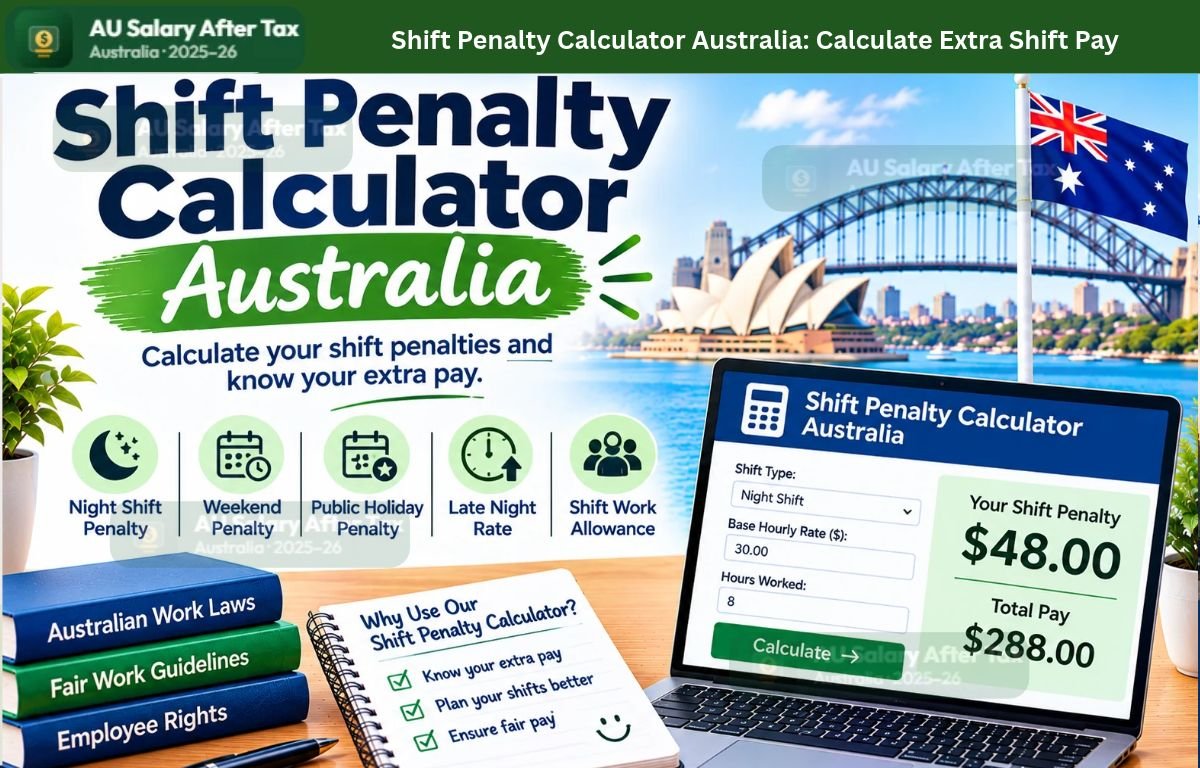
Saturday, Sunday, night and public holiday shifts pay more than weekday day shifts. That extra pay is called a penalty rate, and for millions of Australian workers it is the difference between a liveable wage and a short one. The shift penalty calculator Australia workers use on this page turns three numbers — your base hourly rate, your hours, and the type of shift — into an estimate of that extra pay.
This shift penalty calculator Australia guide explains where penalty rates actually come from, why the calculator’s multipliers are wrong for the biggest awards in the country, and how much of your penalty pay you keep after tax and super in 2026–27. It also corrects the calculator where its numbers are wrong — most seriously on Sundays, where it still uses the 200% rate the Fair Work Commission cut to 150% for retail, hospitality and pharmacy workers years ago.
Important: All figures in this guide are for 2026–27 unless a year is stated. There is no single national penalty rate. Your rate comes from your modern award, enterprise agreement or contract — and the same Saturday shift can pay 125% under one award and 200% under another. The calculator uses four fixed multipliers for everyone. Those multipliers are right for some awards and wrong for others, and the worked examples below show the dollar difference in each case.
Table of Contents
What Is the Shift Penalty Calculator?
The shift penalty calculator estimates the extra pay for working at inconvenient times. It is an estimate of the penalty component only — not a full payslip calculation, and it cannot tell you whether your award pays a different rate, whether your hours count as overtime instead, or how much tax will be withheld.
It takes just three inputs:
| Input | What to enter | Default |
|---|---|---|
| Base Hourly Rate | Your ordinary hourly rate before any penalties or loadings | $35.00 |
| Hours Worked | The number of hours in the shift | 8 |
| Penalty Type | Saturday, Sunday, evening or public holiday | Saturday (1.5×) |
It returns a six-row breakdown:
| Output | What it means |
|---|---|
| Penalty Multiplier | The multiplier for the penalty type you chose |
| Penalty Hourly Rate | Your base rate × the multiplier |
| Hours Worked | The hours you entered |
| Standard Pay | What the same hours pay at your base rate |
| Penalty Pay | What the same hours pay at the penalty rate |
| Extra Earnings | Penalty pay − standard pay |
With the default inputs — $35.00 an hour, Saturday (1.5×), 8 hours — the calculator shows a penalty hourly rate of $52.50, standard pay of $280.00, penalty pay of $420.00, and extra earnings of $140.00. That arithmetic is correct. Whether 1.5× is the right multiplier depends on your award: it is right for a manufacturing worker, and wrong for a retail worker, whose Saturday rate is 125%.
Shift Penalty Calculator Australia: How to Use It
Using the calculator takes less than a minute, but the number you type in as your base rate — and the award you work under — decide what its answer is worth.
- Enter your base hourly rate. Use your ordinary hourly rate before any penalties, loadings or allowances. If you are a casual, enter your base rate without the 25% casual loading, because the calculator does not model casual loading at all.
- Enter the hours in the shift. Enter the hours for one shift type only. A shift that spans two penalty periods — for example, an evening that runs past midnight into a public holiday — needs separate calculations.
- Choose the penalty type. Pick the one that matches the shift: Saturday, Sunday, evening or public holiday. If your shift is both a Sunday and a public holiday, run it as a public holiday — most awards pay the higher rate only, not both.
Use it with these limitations in mind:
- It uses one multiplier per penalty type for every award. Saturday is 1.5×, Sunday is 2×, evening is 1.15× and public holiday is 2.5×, whoever you are. Retail, hospitality, fast food and pharmacy workers are all paid less than these multipliers on weekends.
- It has no night shift option. There is no night multiplier in the dropdown, even though night loadings of 112.5% to 130% apply under many awards.
- It does not know your award. It cannot apply your award’s evening start time, its minimum engagement, or the way your award treats casual loading on penalties.
- It does not model overtime. A shift that is both a penalty shift and overtime is usually paid at the higher rate only — the calculator cannot show that.
- Everything is before tax and before super. Penalty pay is taxed as ordinary income, and super applies to penalties on ordinary hours but not to penalties on overtime hours.
Read more: Best Overtime Calculator Australia: Complete Guide 2026
How Penalty Rates Are Calculated
Three steps turn your base rate and hours into penalty pay, and the shift penalty calculator Australia workers use follows exactly these steps:
Penalty hourly rate = base hourly rate × multiplier
Penalty pay = penalty hourly rate × hours worked
Extra earnings = penalty pay − (base rate × hours worked)
The multiplier is the only variable, and your award sets it. A retail worker and a security guard on the same $30 base rate earn very different Saturday pay: $37.50 an hour for the retail worker at 125%, and $45.00 an hour for the security guard at 150%. Over an 8-hour shift that is $300.00 against $360.00 — a $60.00 gap from one clause in two different awards.
The same logic applies in reverse. Two workers under the same award on different base rates keep the same multiplier but different dollars. The multiplier is the rule; the base rate is personal. That is why this guide gives every rate as a percentage first, and works the dollars out from the percentage.
The 2017 Decision That Changed Penalty Rates
The most important fact about penalty rates in Australia is that the rates most people remember are no longer the law. On 23 February 2017 the Fair Work Commission handed down the penalty rates decision, [2017] FWCFB 1001. It cut Sunday and public holiday penalty rates in six awards: fast food, retail, hospitality, pharmacy, clubs and restaurants.
The cuts were phased in, not immediate. Sunday rates fell gradually from 1 July 2017 — over four years in retail and pharmacy, and over three years in hospitality and fast food — and finished on 1 July 2020. Public holiday rates were cut in full on 1 July 2017, with no phase-in. The final rates, which are the rates in force today, are:
| Award | Sunday before 2017 | Sunday now | Public holiday before 2017 | Public holiday now |
|---|---|---|---|---|
| General Retail | 200% | 150% | 250% | 225% |
| Pharmacy | 200% | 150% | 250% | 225% |
| Hospitality | 175% | 150% | 250% | 225% |
| Fast Food (Level 1) | 150% | 125% | 250% | 225% |
| Fast Food (Levels 2–3) | 150% | 150% (no change) | 250% | 225% |
| Restaurant | 150% | 150% (no change) | 250% | 225% |
Three points deserve emphasis. First, the Sunday cut was large: retail and pharmacy workers lost 50 percentage points, a quarter of the Sunday rate. A retail worker on $28 an hour lost $14.00 an hour on every Sunday hour — $112.00 on an 8-hour Sunday shift.
Saturday rates were not changed by the decision at all. The Commission rejected the application to cut Saturday rates in the retail, hospitality, fast food and restaurant awards. Retail Saturday was already 125% before 2017, so the calculator’s 150% Saturday figure was never right for a retail worker — it is not a rate that was cut, it is a rate that never existed under that award.
Second, the decision touched only six awards. Manufacturing, cleaning, security, nursing, aged care and community services were not cut, and their Sunday rates of 175% to 200% still stand. That split is why a single “Sunday rate” no longer exists.
Third, the cuts cannot be repeated the same way. On 30 August 2025 the Fair Work Amendment (Protecting Penalty and Overtime Rates) Act 2025 took effect, and the Fair Work Commission must now ensure that award penalty and overtime rates are not reduced. The rates in your award are protected from being cut in a modern award review.
The calculator page was written as if 2017 never happened. Its Sunday multiplier of 2× and its public holiday multiplier of 2.5× are the pre-2017 rates for the very awards the decision changed. For a retail worker, that is not a rounding error — it is a $112.00 overstatement on a single Sunday shift.
The Fair Work Ombudsman’s penalty rates page explains what penalty rates are and how to calculate them under your award. (Fair Work Ombudsman – Penalty rates)
Penalty Rates by Award
This is the table the whole guide turns on. There is no typical penalty rate — only the rate your award sets. Full-time and part-time rates are shown first, with the casual rate in brackets. Casual rates already include the 25% casual loading unless the note says otherwise.
| Award | Saturday | Sunday | Public holiday |
|---|---|---|---|
| General Retail (MA000004) | 125% (150% casual) | 150% (175% casual) | 225% (250% casual) |
| Hospitality (MA000009) | 125% (150% casual) | 150% (175% casual) | 225% (250% casual) |
| Restaurant (MA000119) | 125% (150% casual) | 150% (150% casual Intro–L2; 175% casual L3–6) | 225% (250% casual) |
| Fast Food (MA000003) | 125% (150% casual) | 125% L1 (150% casual); 150% L2–3 (175% casual) | 225% (250% casual) |
| Pharmacy (MA000012) | 125% 8am–6pm (150% casual) | 150% 7am–9pm (175% casual) | 225% (250% casual) |
| Nurses (MA000034) | 150% (187.5% casual) | 175% (218.75% casual) | 200% (250% casual) |
| Aged Care (MA000018) | 150% (175% casual) | 175% (200% casual) | 250% (275% casual) |
| Health Professionals (MA000027) | 150% (175% casual) | 150% (175% casual) | 250% (275% casual) |
| SCHADS (MA000100) | 150% (175% casual) | 200% (225% casual) | 250% (275% casual) |
| Manufacturing (MA000010) | 150% (187.5% casual) | 200% (250% casual) | 250% (312.5% casual) |
| Cleaning (MA000022) | 150% (175% casual) | 200% (225% casual) | 250% (275% casual) |
| Security (MA000016) | 150% (175% casual) | 200% (225% casual) | 250% (275% casual) |
Two patterns jump out. First, the four awards that employ the most weekend workers — retail, hospitality, restaurant and fast food — all pay 125% on Saturday and 150% on Sunday. The calculator’s 150% Saturday and 200% Sunday overstate both days for all four.
Second, public holidays split the same way. Retail, hospitality, restaurant, fast food and pharmacy pay 225% for full-time and part-time staff, not 250%. The 250% rate survives in manufacturing, cleaning, security, aged care, health professionals and community services — and in retail and hospitality it survives only for casuals, whose 250% already includes their loading.
Evening and night rates vary even more, because each award defines “evening” differently — and some awards do not use a percentage for evenings at all.
| Award | Evening / night (full-time & part-time) | Casual |
|---|---|---|
| General Retail | Mon–Fri after 6pm: 125% | 150% |
| Hospitality | Mon–Fri 7pm–7am: fixed dollar amount per hour, not a percentage | Fixed dollar amount |
| Restaurant | 10pm–midnight and midnight–6am: fixed dollar amounts per hour | Fixed dollar amounts |
| Fast Food | 10pm–midnight: 110%; midnight–6am: 115% (no penalty before 10pm) | 135% / 140% |
| Pharmacy | 7–9pm: 125%; 9pm–midnight: 150%; 7–8am: 150% | 150% / 175% / 175% |
| Nurses | Afternoon shift: 112.5%; night shift: 115% | Percentages of the casual rate |
| Aged Care | Afternoon: 110% or 112.5%; night: 115% or 110% | 135% / 137.5% / 140% / 135% |
| Health Professionals | Shiftwork: 115% | 140% |
| SCHADS | Afternoon: 112.5%; night: 115% | 137.5% / 140% |
| Manufacturing | Afternoon and night: 115%; permanent night: 130% | Percentages of the casual rate |
| Cleaning | Shift starting before 6am or finishing after 6pm: 115%; permanent night: 130% | 140% / 155% |
| Security | Night 6pm–6am: 121.7%; permanent night: 130% | 146.7% |
General Retail (MA000004). Evening means after 6pm Monday to Friday, at 125%. Ordinary hours run 7am to 9pm Monday to Friday, 7am to 6pm Saturday, and 9am to 6pm Sunday. Work outside that span is usually overtime, not an evening penalty. A casual’s minimum engagement is 3 hours per shift.
Hospitality (MA000009). The evening rate is a fixed dollar amount per hour from 7pm to 7am, not a percentage — so the calculator’s 1.15× evening multiplier has no meaning under this award at all. Saturday and Sunday rates are the post-2017 figures: 125% and 150%. Full-time and part-time staff who work a public holiday can agree to take 125% plus a substitute day off instead of 225%.
Fast Food (MA000003). There is no evening penalty before 10pm on weekdays. A 6pm to 10pm shift is paid at the ordinary rate. The penalties start at 10pm (110%) and rise to 115% after midnight. Sunday is the lowest in the country for a Level 1 worker: 125%, the same as Saturday. The adult Level 1 minimum from 1 July 2026 is $27.81 an hour, or $34.76 for a casual.
Pharmacy (MA000012). Pharmacy is the most time-sliced award in this guide. Saturday morning before 8am pays 200% — the highest Saturday rate anywhere — then drops to 125% from 8am to 6pm, rises to 150% from 6pm to 9pm, and 175% from 9pm to midnight. Sunday is 150% from 7am to 9pm, and 200% outside those hours. A single Saturday shift can cross three different rates.
Nurses (MA000034). Afternoon shift means a shift that starts at noon or later and finishes after 6pm, at 112.5%. Night shift means a shift that starts at 6pm or later and finishes before 7.30am, at 115%. Saturday is 150%, Sunday 175%, and public holiday 200% for permanent staff, with a substitute day off as well.
Casual rates are calculated on the casual hourly rate, which already includes the 25% loading — so a casual nurse’s Saturday rate is 187.5% of the minimum, not 150% plus 25%. Shift loadings do not apply on weekends or public holidays, or to registered nurse levels 4 and 5.
Health Professionals and Support Services (MA000027). Weekend ordinary hours — midnight Friday to midnight Sunday — pay 150% for full-time and part-time staff, and 175% for casuals, who do not also receive the loading. Public holidays pay 250%, or 275% for casuals. Shiftwork pays 115%, or 140% for a casual shiftworker. The Support Services Level 1 minimum from 1 July 2026 is $26.97 an hour: $40.46 on a weekend, $47.20 for a casual, $67.43 on a public holiday, and $74.17 for a casual on a public holiday.
SCHADS (MA000100). Afternoon shift means a shift finishing between 8pm and midnight Monday to Friday, at 112.5%. Night shift means finishing after midnight or starting before 6am, at 115%. Saturday is 150%, Sunday 200%, and public holiday 250%. Casuals add 25 points to each: 137.5%, 140%, 175%, 225% and 275%. Weekend and public holiday rates replace shift loadings — they never stack.
Manufacturing (MA000010). Afternoon and night shiftworkers get 115%, and permanent night shiftworkers get 130%. Day workers get 150% on Saturday, 200% on Sunday and 250% on public holidays. Casuals are paid the weekend and public holiday percentages on their loaded casual rate, so a casual’s Saturday pay is 150% of the rate that already includes the 25% loading.
Cleaning (MA000022). A weekday shift starting before 6am or finishing after 6pm pays 115%, and a permanent night shift finishing after midnight pays 130%. Saturday is 150%, Sunday 200%, and public holiday 250%. Part-time staff have a 15% part-time loading built into their penalty rates — 165% on Saturday, 215% on Sunday, 265% on a public holiday. Casuals get 175%, 225% and 275%.
Security (MA000016). Night work from 6pm to 6am pays 121.7%, and permanent night work pays 130%. Saturday is 150%, Sunday 200%, and public holiday 250%. Casuals get 146.7% at night, 175% on Saturday, 225% on Sunday and 275% on a public holiday. The Level 1 minimum from 1 July 2026 is $28.42 an hour, or $35.53 for a casual.
Aged Care (MA000018). Afternoon shift pays 110% for a shift starting between 10am and 1pm, and 112.5% for a shift starting between 1pm and 4pm. Night shift pays 115% for a shift starting between 4pm and 4am, and 110% for a shift starting between 4am and 6am. Saturday is 150%, Sunday 175%, and public holiday 250%. Casuals get 175% on Saturday, 200% on Sunday and 275% on a public holiday. Part-time and casual shiftworkers only receive the afternoon and night penalties if the shift starts before 6am or finishes after 6pm.
Restaurant (MA000119). Saturday is 125% and Sunday is 150%, the same post-2017 figures as retail and hospitality. Evening and night work are paid as fixed dollar amounts per hour, not percentages. Only one penalty applies at a time — the higher one. A full-time or part-time employee who works a public holiday must be paid for at least 4 hours, and a casual for at least 2 hours, even if the shift is shorter.
All of these rates are minimums, and they rose by 4.75% from the first full pay period on or after 1 July 2026 under the Fair Work Commission’s Annual Wage Review 2026. Your enterprise agreement or contract can pay more than the award, never less.
Public Holidays: Working, Not Working and Minimum Payments
Public holidays pay the highest penalty rates in most awards — and they come with the most extra rules. Three situations matter: working the day, not working the day, and working only part of it.
If you work on a public holiday, you are paid your award’s public holiday rate for every hour worked. For a full-time or part-time retail, hospitality, restaurant, fast food or pharmacy worker that is 225%. For a manufacturing, cleaning, security, aged care, health professional or community services worker it is 250%. Casuals are paid 250% under the first group of awards and 275% under the second — in both cases the casual rate already includes the 25% loading.
If you do not work on a public holiday, you are usually still paid — but only at your base rate, and only if the day is one you would ordinarily have worked. Section 116 of the Fair Work Act requires your employer to pay your base rate of pay for the ordinary hours you would have worked. The base rate excludes loadings, allowances, overtime and penalty rates. Your roster cannot be changed to avoid this payment.
Two groups miss out. A part-time employee whose ordinary hours never include that day of the week is not paid for it. A casual employee who was not rostered on is not paid for it either — casuals are paid for a public holiday only if they work it. An employee can also be asked to work on a public holiday if the request is reasonable, and can refuse if the request — or the refusal — is reasonable.
Minimum payments apply on public holidays under several awards. A full-time or part-time restaurant worker who works a public holiday must be paid for at least 4 hours, even if the shift is shorter. A casual restaurant worker must be paid for at least 2 hours. Hours worked immediately before or after a part-day public holiday count towards that minimum if they form one continuous shift.
Substitute days are an option under some awards. A full-time or part-time restaurant or hospitality worker can agree to be paid 125% for the public holiday hours worked and take a substitute day off instead of the 225% rate. Permanent nurses who work a public holiday receive 200% plus a substitute day off. Check your award before agreeing — the substitute day is worth more than the extra 100% if you would rather have the time off.
Part-day public holidays exist in some states — Christmas Eve and New Year’s Eve in Queensland and South Australia, for example. The rules for part-day holidays follow the same pattern: the penalty rate applies only to the hours inside the declared part-day, and the hours around it are paid at the ordinary or evening rate.
Read more: Annual Leave Calculator Australia: Complete Guide to Annual Leave, Leave Loading and Your Payout
Casual Loading and Penalty Rates
Casual employees get penalty rates. What confuses people is how the 25% casual loading interacts with them, because the answer changes by award. There are three patterns, and using the wrong one changes the pay by dollars an hour.
Pattern 1: the penalty percentage already includes the loading (Retail pattern). The award publishes a separate casual column. The permanent percentage plus 25 points becomes the casual rate, calculated on the unloaded base rate. A retail casual on Saturday gets 150% — that is 125% plus 25 points, not 150% plus a loading on top.
On a $28 base rate that is $42.00 an hour. If you added 25% on top of the 150% rate you would get $52.50 — $10.50 an hour too much. Retail, hospitality, fast food, pharmacy, restaurant, health professionals, SCHADS, cleaning, aged care and security all use this pattern for weekend and public holiday penalties.
Pattern 2: the percentage applies to the loaded rate (Manufacturing pattern). The award applies the penalty percentage to the casual ordinary hourly rate, which by definition includes the loading. A manufacturing casual on a $35 base rate has a loaded rate of $43.75. Saturday at 150% of the loaded rate is $65.63 an hour — not $52.50.
Pattern 3: no loading on the penalty at all (Nurses pattern). The Nurses Award calculates casual penalties as percentages of the casual hourly rate — which already includes the loading — so the casual Saturday rate is 187.5% of the minimum rate. A casual nurse on a $40 minimum rate earns $75.00 an hour on Saturday, against $60.00 for a permanent nurse. The loading is inside the number, not added to it.
The practical rule is simple: never add 25% to a casual penalty rate unless your award tells you to. In most awards the casual penalty percentage is the whole answer. The Fair Work Ombudsman’s Pay and Conditions Tool applies the right pattern automatically, which is the fastest way to check a casual rate you are unsure about.
Penalty Rates vs Overtime
Penalty rates and overtime are different things, and confusing them is the most common error in this whole area. Penalty rates pay more for ordinary hours worked at inconvenient times — weekends, nights, public holidays. Overtime pays more for hours worked beyond your ordinary hours — past 38 hours a week for a full-timer, past your agreed hours if you are part-time, or outside the span of ordinary hours in your award.
The question that matters is what happens when the same hour is both. In most awards, the answer is that you get the higher rate only — the rates do not stack. The Retail Award states this expressly: overtime rates are in substitution for, and not cumulative upon, the penalty rates. The Health Professionals Award says the same, and the Nurses Award provides that overtime replaces shift loadings and weekend rates. A retail worker’s 10th hour on a Sunday is paid at the Sunday overtime rate of 200%, not at 150% plus an overtime loading on top.
A small number of awards do stack rates, and a small number pay overtime on public holidays at a higher rate than the public holiday penalty. Fast food public holiday overtime is 250% for full-time and part-time staff, against a 225% public holiday penalty — the overtime rate wins. Cleaning and security pay public holiday overtime at 250%, the same as the penalty. The rule is always in your award’s overtime clause, and it is the clause most worth reading in full.
Two further points. First, the 38-hour week is the trigger for weekly overtime, but daily caps matter too: many awards cap ordinary hours at 8, 10 or 11 hours a day, and hours past the cap are overtime even inside a 38-hour week. Second, part-time overtime starts earlier than most people think. A part-timer contracted for 20 hours who works 24 has typically worked 4 overtime hours, paid at overtime rates from the first extra hour — not after 38 hours.
Read more: Best Overtime Calculator Australia: Complete Guide 2026
Shift Penalty Calculator Australia: Worked Examples
Every example below uses 2026–27 figures and the correct rate for the award named. Where an example is the calculator page’s own, the page’s figure is stated alongside the correct figure.
Example 1: $35 an hour, 8 hours on Saturday (the calculator default)
- Penalty hourly rate: $35 × 1.5 = $52.50 an hour
- Penalty pay: $52.50 × 8 = $420.00
- Same hours at the standard rate: $280.00
- Extra earnings: $140.00
The calculator shows exactly this figure, and its arithmetic is correct. But the answer is only right if 1.5× is your award’s Saturday rate. For a manufacturing worker it is: $420.00 is correct. For a retail worker it is not: the Saturday rate is 125%, so the penalty hourly rate is $43.75, penalty pay is $350.00, and the extra earnings are $70.00 — exactly half the calculator’s figure.
Example 2: Retail worker, $28 an hour, 8 hours on Saturday
- Penalty hourly rate: $28 × 1.25 = $35.00 an hour
- Penalty pay: $35.00 × 8 = $280.00
- Same hours at the standard rate: $224.00
- Extra earnings: $56.00
The calculator page says this shift pays $336.00. It overstates the shift by $56.00, because it uses 150% where the Retail Award sets 125%. Worked every Saturday for a year, that is $2,912.00 of real extra earnings — the page’s method implies $5,824.00, and overstates the year by $2,912.00.
Example 3: Retail worker, $28 an hour, 8 hours on Sunday
- Penalty hourly rate: $28 × 1.5 = $42.00 an hour
- Penalty pay: $42.00 × 8 = $336.00
- Same hours at the standard rate: $224.00
- Extra earnings: $112.00
The calculator page says this shift pays $448.00 at double time. It overstates the shift by $112.00 — the largest single-shift error in this guide. A casual retail worker does better: 175% gives $49.00 an hour and $392.00 for the shift, still $56.00 below the page’s figure. Sunday at 200% survives only in awards the 2017 decision did not touch, such as manufacturing, cleaning, security and community services.
Example 4: Nurse, $40 an hour, 10 hours on a public holiday
- Permanent nurse, 200%: $40 × 2 = $80.00 an hour
- Penalty pay: $80.00 × 10 = $800.00
- Same hours at the standard rate: $400.00
- Extra earnings: $400.00
The calculator page says this shift pays $1,000.00. That figure is wrong for a permanent nurse by $200.00, because the Nurses Award public holiday rate is 200%, not 250%. The $1,000.00 figure is right only for a casual nurse, whose public holiday rate is 250% of the minimum rate. The page does not say which kind of nurse it means — and for a permanent nurse its figure is wrong.
Example 5: Retail worker, $32 an hour, 5 hours on a weekday evening
- Penalty hourly rate: $32 × 1.25 = $40.00 an hour
- Penalty pay: $40.00 × 5 = $200.00
- Same hours at the standard rate: $160.00
- Extra earnings: $40.00
The calculator page says this shift pays $184.00, using its 1.15× evening multiplier. It understates the shift by $16.00, because the Retail Award evening rate after 6pm is 125%, not 115%. A casual retail worker earns more again: 150% gives $48.00 an hour and $240.00 for the shift. Note that the same evening under the Hospitality Award would not use a percentage at all — it pays a fixed dollar amount per hour from 7pm.
Example 6: A year of Saturdays — what the error is worth
Take the retail worker from Example 2: $28 an hour, 8 hours every Saturday, 52 weeks a year.
- Correct extra earnings: $56.00 × 52 = $2,912.00 a year
- Page’s implied extra earnings: $112.00 × 52 = $5,824.00 a year
- The page overstates the year by $2,912.00
That $2,912.00 is ordinary taxable income. In the 30% bracket it attracts $873.60 of income tax and $58.24 of Medicare levy, a total of $931.84 — leaving $1,980.16 in hand. Superannuation of 12% on those ordinary hours adds $349.44 to the worker’s fund. The calculator shows none of this, because it shows gross pay only. The tax and super sections below work through both.
What the Calculator Gets Wrong
The shift penalty calculator Australia workers use gets its arithmetic right. Its assumptions are wrong. These are the errors the blog guide corrects — the calculator page itself has not been fixed, and that is the site owner’s call, not this guide’s.
- Sunday 200% is wrong for the biggest awards — the central error. The calculator uses 2× for Sunday. Retail, hospitality, pharmacy and restaurant workers are paid 150% on Sunday, and fast food Level 1 workers 125%. The 200% rate was cut by the Fair Work Commission in 2017 and finished phasing out on 1 July 2020. On a $28 base rate for 8 hours, the page shows $448.00 where the correct retail figure is $336.00 — an overstatement of $112.00 per shift.
- Saturday 150% is wrong for the same awards. The calculator uses 1.5× for Saturday. Retail, hospitality, restaurant, fast food and pharmacy workers are paid 125% on Saturday. The 2017 decision did not cut Saturday rates, because they were already 125% — the page’s figure never existed under those awards. On a $28 base rate for 8 hours, the page shows $336.00 where the correct figure is $280.00 — an overstatement of $56.00 per shift, or $2,912.00 over a year of Saturdays.
- Public holiday 250% is wrong for full-time and part-time staff in five awards. The calculator uses 2.5× for public holidays. Retail, hospitality, restaurant, fast food and pharmacy pay 225% for permanent staff. The 250% rate was cut to 225% in full on 1 July 2017. On a $28 base rate for 8 hours, the page implies $560.00 where the correct retail figure is $504.00.
- The nurse public holiday example is wrong for permanent nurses. The page says a nurse on $40 an hour working a 10-hour public holiday shift earns $1,000.00. The Nurses Award public holiday rate is 200% for permanent staff — $800.00. The $1,000.00 figure is right only for a casual nurse at 250%. The page does not say which kind of nurse it means.
- The evening multiplier is wrong for retail and meaningless for hospitality. The calculator uses 1.15× for evenings. The Retail Award evening rate after 6pm is 125% — the page understates a $32, 5-hour evening shift by $16.00. Under the Hospitality Award there is no evening percentage at all: the rate is a fixed dollar amount per hour from 7pm. Under the Fast Food Award there is no evening penalty before 10pm.
- The page says overtime can stack with penalties as a general rule. It says an employee working a 10-hour Sunday shift “may receive double-time penalty rates for all Sunday hours plus overtime rates for hours beyond the daily ordinary limit”. In most awards that is wrong: overtime rates are in substitution for, and not cumulative upon, the penalty rates. Only the higher rate is paid.
- The casual loading advice is misleading. The page says casuals receive penalty rates “plus their 25% casual loading on the ordinary rate portion”. In most awards the casual penalty percentage already includes the loading — a retail casual’s Saturday rate is 150% in total, not 150% plus 25%. Adding the loading on top would overpay by $10.50 an hour on a $28 base rate.
- Night shift rates of 130% to 150% are overstated. The page says night shift penalties “can attract higher loadings under some awards, sometimes 130% to 150%”. The standard night loadings are 112.5% to 115% for nurses, aged care, health professionals and community services, and 115% for manufacturing and cleaning. Only permanent night shift work reaches 130%, and no award in this guide pays a 150% night loading. The calculator does not even offer a night option.
- The page is labelled 2025–26 and its tax section uses that year. The page title and its tax section both say 2025–26. This guide uses 2026–27 figures, including the 15% second-bracket rate that replaced 16% on 1 July 2026. The page’s $65,000 plus $15,000 equals $80,000 arithmetic is correct; the year on it is not.
- Two claims could not be verified at all. The page says some awards “increase Saturday rates to 175% or 200% for hours worked after noon” and that some awards “require 250% for the first several hours and higher rates beyond that” on public holidays. No major modern award found in this guide’s research does either of those things. Both claims are omitted from this guide rather than repeated.
How Penalty Pay Is Taxed in 2026–27
Penalty rate earnings are ordinary income, taxed at your marginal rate like every other dollar you earn. There is no penalty rate tax concession, no separate penalty tax bracket, and no flat rate on penalty pay. All figures below use 2026–27 rates unless a year is stated, and are before any deductions and before tax offsets.
The 2026–27 tax brackets
| Taxable income | Tax on this income |
|---|---|
| $0 – $18,200 | Nil |
| $18,201 – $45,000 | 15c for each $1 over $18,200 |
| $45,001 – $135,000 | $4,020 plus 30c for each $1 over $45,000 |
| $135,001 – $190,000 | $31,020 plus 37c for each $1 over $135,000 |
| $190,001 and over | $51,370 plus 45c for each $1 over $190,000 |
The only change from 2025–26 is the second bracket: 16% became 15% on 1 July 2026. The 2025–26 figures were $4,288 plus 30c over $45,000, $31,288 plus 37c over $135,000, and $51,638 plus 45c over $190,000. These rates exclude the 2% Medicare levy, which applies on top for most taxpayers above the low-income thresholds. The one-point cut saves at most $268.00 a year.
The page’s $65,000 plus $15,000 example, done properly
The calculator page says a worker earning $65,000 base plus $15,000 in penalty rates has $80,000 of taxable income. That part is right. Here is what it means in tax:
| $65,000 base only | $65,000 + $15,000 penalties | |
|---|---|---|
| Taxable income | $65,000 | $80,000 |
| Income tax | $10,020.00 | $14,520.00 |
| Medicare levy (2%) | $1,300.00 | $1,600.00 |
| Total tax | $11,320.00 | $16,120.00 |
| Extra tax on the $15,000 | $4,800.00 | |
| Kept from the $15,000 | $10,200.00 |
The whole $15,000 sits in the 30% bracket, so $4,500.00 goes in income tax and $300.00 in Medicare levy. The worker keeps $10,200.00 of it. The important point is that only the dollars above each threshold are taxed at the higher rate — earning penalty pay never taxes your base pay at a higher rate, and moving into a higher bracket never leaves you with less after tax.
PAYG withholding: why a big penalty week looks over-taxed
Your employer does not divide your annual tax by 52. Under PAYG withholding, each pay is annualised and looked up in the ATO’s tax tables. A fortnight loaded with public holiday penalty pay is withheld as though you earned at that rate all year. If your real annual income is lower, the difference comes back as a refund at tax time. It is a timing effect, not extra tax.
The reverse is also true. If penalty work is regular and your employer withholds on a low estimate, you can face a bill at lodgement. The fix in both directions is the same: check your year-to-date withholding against your expected annual income before June, not after.
HELP debts and penalty pay
Penalty pay counts towards your HELP repayment income. The 2026–27 HELP repayment threshold is $69,528, and repayments are charged at a marginal rate above it. A worker on a $65,000 base with $15,000 of penalty pay has repayment income of $80,000 — above the threshold — even though the base pay alone is below it. Withholding under the ATO’s tax tables does not include HELP repayments in the same way, so a HELP debtor with heavy penalty earnings can face a bill at lodgement even when the withholding looks right.
Read more: Income Tax Calculator Australia: Complete Guide to Income Tax, Brackets and Take-Home Pay
Superannuation on Penalty Rates
The superannuation guarantee rate is 12% of ordinary time earnings in 2026–27. From 1 July 2026, Payday Super applies: contributions must reach your fund within 7 business days of payday. But super is not payable on every penalty dollar — it depends on whether the hours were ordinary hours or overtime hours.
| Penalty pay | Super payable? |
|---|---|
| Penalty rates on ordinary hours (weekends, nights, public holidays within ordinary hours) | Yes — it is ordinary time earnings |
| Penalty rates on overtime hours | No — overtime is not ordinary time earnings |
| Overtime pay itself | No |
That distinction is worth real money. The $420.00 Saturday penalty pay in Example 1 attracts $50.40 of super. The $15,000.00 of annual penalty earnings in the tax example attracts $1,800.00 of super — if all of it was earned on ordinary hours. The same dollars earned as overtime penalties attract none. If your payslip shows super on some penalty hours and not others, the ordinary-hours line is usually the reason.
Part-Time Workers and Penalty Rates
Part-time workers receive the same penalty rates as full-time colleagues for equivalent shift work. A part-timer on $28 an hour earns the same $35.00 an hour on a Saturday as a full-timer on the same rate. The difference is in the hours, not the rate: the penalty applies to the part-timer’s ordinary hours, and overtime starts once they pass the pattern of hours agreed in writing — not after 38 hours.
Two traps catch part-timers. First, a public holiday that falls on a day they never work is not paid — section 116 only pays for ordinary hours the employee would have worked. Second, a part-timer’s evening and weekend penalties are calculated on their own ordinary rate, which is lower than the full-time equivalent if they work fewer hours. Enter your actual part-time rate, not the full-time rate for the role.
Checking Your Payslip and What to Do If You Are Underpaid
Getting a penalty rate wrong is an easy mistake to make, and the regulator’s own figures show the scale of underpayment overall. In 2025–26 the Fair Work Ombudsman recovered $453 million in underpaid wages and entitlements for more than 181,000 workers — about $2,500.00 per worker on average, and up 27% on the year before. Total back-payments over the last six financial years stand at almost $2.5 billion. The Ombudsman also received a record 31,596 anonymous reports in 2025–26, up 23% on the year before.
Check your payslip against this list every pay:
- Your base rate — the ordinary hourly rate in your contract or award, before any penalty.
- Each penalty shown separately — the rate and the hours for each shift type, or the loaded rate with the penalty identified.
- Casual loading shown separately — or a casual penalty rate that already includes it, never both.
- Overtime shown at the overtime rate — not at the penalty rate for the same hours.
- Super on ordinary-hours penalties — 12% on penalty pay for ordinary hours, none on overtime.
- Public holiday not worked — base rate for ordinary hours you would have worked, if the day is your ordinary working day.
If a rate looks wrong, gather your records before you raise it: payslips, rosters, timesheets, your award or agreement, and your contract. Employers must keep employment records for 7 years, and you can ask for your own. Underpayments can be recovered for up to 6 years. You can contact the Fair Work Ombudsman on 13 13 94 or report online, anonymously if you prefer. The small claims process in the Federal Circuit and Family Court handles claims up to $100,000.00 without a lawyer. Deliberate underpayment of wages or superannuation has been a criminal offence since 1 January 2025.
This guide is general information, not legal advice. If your situation involves an enterprise agreement, an individual flexibility arrangement, or a dispute that is already formal, get advice on your own facts.
Common Mistakes
- Trusting the calculator’s Sunday rate. It uses 200% for everyone. Retail, hospitality, pharmacy and restaurant workers are paid 150%, and fast food Level 1 workers 125%.
- Trusting the calculator’s Saturday rate. It uses 150% for everyone. Retail, hospitality, restaurant, fast food and pharmacy workers are paid 125%.
- Trusting the calculator’s public holiday rate. It uses 250% for everyone. Permanent staff in five major awards are paid 225%.
- Adding casual loading on top of a casual penalty rate. In most awards the casual penalty percentage already includes the loading.
- Assuming penalties and overtime stack. In most awards only the higher rate is paid for the same hour.
- Assuming evening starts at the same time everywhere. Retail evening starts at 6pm, hospitality at 7pm, fast food penalties start at 10pm — and hospitality evenings are a dollar amount, not a percentage.
- Using the page’s nurse example for a permanent nurse. The $1,000.00 figure is right only for a casual. A permanent nurse on the same shift earns $800.00.
- Treating a big penalty week as over-taxed. PAYG withholding annualises each pay. The difference usually comes back as a refund at tax time.
- Forgetting HELP. Penalty pay counts towards repayment income, and a heavy penalty year can push you over the $69,528 threshold.
- Not checking super on penalty hours. Penalties on ordinary hours attract 12% super. Penalties on overtime hours attract none — and the difference is invisible unless you check.
Practical Tips
- Find your award first. Everything in this guide is secondary to it. The Fair Work Ombudsman’s Pay and Conditions Tool gives the exact rates for your classification.
- Run the shift penalty calculator Australia workers use twice. Once with its multipliers, and once with your award’s rates from the tables above, so you can see how far its figure is from the right one.
- Work in percentages, not dollars. A percentage from your award survives a pay rise. A dollar figure from last year’s payslip does not.
- Split mixed shifts. A shift crossing two penalty periods needs two calculations — one per period, at each period’s rate.
- Check casual rates as totals. A casual penalty percentage is usually the whole answer. Never add 25% to it unless your award tells you to.
- Keep a roster diary. Note the award, the shift type, the hours and the rate for each shift. It is the evidence an underpayment claim runs on.
- Model the tax before June. If penalty work has been heavy, check your year-to-date withholding against your expected annual income while there is still time to adjust it.
- Check the public holiday rules before you agree to work one. The rate, the minimum payment and the substitute-day option are all in your award — and the substitute day is sometimes worth more than the extra pay.
- If you are a shiftworker taking annual leave, check both loadings. Some awards pay the higher of 17.5% annual leave loading or the shift loading you would have earned — the shift loading sometimes wins.
- Do not rely on the calculator page’s year. It is labelled 2025–26. Use the 2026–27 figures in this guide, and check the ATO and Fair Work sites for the year you are actually in.
What is time-and-a-half on a Saturday?
Time-and-a-half means 150% of your ordinary hourly rate. But that is not the Saturday rate under every award: retail, hospitality, restaurant, fast food and pharmacy workers are paid 125% on Saturday. On a $28 base rate, a retail worker earns $35.00 an hour on Saturday, not $42.00. An 8-hour Saturday shift pays $280.00, not $336.00.
How much is double time on Sunday?
Double time is 200% of your base hourly rate — but it is not the Sunday rate under the awards that employ the most weekend workers. Retail, hospitality, pharmacy and restaurant workers are paid 150% on Sunday, and fast food Level 1 workers 125%. Sunday at 200% survives only in awards the 2017 Fair Work Commission decision did not touch, such as manufacturing, cleaning, security and community services.
What is the public holiday pay rate in Australia?
It depends on your award. Full-time and part-time workers in retail, hospitality, restaurant, fast food and pharmacy are paid 225% for working a public holiday. Workers in manufacturing, cleaning, security, aged care, health and community services are paid 250%. Casuals are paid 250% under the first group of awards and 275% under the second. If you do not work the public holiday and it is your ordinary working day, you are paid your base rate for the hours you would have worked.
Do casual workers get penalty rates?
Yes. Casual employees are entitled to penalty rates under their award, on top of their ordinary rate. In most awards the casual penalty percentage already includes the 25% casual loading — a retail casual’s Saturday rate is 150% in total, not 150% plus a loading. In a few awards, such as manufacturing, the penalty percentage is applied to the loaded casual rate instead. Check your award’s casual clause before adding anything.
Are penalty rates taxed?
Yes. Penalty rate earnings are ordinary taxable income, taxed at your marginal rate like every other dollar you earn. There is no special penalty tax rate. A worker on $65,000 base plus $15,000 in penalty rates has $80,000 of taxable income: $14,520.00 of income tax plus $1,600.00 of Medicare levy in 2026–27. PAYG withholding on a heavy penalty week can look high, because each pay is annualised — the difference usually comes back as a refund at tax time.
Can penalty rates and overtime apply together?
Usually not. In most awards, when the same hour is both a penalty hour and an overtime hour, only the higher rate is paid — overtime rates are in substitution for, and not cumulative upon, the penalty rates. A retail worker’s 10th hour on a Sunday is paid at the Sunday overtime rate of 200%, not at the Sunday penalty rate plus an overtime loading. A small number of awards do stack rates, so check your award’s overtime clause.
Do I get paid if I don’t work on a public holiday?
Yes, if the public holiday falls on a day you would ordinarily work. Under section 116 of the Fair Work Act, your employer must pay your base rate of pay for the ordinary hours you would have worked. The base rate excludes loadings, allowances, overtime and penalty rates. Part-time employees whose ordinary hours never include that day are not paid, and casual employees who were not rostered on are not paid either.
What is the evening penalty rate?
There is no single evening rate. Under the Retail Award, evening work after 6pm Monday to Friday pays 125%. Under the Hospitality Award, evening work from 7pm pays a fixed dollar amount per hour, not a percentage. Under the Fast Food Award there is no evening penalty before 10pm — the rate is 110% from 10pm to midnight and 115% after midnight. Under the Pharmacy Award, evening rates run from 125% to 150% depending on the hour. Your award’s evening start time is the figure that matters.
Is superannuation paid on penalty rates?
Yes, on penalty rates for ordinary hours — they are ordinary time earnings, so the 12% superannuation guarantee applies. No, on penalty rates for overtime hours — overtime is not ordinary time earnings. On a $420.00 Saturday penalty shift worked within ordinary hours, $50.40 of super is payable. The same dollars earned as overtime penalties attract none.
What should I do if my employer pays the wrong penalty rate?
Check your award first, using the Fair Work Ombudsman’s Pay and Conditions Tool for your exact classification. Then gather your records — payslips, rosters, timesheets, your award or agreement and your contract — and raise it with your employer. If that does not fix it, contact the Fair Work Ombudsman on 13 13 94 or report online, anonymously if you prefer. Underpayments can be recovered for up to 6 years, and the small claims process handles claims up to $100,000.00 without a lawyer.
Final Takeaway
Penalty rates are the most variable part of Australian pay — and the calculator on this page treats them as if they were fixed. Its Sunday rate of 200% was cut to 150% for retail, hospitality and pharmacy workers in 2017. Its Saturday rate of 150% never existed under those awards. Its public holiday rate of 250% is 25 points too high for permanent staff in five major awards. And its nurse example is right only for a casual.
Penalty hourly rate = base hourly rate × multiplier
Penalty pay = penalty hourly rate × hours worked
Extra earnings = penalty pay − (base rate × hours worked)
Tax on penalty pay: ordinary income at marginal rates — $65,000 base plus $15,000 penalties is $80,000 taxable income, $14,520.00 income tax plus $1,600.00 Medicare levy in 2026–27
Super on penalty pay: 12% on penalties for ordinary hours, none on penalties for overtime hours
Find your award, check its rate in the tables above, and run the calculator with your award’s multiplier instead of the page’s. If your payslip does not match, the tables in this guide and the Fair Work Ombudsman’s Pay and Conditions Tool will tell you which number is wrong — and the Ombudsman’s 2025–26 recovery of $453 million for more than 181,000 workers shows that getting it checked is worth doing.