If you work casually in Australia, your hourly rate is almost certainly higher than the permanent rate for the same job — and the difference is called casual loading. The standard loading is 25%, paid on top of your base hourly rate to make up for the paid leave and job security you do not receive. This casual loading calculator Australia guide explains exactly how casual loading works in 2026–27, how to use the casual loading calculator above, what the 25% is really paying for, and how loading interacts with superannuation, tax, penalty rates and your right to become permanent.
Important: Casual loading is not a bonus and it is not extra money for nothing. It is compensation. In exchange for the higher hourly rate, casual employees give up paid annual leave, paid personal (sick) leave, paid public holidays they do not work, notice of termination and redundancy pay. Whether casual or permanent work leaves you better off depends on how many hours you actually work across the year — this guide does that maths with you, step by step.
Table of Contents
What Is Casual Loading?
Casual loading is an extra percentage added to the base (permanent) hourly rate for your classification. Under the National Minimum Wage Order and the great majority of modern awards, that percentage is 25%. A typical award clause puts it plainly: a casual employee must be paid a loading of 25% on top of the minimum hourly rate, and the loading is payable instead of the leave and termination entitlements casuals are excluded from.
You are a casual employee, in law, when two things are true at the start of your employment: there is no firm advance commitment to continuing, indefinite work, and you are entitled to a casual loading or a specific casual rate of pay under an award, registered agreement or your contract. That definition has applied since 26 August 2024, and it is judged on the real substance of the working relationship — not just on what the contract calls you.
A few things casual loading is not:
- It is not the same as annual leave loading (often 17.5%), which some permanent employees receive on top of their pay when they take annual leave. Casuals do not receive leave loading, because casuals do not take paid annual leave.
- It is not a penalty rate. Penalty rates for weekends, nights and public holidays are calculated under your award separately, as explained further below.
- It is not set by the ATO, and it has nothing to do with tax. It is a workplace entitlement set by the Fair Work system — awards, agreements and the National Minimum Wage Order.
Read more: Income Tax Calculator Australia: Complete Guide to Income Tax, Brackets and Take-Home Pay
How to Use the Casual Loading Calculator
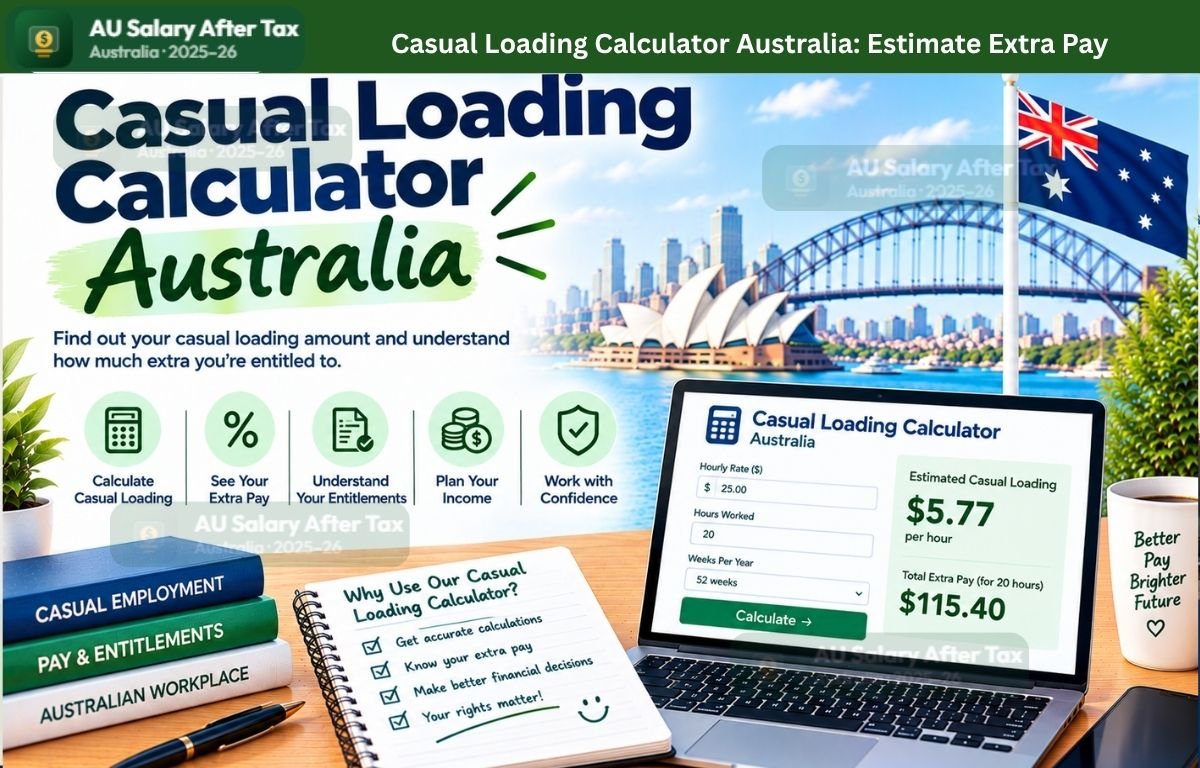
The casual loading calculator Australia employees use on this page is deliberately simple. It has two inputs and applies the standard 25% loading automatically:
- Base Hourly Rate — enter the permanent (non-casual) hourly rate for the job. If you only know your casual rate, divide it by 1.25 first (there is a worked example of this below).
- Hours per Week — enter the hours you expect to work in a typical week.
It then shows your casual hourly rate, your weekly pay on the base rate, your weekly pay on the casual rate, and an annual figure. With the default inputs — a $30 base rate and 38 hours a week — the results are a casual rate of $37.50 per hour, $1,425 per week and $74,100 per year.
Just as important is what the calculator does not do, so you read its results correctly:
- The loading is fixed at 25%. That is the standard rate, but your award or enterprise agreement is the legal source of your loading. If your agreement sets a different casual rate, the calculator’s results will not match it exactly.
- The annual figure assumes 52 weeks of work at the same hours. Very few casuals work all 52 weeks — work dries up, rosters change, and any week you take off is unpaid. Treat the annual number as a full-year equivalent, not a promise.
- It does not calculate tax, super, Medicare levy or HELP repayments. It is a gross pay calculator. Use the worked tax example later in this guide, and our income tax calculator guide, to estimate what lands in your bank account.
- It does not include penalty rates or overtime. Weekend, night and public holiday rates depend on your award and are covered separately below.
How the 25% Casual Loading Is Calculated
The maths is one multiplication:
Casual hourly rate = base hourly rate × 1.25
Weekly casual pay = casual hourly rate × hours per week
Annual casual pay = weekly casual pay × 52
The loading itself is worth 25 cents for every dollar of base rate. On a $30 base rate, the loading is $7.50 an hour, producing the $37.50 casual rate.
Working backwards: finding the base rate inside a casual rate
Employers often advertise only the casual rate. To find the base rate it was built from, divide by 1.25:
- Casual rate $50.00 ÷ 1.25 = $40.00 base rate ✔
- The common mistake: $50.00 × 0.75 = $37.50 ✘ — subtracting 25% of the casual rate gives the wrong answer, because the 25% loading was calculated on the smaller base rate, not on the casual rate.
The same check works on the minimum wage. The 2026–27 national minimum wage is $26.44 an hour, and $26.44 × 1.25 = $33.05 — exactly the published casual minimum wage. If your casual rate is below $33.05 an hour and you are an adult on the national minimum wage, something is wrong.
Casual Loading Worked Examples
Every example below uses the calculator’s own formula and has been checked against the calculator itself.
Example 1: $30 base rate, 38 hours a week (the calculator default)
- Casual rate: $30.00 × 1.25 = $37.50 per hour
- Weekly base pay: $30.00 × 38 = $1,140.00
- Weekly casual pay: $37.50 × 38 = $1,425.00
- Annual casual pay: $1,425.00 × 52 = $74,100.00
The loading alone is worth $285 a week ($1,425 − $1,140) — $14,820 across a full 52-week year.
Example 2: The 2026–27 minimum wage
From 1 July 2026, the national minimum wage is $26.44 an hour ($1,004.90 a week). The casual minimum, including the 25% loading, is $33.05 an hour. A casual on the minimum wage working 38 hours a week earns $33.05 × 38 = $1,255.90 a week, or $65,306.80 across 52 weeks. Last year (2025–26) the figures were $24.95 an hour permanent and $31.19 an hour casual — so if your rate did not move on 1 July 2026, check your award.
Example 3: $25 base rate, 38 hours a week
- Casual rate: $25.00 × 1.25 = $31.25 per hour
- Weekly casual pay: $31.25 × 38 = $1,187.50
- Annual casual pay: $1,187.50 × 52 = $61,750.00
Note that a $25 base rate is below the 2026–27 national minimum wage for an adult, so this example only works for a junior, apprentice or trainee rate, or as a maths exercise — an adult casual’s loaded rate cannot legally sit below $33.05 an hour unless a higher award or agreement rate applies.
Example 4: Part-time hours — $28 base rate, 20 hours a week
- Casual rate: $28.00 × 1.25 = $35.00 per hour
- Weekly casual pay: $35.00 × 20 = $700.00
- Annual casual pay: $700.00 × 52 = $36,400.00
This is the pattern for many retail, hospitality and care casuals: a healthy hourly rate, but a modest annual income because the hours are limited. The loading does not compensate for hours you are never rostered.
Example 5: $40 base rate, 38 hours a week
- Casual rate: $40.00 × 1.25 = $50.00 per hour
- Weekly casual pay: $50.00 × 38 = $1,900.00
- Annual casual pay: $1,900.00 × 52 = $98,800.00
Casual Loading Calculator Australia: Rates at a Glance
| Base hourly rate | Loading (25%) | Casual hourly rate |
|---|---|---|
| $26.44 (2026–27 minimum wage) | $6.61 | $33.05 |
| $28.00 | $7.00 | $35.00 |
| $30.00 | $7.50 | $37.50 |
| $32.00 | $8.00 | $40.00 |
| $35.00 | $8.75 | $43.75 |
| $40.00 | $10.00 | $50.00 |
| $45.00 | $11.25 | $56.25 |
| $50.00 | $12.50 | $62.50 |
What the 25% Loading Pays For
The loading replaces specific entitlements. Here is the honest trade:
| Permanent employees receive | Casual employees receive instead |
|---|---|
| 4 weeks of paid annual leave a year | No paid annual leave — time off is unpaid |
| 10 days of paid personal/carer’s leave a year | No paid sick or carer’s leave (2 days of unpaid carer’s leave per occasion) |
| Paid public holidays that fall on a normal workday | No pay for a public holiday not worked |
| Notice of termination (or pay instead) | No notice required from either side |
| Redundancy pay after qualifying service | No redundancy pay |
| A firm commitment to ongoing work and regular hours | Hours can rise, fall or end with the roster |
So what is that package worth? Fair Work does not publish an official breakdown of the 25%, but the arithmetic is instructive — treat these figures as illustrations, not an official formula. A permanent employee is paid for 52 weeks but, after 4 weeks of annual leave and 2 weeks of personal leave, works about 46. To earn the same total while being paid only for weeks worked, you would need a loading of about 13% (52 ÷ 46).
Add roughly 11 public holidays (about 2 more weeks not worked but paid) and the figure rises to about 18%. The remaining slice of the 25% — roughly 7 points — is what covers the missing notice period, missing redundancy pay and the basic insecurity of casual work: no guaranteed hours, no guaranteed income, and shifts that can disappear at short notice.
The practical lesson: the loading roughly balances the leave you give up if you work close to full-time hours all year. The fewer weeks you work, the more the balance tips toward permanent employment, because a permanent employee is paid for leave weeks and a casual is paid nothing at all for weeks not worked.
Important: “Casuals get no paid leave” is not quite true. Since 2023, casual employees get 10 days of paid family and domestic violence leave each year, available in full from day one and paid at your full rate including the loading, for the hours you were rostered. It does not accumulate from year to year — it renews on your work anniversary.
What Casual Employees Still Get
Loading compensates for what is missing, but casuals are employees with real rights under the National Employment Standards (NES) and the Fair Work Act:
- Superannuation guarantee at 12% of ordinary time earnings — the same as every other employee (more below).
- 10 days of paid family and domestic violence leave per year, from day one.
- 2 days of unpaid carer’s leave per occasion, when a family or household member needs care because of illness, injury or an unexpected emergency.
- 2 days of unpaid compassionate leave per occasion, for a death or life-threatening illness or injury in your immediate family or household.
- Unpaid community service leave, including jury service and voluntary emergency management activities.
- The Casual Employment Information Statement from your employer when you start, and again at set points in your first year and beyond.
- Protection from unfair dismissal once you pass the minimum employment period (6 months, or 12 months for a small business with fewer than 15 staff) — but only if your work has been regular and systematic and you had a reasonable expectation it would continue.
- General protections from day one — you cannot be sacked or disadvantaged for exercising a workplace right, and discrimination and work health and safety laws cover you exactly as they cover permanent staff.
- The right to request flexible working arrangements in set circumstances (for example, if you are pregnant, a parent or carer, aged 55 or over, or have a disability) after 12 months of regular and systematic work.
- 12 months of unpaid parental leave after 12 months of regular and systematic service, if you would reasonably have expected the work to continue.
- Long service leave in some states and territories, if you have served long enough under your state or territory law — check the rules where you work.
Casual Loading and Superannuation
Casual employees get superannuation on the same basis as everyone else. The super guarantee (SG) rate is 12% for both 2025–26 and 2026–27, and it is calculated on your ordinary time earnings — which include the casual loading on your ordinary hours. In plain terms, super is paid on the loaded rate, not the base rate.
Using Example 1: on a casual rate of $37.50 an hour for 38 hours, weekly ordinary time earnings are $1,425, so your employer must contribute $1,425 × 12% = $171.00 a week to your fund — $8,892 across a full year. The permanent employee on the $30 base rate receives $136.80 a week. The loading quietly grows your super balance as well as your pay.
Four super rules casuals commonly get wrong:
- There is no $450-a-month threshold anymore. It was removed on 1 July 2022. You earn super from the first dollar, however few hours you work in a month.
- Under-18s are the exception: if you are under 18, your employer only has to pay super for a week in which you work more than 30 hours.
- Payday Super started on 1 July 2026. Your employer now has to pay your super on payday, at the same time as your wages, and it must reach your fund within 7 business days — instead of the old quarterly deadlines. If your super used to arrive in quarterly lumps, check your fund: it should now track your payslips.
- Super is paid on top of your rate unless your contract expressly states a super-inclusive package. The 25% loading is not reduced to “make room” for super.
The Fair Work Ombudsman’s guidance on casual employment, including super and the Casual Employment Information Statement, is at fairwork.gov.au — Casual employment changes.
Casual Loading and Tax
There is no casual tax rate. Casual pay is taxed under exactly the same system as permanent pay: your employer withholds PAYG tax from each pay using the ATO tax tables, based on that pay, whether you claim the tax-free threshold, and whether you have a study loan. The loading is simply part of your gross wages, taxed at your marginal rate like every other dollar.
The 2026–27 resident income tax rates (excluding the 2% Medicare levy) are:
| Taxable income | Rate |
|---|---|
| $0 – $18,200 | 0% |
| $18,201 – $45,000 | 15% |
| $45,001 – $135,000 | 30% |
| $135,001 – $190,000 | 37% |
| Over $190,000 | 45% |
One rate changed on 1 July 2026: the second bracket fell from 16% to 15% (it falls again to 14% on 1 July 2027). Everything else is unchanged.
Why casual tax can look too high in a big week
Withholding tables treat each pay as if you earned that amount every week of the year. Work 45 hours in a festival week and the withholding is calculated as though you earn that all year, pushing some of it into a higher bracket. If your actual annual income is lower, the extra comes back as a refund when you lodge your return. It is a timing effect, not extra tax — over the full year, a casual and a permanent employee on the same total income pay the same tax.
Worked tax example: $74,100 of casual income in 2026–27
Take Example 1’s full-year figure of $74,100, claim the tax-free threshold, no HELP debt:
- $0 – $18,200: $0
- $18,201 – $45,000 (26,800 × 15%): $4,020
- $45,001 – $74,100 (29,100 × 30%): $8,730
- Income tax: $12,750
- Medicare levy (2%): $1,482
- Total: $14,232 — take-home pay $59,868
If the same worker has a HELP debt, the compulsory repayment for 2026–27 is worked out on the marginal system: nothing up to $69,528 of repayment income, then 15 cents per dollar above that. On $74,100 that is ($74,100 − $69,528) × 15% = $685.80 extra, reducing take-home pay to $59,182.20. (HELP repayments are assessed on your whole repayment income in your tax return; extra amounts withheld during the year are a prepayment, not the final bill.)
Read more: HECS Calculator Australia: Complete Guide to HECS-HELP Repayments, Thresholds and Rates
Two casual jobs? Claim the threshold once
Casuals often hold two or three jobs. Claim the tax-free threshold from your main (usually highest-paying) employer only, and tell your other employers to withhold at the no-tax-free-threshold rate on your TFN declaration. If every job claims the threshold for you, too little tax is withheld during the year, and you can end up with a tax debt at lodgement — the single most common tax trap for casual workers.
Casual vs Permanent: Which Pays More?
Compare like with like: same job, same $30 base rate, and the same shifts actually worked across a year. Assume the permanent employee takes all annual and personal leave and about 11 public holidays fall on their workdays — so the shifts actually worked total about 1,664 hours.
| Permanent | Casual | |
|---|---|---|
| Hourly rate | $30.00 | $37.50 |
| Hours actually worked | ≈1,664 | ≈1,664 |
| Gross pay for the year | $59,280 (paid for 52 weeks, including leave) | $62,415 (paid only for hours worked) |
| Paid leave | 4 weeks annual + 10 days personal, paid | None (unpaid if taken) |
| Super (12%, on top) | Paid on $59,280 of earnings | Paid on the higher casual earnings |
| Job security | Notice period + redundancy pay | Neither |
On pure cash for hours worked, the casual comes out about $3,135 ahead (about 5.3%) — that is the leftover value of the loading after it “pays for” the leave. What the casual gives up for that difference is everything in the right-hand column feeling very real at the wrong moment: no income in a sick week, no pay over a Christmas shutdown unless rostered, no notice if the work ends, and no redundancy payment after years of service.
And if the casual works fewer shifts — say the roster drops to 30 hours a week for half the year — the comparison flips quickly, while the permanent salary does not move. The loading is fair compensation at full hours; it is thin protection at low hours.
Penalty Rates, Overtime and Public Holidays
Casual loading and penalty rates are separate things, and how they combine is set by your award — there is no single national rule. Across awards you will see three patterns: penalties calculated on the base rate with the loading added; a single combined casual rate published for evenings, weekends and public holidays that already includes both; and overtime rates worked out under their own casual clause. What you should never assume is that the two automatically multiply together ($30 × 1.25 × 2.5-style compounding) — that is the most common pay-checking error casuals make.
The fixed points that do apply broadly:
- A public holiday you do not work is unpaid as a casual. That is one of the things the loading compensates for.
- A public holiday you do work is paid at your award’s public holiday penalty rate for casuals — commonly around 250% of the base rate in many awards.
- The calculator excludes penalties and overtime entirely. For an exact rate for a specific shift, check your award or use the Fair Work Ombudsman’s Pay and Conditions Tool.
Changing from Casual to Permanent: The Employee Choice Pathway
Working regular hours for a long time does not automatically convert you to permanent — your status changes only through the legal pathway, an agreement with your employer, a new permanent offer, or a Fair Work Commission order. Since the Closing Loopholes changes, the pathway is driven by the employee:
- You must have been employed for at least 6 months — or 12 months if your employer is a small business (fewer than 15 employees). The pathway has been available to eligible employees of larger employers since 26 February 2025, and to small business employees since 26 August 2025.
- You must believe you no longer meet the casual employee definition — in practice, that there is now a firm advance commitment to ongoing work (a settled, regular pattern of shifts that will continue indefinitely).
- You give your employer written notice that you intend to change to full-time or part-time employment.
- Your employer must consult with you and respond in writing within 21 days. They can refuse only on limited grounds: you still meet the casual definition; there are fair and reasonable operational grounds; or accepting would breach a legally required recruitment or selection process.
- If you convert, the loading stops — and paid annual leave, paid personal leave, notice and redundancy entitlements start accruing instead.
Disputes about a refusal can go to the Fair Work Commission. Note that older “casual conversion” rules, under which employers had to offer conversion after 12 months, no longer operate — if a website or an old fact sheet tells you your employer must make you an offer, it is describing the pre-2025 system.
Read more: Second Job Tax Calculator Australia: Complete Guide to Second-Job Tax, PAYG and Take-Home Pay
Common Mistakes When Checking Casual Pay
- Subtracting 25% to find the base rate. Divide by 1.25 instead — subtracting 25% of the casual rate understates your base rate every time.
- Assuming every job pays 25%. It is the standard under the National Minimum Wage Order and most modern awards, but your award or enterprise agreement is the legal source. Read the casual clause that actually covers you.
- Multiplying loading and penalties together. Penalty interaction is award-specific; compounding is rarely how it works.
- Claiming the tax-free threshold at two jobs. One job only, unless your total income from all sources will be $18,200 or less.
- Assuming casuals get no super. You do — 12% on the loaded rate, from the first dollar (unless you are under 18 and work 30 hours or less in a week).
- Treating the calculator’s annual figure as guaranteed income. It assumes 52 weeks at the same hours. Casual income follows the roster, not the calculator.
- Confusing casual loading with leave loading. The 25% replaces leave; the 17.5% leave loading some permanent staff receive is a separate entitlement casuals do not get.
What is the standard casual loading in Australia?
The standard casual loading is 25% of the base (permanent) hourly rate. It applies under the National Minimum Wage Order and the great majority of modern awards, although your own award or enterprise agreement is the legal source of your rate. The loading compensates casuals for having no paid annual leave, no paid personal leave, no paid public holidays off, no notice of termination and no redundancy pay.
How do I calculate my casual hourly rate?
Multiply your base hourly rate by 1.25. For example, a base rate of $30 an hour becomes $30 × 1.25 = $37.50 an hour as a casual. Weekly casual pay is that rate multiplied by your hours per week, and the annual equivalent is the weekly figure multiplied by 52.
What is the minimum casual wage in Australia in 2026–27?
From 1 July 2026, the national minimum wage is $26.44 an hour, so the minimum casual rate — including the 25% loading — is $33.05 an hour for an adult employee entitled to the national minimum wage. Most casuals are covered by an award with classification rates above the minimum.
How do I work out the base rate from a casual rate?
Divide the casual rate by 1.25. A casual rate of $50 an hour is $50 ÷ 1.25 = a $40 base rate. Do not subtract 25% from the casual rate — that gives $37.50, which is wrong, because the loading was calculated on the base rate, not on the casual rate.
Do casual employees get superannuation?
Yes. Casuals receive the super guarantee at 12% of ordinary time earnings, the same as other employees, and it is calculated on the loaded casual rate for ordinary hours. There has been no minimum monthly earnings threshold since 1 July 2022 — super is payable from the first dollar. The only common exception is employees under 18, who are entitled to super only for weeks in which they work more than 30 hours.
Do casual employees get paid annual leave or sick leave?
No. Casuals do not accrue paid annual leave or paid personal (sick/carer’s) leave — that is precisely what the 25% loading compensates for. Casuals do get 2 days of unpaid carer’s leave and 2 days of unpaid compassionate leave per occasion, and 10 days of paid family and domestic violence leave each year.
Is casual pay taxed differently from permanent pay?
No. There is no casual tax rate. Casual wages are taxed under the same PAYG withholding system and the same income tax brackets as permanent wages, and the loading is simply part of gross pay. Tax can look high in a big week because withholding tables annualise each pay, but any excess is refunded when you lodge your tax return.
Do casuals get penalty rates on top of the loading?
It depends on your award. Some awards calculate penalties on the base rate and add the loading, some publish a combined casual rate for weekends and public holidays that already includes the loading, and overtime has its own rules. The loading and a penalty do not automatically multiply together — check the casual clause of your award or use the Fair Work Ombudsman’s Pay and Conditions Tool for an exact shift rate.
Can a casual employee become permanent?
Yes, through the employee choice pathway. If you have been employed for at least 6 months (12 months for a small business employer) and you believe you no longer meet the casual employee definition, you can give your employer written notice of your intention to change to full-time or part-time work. The employer must consult and respond in writing within 21 days, and can refuse only on limited grounds.
Does casual loading apply to overtime hours?
Not automatically. Casual loading applies to your ordinary hourly rate for ordinary hours. Whether overtime is paid at a rate that includes the loading, a combined casual overtime rate, or a separate formula is set by your award — many awards have a specific casual overtime clause. Check your award before assuming the loading is added to overtime.
Final Takeaway
Casual loading is a 25% addition to your base hourly rate that pays you, in cash, for the paid leave, notice and redundancy rights you do not have. The formula never changes — casual rate = base rate × 1.25 — and in 2026–27 it puts the minimum casual wage at $33.05 an hour.
The loading is roughly fair value if you work near-full-time hours all year, and it comes with real extras many casuals underrate: 12% super paid on the loaded rate, 10 days of paid family and domestic violence leave, and a legal pathway to permanent employment once your work stops being genuinely casual. Check your rate against your award, claim your tax-free threshold at one job only, and remember that the annual figure is only as reliable as your roster.