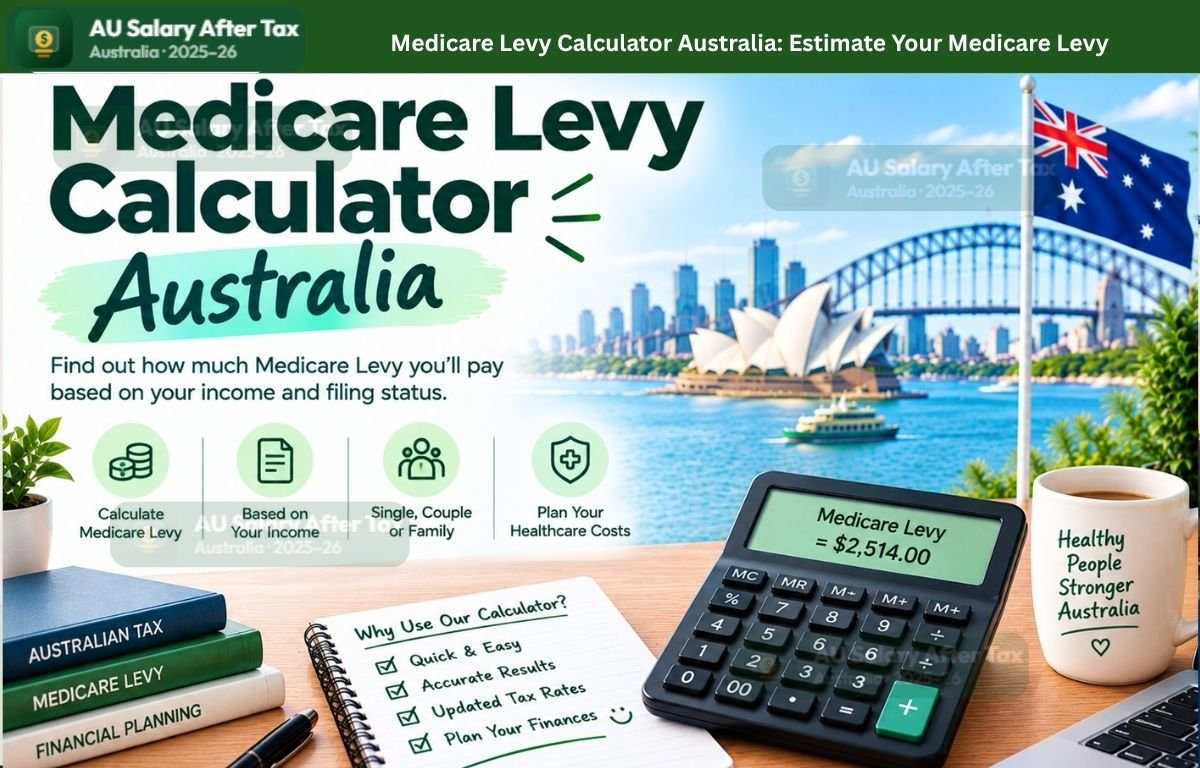
It’s the line on your tax assessment most people never question — a flat 2% of your taxable income, quietly added to your tax bill every year. But the Medicare levy has more moving parts than its simple headline rate suggests: low-income thresholds, a shade-in reduction, full exemptions for some taxpayers, and a separate surcharge that can add another 1.5% if you earn over the limits without private hospital cover.
If you earn income in Australia, this guide walks you through everything: how the Medicare levy is calculated, what the 2025–26 thresholds mean, who pays a reduced amount or nothing at all, how the Medicare levy surcharge works, and how to use the Medicare levy calculator to estimate your own levy in seconds.
Our Medicare Levy Calculator Australia takes your taxable income and instantly shows your Medicare levy amount at the standard 2% rate. This guide explains what that figure means, how the ATO’s full calculation differs in the fine print, and what the calculator deliberately leaves out.
Important
All levy figures in this guide use 2025–26 Australian thresholds. The calculator shows the standard 2% Medicare levy only — it does not model the low-income shade-in reduction, family thresholds, exemptions, or the Medicare levy surcharge. This guide is general information, not tax or financial advice.
Table of Contents
What Is the Medicare Levy Calculator?
The Medicare Levy Calculator Australia is a free online tool that estimates the Medicare levy payable on your taxable income for the 2025–26 financial year. Enter one number — your taxable income — and it instantly returns your levy amount at the standard 2% rate, along with the rate applied and a payable/exempt status.
Unlike full take-home pay calculators, which bundle income tax, the levy, and other deductions together, this calculator isolates the Medicare levy component so you can see exactly what this one charge costs you.
Who should use it
- Employees who want to see the Medicare levy line on their tax bill separately
- Low-income earners checking whether they fall under the levy thresholds
- High-income earners weighing up the Medicare levy surcharge against private hospital cover
- Families wanting a quick sense of the levy before the ATO applies family thresholds
- Migrants and temporary residents checking whether they’re exempt
- Anyone comparing the levy across different income scenarios
What Does the Medicare Levy Calculator Do?
The calculator has a single input and four outputs. Here’s exactly what each one means:
| Input | Meaning | What to enter |
|---|---|---|
| Taxable Income | Your annual income after deductions, before tax | Your gross income minus claimable deductions |
| Output | Meaning |
|---|---|
| Medicare Levy (hero) | Your estimated levy for the year at the standard 2% rate |
| Taxable Income | The figure you entered, echoed back for reference |
| Medicare Levy Rate | The rate applied — 2% for standard scenarios |
| Medicare Levy Amount | The same annual levy figure, shown in the results table |
| Status | Whether the levy is payable at the income you entered |
The headline result is the Medicare Levy dollar figure — the amount added to your income tax bill.
How to Use the Medicare Levy Calculator
Step 1: Enter your taxable income
Type your annual taxable income — your gross income minus any tax deductions you claim. If you don’t claim deductions, your taxable income is simply your gross salary. The field accepts whole numbers in steps of $1,000, starting from $0.
Step 2: Review your results
The calculator instantly shows your levy at 2% of the income you entered. Use it as a quick estimate, then read the sections below to see how the ATO’s full calculation — thresholds, reductions, and exemptions — can change the real figure.
Read more: How to Calculate Your Take-Home Pay in Australia: Salary, Tax and Deductions Explained
How the Medicare Levy Is Calculated
For most Australian residents, the calculation is refreshingly simple:
Medicare levy = Taxable income × 2%
There is no tax-free threshold equivalent for the levy itself — once you’re above the low-income limits, the 2% applies to your full taxable income from the first dollar. The levy is finalised as part of your annual tax assessment; your employer’s PAYG withholding tables already build in an allowance for it, but the exact levy is reconciled when you lodge, which is why the final figure can still surprise people at tax time.
Example
Example Calculation Taxable income $80,000 Medicare levy (2% × $80,000) $1,600.00 Status Payable This matches the calculator’s default result for $80,000 exactly.
But the simple version isn’t the whole story. Low-income earners pay a reduced levy or nothing, some taxpayers are fully exempt, and high earners without hospital cover pay a surcharge on top. Each of those has its own rules.
2025–26 Low-Income Thresholds and the Shade-In Reduction
You don’t pay the full 2% from the first dollar. Below a lower threshold you pay nothing; between the lower and upper thresholds you pay a reduced amount that shades in gradually; above the upper threshold you pay the full 2%. For 2025–26, the ATO’s thresholds are:
| Category | No levy at or below | Full 2% above |
|---|---|---|
| Singles | $28,011 | $35,013 |
| Singles entitled to SAPTO | $44,268 | $55,335 |
| Families | $47,238 (+$4,338 per dependent child) | $59,047 (+$5,423 per dependent child) |
| Families entitled to SAPTO | $61,623 (+$4,338 per dependent child) | $77,028 (+$5,423 per dependent child) |
(ATO – Medicare levy reduction or exemption, myTax 2026)
Note: the ATO publishes the single thresholds and family upper limits directly; the family lower thresholds follow from the legislated 1.25 phase-in ratio and match the 2025 Budget figures.
A warning: several third-party websites still show $27,222 and $34,027 — those are the 2024–25 thresholds, not 2025–26. The thresholds rose in the 2025 Federal Budget, so always check the current year.
The shade-in formula
Between the lower and upper thresholds, your reduced levy is:
Reduced levy = 10% × (taxable income − lower threshold)
The result is capped so it never exceeds the full 2% levy — the shade-in meets the full rate exactly at the upper threshold (which is why the upper threshold is always 1.25 times the lower one). The ATO works this out automatically when you lodge; you don’t self-calculate it.
Example
Example Calculation Taxable income (single) $30,000 Excess over lower threshold ($30,000 − $28,011) $1,989.00 Reduced levy (10% × $1,989) $198.90 Compare that with the full 2% on $30,000, which would be $600 — the shade-in saves this taxpayer just over $400.
Family thresholds work on combined taxable income: both spouses’ taxable incomes added together, or your own if you’re a sole parent. Each dependent child lifts the family thresholds by the per-child amounts in the table above.
Read more: Australian Pay Calculator: Complete Guide to Salary, Tax and Take-Home Pay
What the Calculator Simplifies — and Why It Matters
The calculator is deliberately simple: one input, one flat 2% calculation. That’s its strength for quick estimates, but it’s worth knowing exactly where its answer differs from the ATO’s real calculation.
The low-income shade-in. As the $30,000 example above shows, the calculator displays $600 (2% × $30,000) while the ATO’s shade-in formula gives a standard single taxpayer just $198.90. If your taxable income sits anywhere between the lower and upper thresholds, treat the calculator’s figure as an upper bound, not your actual bill.
Family thresholds. The calculator doesn’t ask about your spouse or dependants, so it can’t apply the higher family thresholds. A couple with a combined taxable income of $55,000, for instance, pays a reduced or zero levy under the family rules — the calculator would simply show 2% of whatever single figure you typed in.
Exemptions. The calculator has no way of knowing whether you qualify for a full or half exemption. If you’re exempt for the whole year, your real levy is $0 regardless of what the calculator shows.
The Medicare levy surcharge. The calculator never adds the surcharge. High earners without appropriate hospital cover can owe an extra 1–1.5% on top of the base levy — covered in detail below.
None of this makes the calculator wrong for its purpose; it answers one question well: what is 2% of my taxable income? Just don’t mistake that answer for your final tax bill.
Who Is Exempt from the Medicare Levy?
Some taxpayers pay no Medicare levy at all. The ATO groups exemptions into three categories, claimed at item M1 of your tax return:
Category 1 — Medical. This covers blind pensioners, people receiving the sickness allowance, and those entitled to full free medical treatment for all conditions under Defence Force arrangements or a Veterans’ Affairs Repatriation Health Card (gold card). Whether the exemption is full or half can depend on your dependants’ status — family agreements can split full and half exemptions between spouses.
Category 2 — Foreign residents. If you were not an Australian resident for tax purposes for the whole financial year, you’re fully exempt for all 365 days. Part-year foreign residents get a full exemption for the relevant period if they had no dependants, or if all their dependants were also in an exemption category.
Category 3 — Not entitled to Medicare benefits. This is the big one for temporary residents. If you’re a temporary resident for Medicare purposes and hold a Medicare Entitlement Statement (MES) from Services Australia confirming you weren’t entitled to Medicare benefits, you can claim a full exemption. Members of diplomatic missions and consular posts (and family living with them) who aren’t Australian citizens and don’t ordinarily live here also qualify.
The Medicare Entitlement Statement
If you’re claiming a Category 3 exemption, the MES isn’t optional paperwork — the ATO won’t grant the exemption without it. You must apply to Services Australia (via servicesaustralia.gov.au or 1300 300 271) and have the statement before you lodge your return. Note that the test is about entitlement, not use: holding private health cover, or simply never visiting a doctor, doesn’t create an exemption on its own.
At tax time, you enter the number of full-exemption days and half-exemption days at item M1. Part-year exemptions are pro-rated by days, so if you arrived in Australia in January, only the days before you became a tax resident count.
Important
The calculator cannot model exemptions. If any of the above applies to you, your real levy may be $0 or halved for the exempt period — regardless of the figure the calculator displays.
The Medicare Levy Surcharge (MLS)
The surcharge is where the Medicare levy stops being simple. If your income is above the surcharge thresholds and you don’t hold appropriate private hospital cover, you pay an extra 1%, 1.25% or 1.5% — on top of the standard 2% levy, not instead of it.
2025–26 surcharge thresholds and rates
| Tier | Singles | Families | Surcharge rate |
|---|---|---|---|
| No surcharge | $101,000 or less | $202,000 or less | 0% |
| Tier 1 | $101,001 – $118,000 | $202,001 – $236,000 | 1% |
| Tier 2 | $118,001 – $158,000 | $236,001 – $316,000 | 1.25% |
| Tier 3 | $158,001 or more | $316,001 or more | 1.5% |
(ATO – Medicare levy surcharge income, thresholds and rates)
Family thresholds are double the single figures, and they rise by $1,500 for each MLS dependent child after the first — so a family with two children faces a base threshold of $203,500, and with three children $205,000.
“Income for MLS purposes” — a broader measure
Here’s the trap: the surcharge isn’t tested on your taxable income. It’s tested on income for MLS purposes, which adds back several items:
- Taxable income
- Reportable fringe benefits
- Total net investment losses (financial and rental)
- Reportable super contributions (reportable employer contributions plus deductible personal contributions)
- Your spouse’s share of trust income not already in their taxable income
So someone with $95,000 of taxable income and $10,000 of reportable fringe benefits has $105,000 of income for MLS purposes — pushing them into Tier 1 even though their taxable income alone sits below the threshold. And the surcharge applies to the whole income for MLS purposes, not just the amount above the threshold: the ATO’s own example computes ($90,000 + $20,000 RFB) × 1.25% = $1,375.
The base 2% levy, by contrast, is always calculated on plain taxable income — none of those add-backs apply to it. This is why the two charges can land in different bands for the same person.
What counts as appropriate hospital cover
To avoid the surcharge entirely, you (and your spouse and dependants) must hold appropriate private patient hospital cover for every day of the financial year. “Appropriate” means:
- Provided by a registered health insurer
- Covering hospital treatment in Australia
- With an excess of $750 or less for a policy covering one person, or $1,500 or less for all other policies
Extras-only cover — optical, dental, physio, chiro — does not count, no matter how generous it is. If you’re unsure whether your policy qualifies, the ATO’s advice is blunt: ask your insurer.
Part-year cover and part-year surcharge
Cover doesn’t have to be all-or-nothing. If you held appropriate cover for only part of the year, the surcharge is pro-rated: at tax time you report the number of days you don’t have to pay the surcharge, and the ATO bills you only for the uncovered days. The same day-counting logic applies to exemptions.
Base levy vs surcharge at a glance
| Base Medicare levy | Medicare levy surcharge | |
|---|---|---|
| Rate | 2% (or reduced via shade-in) | 1% / 1.25% / 1.5% |
| Income measure | Taxable income | Income for MLS purposes |
| Who pays | Most tax residents above low-income thresholds | Only those above MLS thresholds without appropriate hospital cover |
| Avoidable with hospital cover? | No | Yes |
Example
Example Calculation Single, taxable income $120,000, no hospital cover Base levy (2% × $120,000) $2,400.00 Surcharge Tier 2 (1.25% × $120,000) $1,500.00 Total Medicare charges $3,900.00 With appropriate hospital cover held all year, the surcharge drops to $0 — leaving just the $2,400 base levy. This is why the “is private hospital cover worth it?” maths starts with the surcharge.
Worked Examples Across Common Incomes
How the rules combine in practice, for a standard single taxpayer with no exemptions and no surcharge:
| Taxable income | ATO result | Calculator shows | Why they differ |
|---|---|---|---|
| $25,000 | $0 | $500 | Below $28,011 lower threshold — no levy at all |
| $28,011 | $0 | $560.22 | Exactly at the lower threshold — still no levy |
| $30,000 | $198.90 | $600 | Shade-in: 10% × ($30,000 − $28,011) |
| $35,013 | $700.20 (capped ≈ full 2%) | $700.26 | Shade-in meets the full rate at the upper threshold |
| $50,000 | $1,000.00 | $1,000.00 | Above the upper threshold — identical |
| $80,000 | $1,600.00 | $1,600.00 | Above the upper threshold — identical |
| $100,000 | $2,000.00 | $2,000.00 | Above the upper threshold — identical |
The pattern is clear: the calculator and the ATO agree exactly for everyone above the upper threshold ($35,013 for singles). Below that, the ATO’s shade-in always gives a lower figure than the calculator’s flat 2%.
Taxable Income: What Counts Toward the Levy
The levy is charged on your taxable income — your assessable income minus the deductions you’re entitled to claim. That means anything that legitimately reduces your taxable income also reduces your levy:
- Work-related expenses (tools, uniforms, professional memberships)
- Self-education expenses connected to your current employment
- Charitable donations to deductible gift recipients
- The cost of managing your tax affairs
- Salary-sacrificed super contributions (these reduce your taxable salary, though reportable employer contributions still count toward income for MLS purposes)
This is the one genuine lever most employees have: every dollar of legitimate deduction saves 2 cents of levy on top of the income-tax saving. Just remember that deductions which reduce taxable income don’t necessarily reduce your income for MLS purposes — salary-sacrificed super is the classic example, since reportable employer contributions are added back for the surcharge test.
Read more: Weekly Pay Calculator Australia: Complete Guide to Weekly Pay, Tax and Take-Home Pay
Common Mistakes
- Using gross salary instead of taxable income. The calculator asks for taxable income — if you claim $5,000 of deductions on a $65,000 salary, enter $60,000, not $65,000.
- Treating the calculator’s figure as final in the shade-in zone. Between $28,011 and $35,013 (singles), the ATO’s reduced levy is always lower than the calculator’s flat 2%.
- Assuming extras cover avoids the surcharge. Only hospital cover with a registered insurer and a low enough excess counts. A gold-plated extras policy alone leaves you fully exposed to the MLS.
- Forgetting fringe benefits in the surcharge test. Salary-packaged cars, entertainment and other reportable fringe benefits inflate your income for MLS purposes and can tip you over a threshold your taxable income alone wouldn’t reach.
- Ignoring the family thresholds. Couples are tested on combined income against higher family thresholds — being assessed as a single when you’re part of a family (or vice versa) gives the wrong answer.
- Claiming a Category 3 exemption without an MES. The Medicare Entitlement Statement must be in hand before you lodge. No statement, no exemption — even if you genuinely weren’t entitled to Medicare.
- Mixing up financial years. The thresholds in this guide are 2025–26. Using last year’s figures (or a random website’s undated figures) is one of the most common sources of error — several sites still display 2024–25 numbers as current.
Practical Tips
- Run the calculator first, then adjust. Get the flat 2% figure in seconds, then check where you sit against the low-income thresholds, family rules, and surcharge tests in this guide.
- Low-income earners: don’t over-budget the levy. If you’re near the $28,011–$35,013 shade-in band, your actual levy will be well below 2% of your income.
- Approaching $101,000? Price hospital cover. Compare the annual premium against the surcharge you’d otherwise pay — for many Tier 1 earners the premium is cheaper than the surcharge, and you get the cover as well.
- New arrivals: check your residency and MES early. If you’re a temporary resident, sort out your Medicare Entitlement Statement well before tax time, not the week your return is due.
- Keep the ATO’s pages bookmarked. Levy thresholds move most years — the myTax instructions for the current year are the single source of truth.
Frequently Asked Questions
What is the Medicare levy rate in Australia?
The standard Medicare levy is 2% of your taxable income for 2025–26. Low-income earners pay a reduced amount or nothing under the shade-in rules, and some taxpayers are fully exempt.
How is the Medicare levy calculated?
For most people it’s simply taxable income × 2%. If your income falls between the lower and upper low-income thresholds, the ATO instead charges 10% of the amount by which your income exceeds the lower threshold, capped at the full 2%.
At what income do you start paying the Medicare levy?
A single taxpayer pays no levy at or below $28,011 of taxable income in 2025–26. Between $28,011 and $35,013 a reduced levy shades in, and above $35,013 the full 2% applies. Family and SAPTO thresholds are higher.
What is the Medicare levy shade-in?
The shade-in is the phase-in of the levy between the lower and upper thresholds. Instead of jumping from $0 to the full 2%, the levy rises gradually at 10 cents for each dollar above the lower threshold until it meets the full 2% rate at the upper threshold.
Who is exempt from the Medicare levy?
Three main groups: people in specific medical categories (such as blind pensioners and gold-card veterans), foreign residents for tax purposes, and people not entitled to Medicare benefits (including temporary residents with a Medicare Entitlement Statement). Exemptions are claimed at item M1 of the tax return.
What is the Medicare levy surcharge?
An extra 1%, 1.25% or 1.5% charged on top of the 2% levy if your income for MLS purposes exceeds $101,000 (singles) or $202,000 (families) and you don’t hold appropriate private hospital cover. It’s designed to encourage higher earners to take out private hospital insurance.
Does private health insurance reduce the Medicare levy?
No — the base 2% levy applies regardless of any insurance you hold. But appropriate private hospital cover lets you avoid the Medicare levy surcharge entirely. Extras-only cover doesn’t count.
Is the Medicare levy the same as the Medicare levy surcharge?
No. The levy is the standard 2% charge most residents pay. The surcharge is a separate additional charge (1–1.5%) that only applies above the MLS income thresholds when you lack appropriate hospital cover. You can pay both at once.
Do I pay the Medicare levy if I’m on a temporary visa?
It depends on your tax residency and Medicare entitlement. If you’re a foreign resident for tax purposes, you’re generally exempt. If you’re a tax resident but a temporary resident for Medicare purposes, you may claim a Category 3 exemption — but only with a Medicare Entitlement Statement from Services Australia obtained before you lodge.
Why does the calculator show a different amount than my tax assessment?
The calculator shows the flat 2% on the income you enter. Your assessment applies the low-income shade-in, family thresholds, exemptions, and any surcharge — any of which can make the ATO’s figure lower (or, with the surcharge, higher) than the calculator’s.
Final Takeaway
The Medicare levy looks like the simplest charge in the tax system — taxable income × 2% — and for most earners above the low-income thresholds, that’s exactly what it is. But the edges matter: the shade-in that can cut a $600 calculator figure to $198.90, the family thresholds tested on combined income, the exemptions that can wipe the levy out entirely, and the surcharge that can add up to 1.5% more for high earners without hospital cover.
Use the calculator for the instant headline number, then use this guide to work out which of the adjustments apply to you. And when the figures that decide real money are involved, the ATO’s current-year myTax instructions are always the final word.


Pingback: Bonus Tax Calculator Australia: Estimate Your Tax (2026)
Pingback: Best HECS Calculator Australia – Calculate Student Debt 7
Pingback: Best Redundancy Pay Calculator Australia: Complete Guide 2026