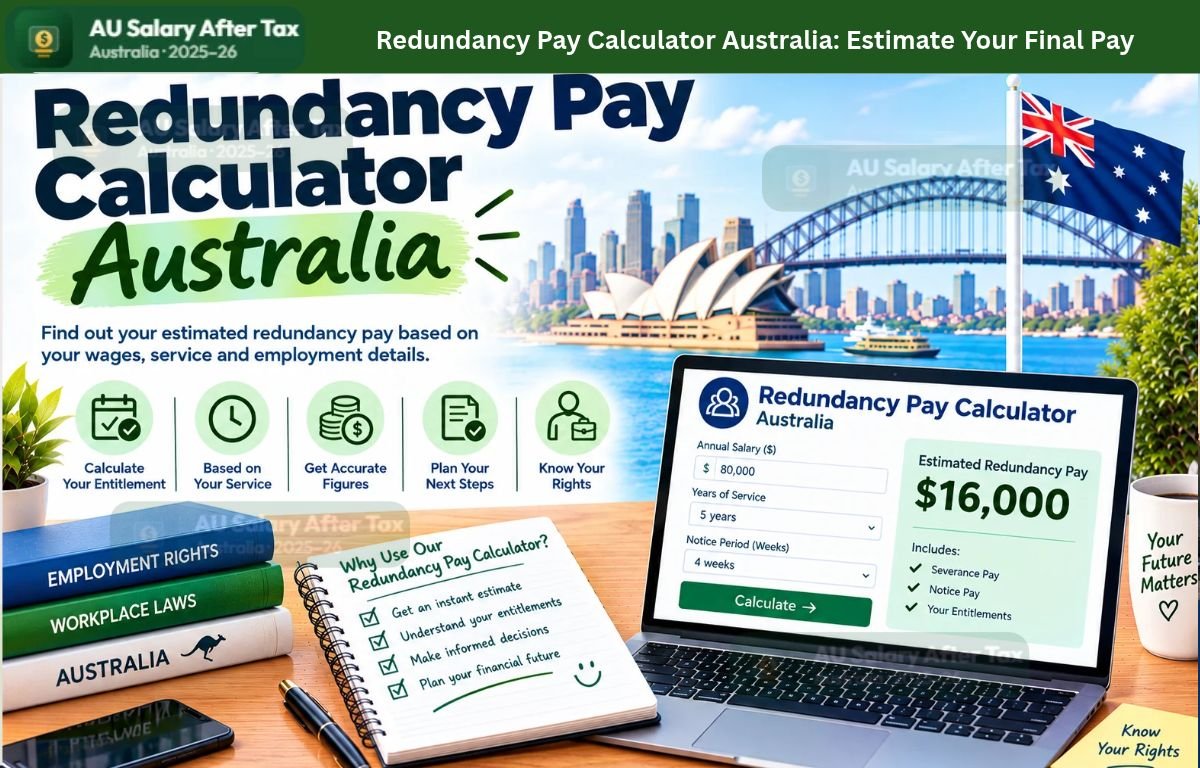
Losing your job to redundancy is stressful enough without having to guess what you are owed. The redundancy pay calculator Australia workers use on this page turns two numbers — your annual salary and your years of service — into an estimated redundancy payout, split into its tax-free and taxable parts. This redundancy pay calculator Australia guide explains where that number comes from, how it is taxed in 2026–27, what the calculator leaves out, and the mistakes that cost people thousands at the end of employment.
Important: All figures in this guide are for 2026–27 unless a year is stated. The calculator itself still uses 2024–25 tax-free limits ($12,524 + $6,264 per year of service) even though its page is labelled 2025–26 — so on larger payouts it understates your net figure. On a $260,000 salary with 9 years of service, the calculator shows a net of $76,448; the correct 2026–27 net is $78,338.24, a difference of $1,890.24. The worked examples below use the correct 2026–27 figures, and the section “What the Calculator Gets Wrong” shows exactly where the calculator’s numbers go stale.
Table of Contents
What Is the Redundancy Pay Calculator?
The redundancy pay calculator estimates the minimum redundancy payment an employee is owed under the National Employment Standards (NES), and how much of it is tax-free. It is an estimate of one component of a final payout — the NES redundancy component — not a full final-payslip calculation.
It takes just two inputs:
| Input | What to enter | Default |
|---|---|---|
| Annual Salary | Your base annual salary before tax, not including superannuation | $90,000 |
| Years of Service | Your completed years of continuous service with the same employer | 5 |
It returns a nine-row breakdown:
| Output | What it means |
|---|---|
| Weekly Pay | Annual salary ÷ 52 |
| NES Redundancy Weeks | Weeks of pay from the NES scale for your years of service |
| Gross Redundancy Pay | Weekly pay × NES redundancy weeks |
| Est. Tax-Free Component | The part of the gross payment covered by the genuine redundancy tax-free limit |
| Est. Taxable Component | Gross redundancy pay minus the tax-free component |
| Est. Tax (32% on taxable) | A flat 32% applied to the taxable component |
| Est. Net Payout | Gross redundancy pay minus the estimated tax |
With the default inputs — $90,000 salary and 5 years of service — the calculator shows weekly pay of $1,730.77, 10 NES weeks, gross redundancy pay of $17,307.69, and, because the whole amount sits under the tax-free limit, a net payout of $17,307.69 with no tax at all.
Read more: Income Tax Calculator Australia: Complete Guide to Income Tax, Brackets and Take-Home Pay
Redundancy Pay Calculator Australia: How to Use It
Using the calculator takes less than a minute, but the two numbers you enter decide everything it shows.
- Enter your annual salary. Use your base salary — the ordinary rate for your ordinary hours, before tax and before superannuation. Do not include overtime, bonuses, allowances or penalty rates: redundancy pay is calculated on your base rate only. If you are part-time, enter your part-time annual salary (your hourly base rate × your ordinary weekly hours × 52), not the full-time equivalent.
- Enter your completed years of service. Only completed years count. Five years and eleven months is five years for redundancy purposes. Service is continuous service with the same employer; unpaid leave does not break continuity but does not count towards it, and casual service generally does not count at all.
- Read the breakdown, not just the headline. The headline “Est. Net Redundancy Pay” is the gross redundancy pay minus the calculator’s estimated tax. Check the tax-free component against the 2026–27 limit in the tax section below — if your payout is large enough to be taxable, the calculator’s figure will be too low, because its limits are two years out of date.
Use it with these limitations in mind:
- It models the NES minimum only. Your award, enterprise agreement or contract may pay more — some pay a set number of weeks per year of service, often with a cap. The calculator cannot apply above-NES weeks, so if your agreement is more generous, its figure is a floor, not your entitlement.
- It has no age input. The tax on the taxable part of a genuine redundancy payment is 32% if you are under preservation age (60) and 17% if you are 60 or over, up to the ETP cap. The calculator always applies 32%.
- It does not know your employer size or employment type. A small business with fewer than 15 employees generally owes no NES redundancy pay at all, and casual employees generally get none either — the calculator will still show a figure for both.
- It computes no leave, notice or super. Unused annual leave, long service leave, payment in lieu of notice and superannuation are separate components of a final payout, covered later in this guide.
How Redundancy Pay Is Calculated
Three steps turn your salary and service into a payout, and the redundancy pay calculator Australia workers use follows exactly these steps:
Weekly base pay = annual base salary ÷ 52
Gross redundancy pay = weekly base pay × NES redundancy weeks
Tax-free limit (2026–27) = $13,598 + ($6,801 × completed years of service)
The tax-free limit is the ATO’s genuine redundancy limit. Everything up to it is tax-free and does not even appear in your tax return. The amount above it is an employment termination payment (ETP), taxed at concessional flat rates. The calculator applies the same three steps — but with the 2024–25 limit of $12,524 + ($6,264 × years), which is why its taxable cases are wrong.
Note the base rate rule. Redundancy pay is paid at your base rate of pay for your ordinary hours. It does not include incentive payments or bonuses, loadings (including casual loading), monetary allowances, overtime or penalty rates, or any other separately identifiable amounts. A $90,000 salary with regular overtime is still a $90,000 salary for redundancy purposes.
The NES Redundancy Pay Scale
The National Employment Standards set redundancy pay as weeks of pay at your base rate, by completed years of continuous service (Fair Work Act 2009, s 119) — and this is the scale built into the redundancy pay calculator Australia workers use on this page:
| Continuous service | Redundancy pay |
|---|---|
| Less than 1 year | Nil |
| At least 1 year but less than 2 years | 4 weeks |
| At least 2 years but less than 3 years | 6 weeks |
| At least 3 years but less than 4 years | 7 weeks |
| At least 4 years but less than 5 years | 8 weeks |
| At least 5 years but less than 6 years | 10 weeks |
| At least 6 years but less than 7 years | 11 weeks |
| At least 7 years but less than 8 years | 13 weeks |
| At least 8 years but less than 9 years | 14 weeks |
| At least 9 years but less than 10 years | 16 weeks |
| At least 10 years | 12 weeks |
The drop at 10 years surprises people. It falls from 16 weeks to 12 because long service leave — which typically becomes payable around the same point — is assumed to pick up the difference. An employee with 10 years of service gets 12 weeks of redundancy pay plus their long service leave entitlement, which in most states is about 8.67 weeks.
The scale has not changed since the Fair Work Act commenced, and it did not change in 2025–26 or 2026–27. What changed in 2026–27 are the indexed tax figures, not the weeks.
Who Gets Redundancy Pay — and Who Doesn’t
Not everyone who loses a job gets NES redundancy pay. You do not get it if you:
- have less than 12 months of continuous service;
- were employed for a specific period, project or season — a fixed-term or seasonal arrangement ending as planned is not a redundancy (unless the arrangement was set up mainly to avoid redundancy pay);
- were dismissed for serious misconduct;
- are a casual employee — casual service does not count towards continuous service for redundancy pay, and casuals are excluded from the NES entitlement (an award or agreement can still provide it);
- are a trainee employed only for the length of the training arrangement, or an apprentice;
- work for a small business employer — fewer than 15 employees at the time of the redundancy. The count includes the employees being made redundant, other full-time and part-time staff, regular and systematic casuals, and employees of associated entities. One exception, in force since 15 December 2023: an employer that became a small business by downsizing through insolvency may still owe redundancy pay to employees made redundant afterwards;
- have your employment transferred to a new employer that recognises your service.
Industry-specific redundancy schemes in some awards (including Black Coal, Building and Construction, Joinery, Manufacturing, Plumbing and Timber) can cover small-business employees and apply instead of the NES.
An employer can also apply to the Fair Work Commission under s 120 to reduce NES redundancy pay — even to nil — if it finds you other acceptable employment or genuinely cannot afford the full amount. That applies only to NES entitlements, not to anything extra your award or agreement provides.
Read more: Annual Leave Calculator Australia: Complete Guide to Annual Leave, Leave Loading and Your Payout
What Is a Genuine Redundancy?
Two different laws ask this question, and they do not ask it the same way. The Fair Work Act decides whether your dismissal was a genuine redundancy for unfair dismissal purposes. The tax law decides whether your payment gets the tax-free limit. Most redundancies pass both tests, but the distinction matters when one fails.
Under the Fair Work Act (s 389), a dismissal is a genuine redundancy only if all three conditions are met:
- The job is no longer required. The employer no longer requires the person’s job to be performed by anyone, because of changes in the operational requirements of the enterprise. It is the job that disappears, not the person being replaced.
- Consultation obligations were complied with. The employer followed any consultation obligation in the applicable modern award or enterprise agreement. Consultation must be meaningful — affected employees must get a genuine opportunity to understand the proposed change, raise concerns and suggest alternatives before an irreversible decision is made. Simply telling an employee they have already been selected is not consultation.
- Redeployment was not reasonable. It would not have been reasonable in all the circumstances for the person to be redeployed within the employer’s enterprise or the enterprise of an associated entity.
If any condition fails, the dismissal is not a genuine redundancy and the employee may be able to claim unfair dismissal — applications must be lodged with the Fair Work Commission within 21 days of the dismissal taking effect. The redeployment test got wider in 2025: on 6 August 2025 the High Court held in the Helensburgh Coal case that the Commission may consider whether the employer could have created a new position or insourced contractor work to redeploy the employee.
For tax purposes, the ATO applies its own test (Income Tax Assessment Act 1997, s 83-175; Taxation Ruling TR 2009/2). In addition to the job being abolished, the ATO requires that the employee is dismissed before Age Pension age (67), the payment is not in lieu of superannuation benefits, there is no arrangement to re-employ the employee, the parties deal at arm’s length, and any amount the employee would have received on voluntary resignation is excluded. A voluntary redundancy still qualifies if the role genuinely disappears. Resignation, disciplinary dismissal, reaching normal retirement age, or a fixed-term contract simply ending are not genuine redundancies for tax purposes — and if the tax test fails, the whole payment loses its tax-free portion.
Where an employer proposes to dismiss 15 or more employees for economic, technological, structural or similar reasons, it must also notify Services Australia in writing as soon as possible and before any dismissals, and notify and consult with any relevant union.
How Redundancy Pay Is Taxed in 2026–27
The tax treatment has three layers: the tax-free limit, the ETP caps, and the flat rates. All three use 2026–27 figures below.
The tax-free limit
Tax-free limit (2026–27) = $13,598 + ($6,801 × completed years of service)
Only completed years count. The amounts are indexed each 1 July. For 2025–26 the figures were $13,100 + $6,552 per year.
| Completed years of service | Tax-free limit (2026–27) |
|---|---|
| 1 year | $20,399 |
| 3 years | $34,001 |
| 5 years | $47,603 |
| 6 years | $54,404 |
| 8 years | $68,006 |
| 10 years | $81,608 |
| 15 years | $115,613 |
| 20 years | $149,618 |
What counts towards the limit: severance/redundancy pay, payment in lieu of notice, and gratuities or golden handshakes. What is excluded and taxed separately: wages or allowances owed for work done, unused annual leave, leave loading, unused long service leave, and payments in lieu of superannuation. The tax-free amount is reported as Lump Sum D on the income statement and is not assessable income — it does not even appear in your tax return.
The ETP caps and rates
The part of a genuine redundancy payment above the tax-free limit is an employment termination payment (ETP). Where the redundancy is not genuine, the whole payment is an ETP.
| Cap | 2025–26 | 2026–27 |
|---|---|---|
| ETP cap (indexed annually) | $260,000 | $270,000 |
| Whole-of-income cap (not indexed) | $180,000 | $180,000 |
Genuine redundancy payments above the tax-free limit are concessionally taxed up to the ETP cap only. Other ETPs — a golden handshake, a non-genuine redundancy, severance outside a genuine redundancy, a gratuity, or payment in lieu of notice on its own — are concessionally taxed only up to the smaller of the ETP cap and the whole-of-income cap, and the whole-of-income cap is $180,000 minus any other taxable income received in that income year.
| Taxable ETP portion | Tax rate (includes 2% Medicare levy) |
|---|---|
| Up to the ETP cap, under preservation age (60) | 32% |
| Up to the ETP cap, at or over preservation age (60) | 17% |
| Above the relevant cap, any age | 47% (45% + 2% Medicare levy) |
Preservation age is 60 for anyone born on or after 1 July 1964. ETPs cannot be rolled over into superannuation. The taxable ETP is assessable income and can push your repayment income over a HECS/HELP threshold, triggering a compulsory HELP repayment at assessment — the tax-free portion never enters the return, so it cannot.
Read more: HECS Calculator Australia: Complete Guide to HECS-HELP Repayments, Thresholds and Rates
Redundancy Pay Calculator Australia: Worked Examples
Every example below uses 2026–27 figures and has been checked against the calculator’s own formula, so you can see where the calculator agrees with the correct figures — and where it does not.
Example 1: $90,000 salary, 5 years of service (the calculator default)
- Weekly base pay: $90,000 ÷ 52 = $1,730.77
- Redundancy pay: 10 weeks × $1,730.77 = $17,307.69
- Tax-free limit: $13,598 + (5 × $6,801) = $47,603
- The whole payment is under the limit, so it is entirely tax-free
- Net payout: $17,307.69
The calculator shows exactly this figure — its stale limits do not matter here, because the payment is far below any year’s limit.
Example 2: $95,000 salary, 7 years of service
- Weekly base pay: $95,000 ÷ 52 = $1,826.92
- Redundancy pay: 13 weeks × $1,826.92 = $23,750.00
- Tax-free limit: $13,598 + (7 × $6,801) = $61,205
- The whole payment is under the limit, so it is entirely tax-free
- Net payout: $23,750.00
Again the calculator agrees. This is the page’s own worked example, and its arithmetic is correct — only its stated limit ($56,372, the 2024–25 figure) is wrong.
Example 3: $140,000 salary, 15 years of service
- Weekly base pay: $140,000 ÷ 52 = $2,692.31
- Redundancy pay: 12 weeks (the 10+ year rate) × $2,692.31 = $32,307.69
- Tax-free limit: $13,598 + (15 × $6,801) = $115,613
- The whole payment is under the limit, so it is entirely tax-free
- Net payout: $32,307.69
Two corrections to the page’s version of this example. First, the page’s guide text gives the gross as $32,307.72 — a 3-cent rounding error from multiplying the rounded weekly pay by 12; the calculator’s own $32,307.69 is accurate. Second, the page claims that if this employee’s contract provided 30 weeks of redundancy ($80,769), “the amount above any applicable limits would be taxed” — but $80,769 is below both its own stated limit ($106,484) and the correct limit ($115,613), so nothing would be above the limit at all.
Example 4: $260,000 salary, 9 years of service — where tax starts
- Weekly base pay: $260,000 ÷ 52 = $5,000.00
- Redundancy pay: 16 weeks × $5,000 = $80,000.00
- Tax-free limit: $13,598 + (9 × $6,801) = $74,807
- Taxable ETP: $80,000 − $74,807 = $5,193.00
- Tax at 32% (under 60, within the $270,000 ETP cap): 32% × $5,193 = $1,661.76
- Net payout: $78,338.24
The calculator shows a net of only $76,448 for this case, because it uses the 2024–25 limit of $68,900 — it taxes $11,100 instead of $5,193. It understates the net by $1,890.24. In 2025–26 the same person would have paid $2,538.24 in tax (limit $72,068), so the 2026–27 indexation alone saves $876.48.
Example 5: $120,000 salary, 10 years of service, plus notice
- Weekly base pay: $120,000 ÷ 52 = $2,307.69
- Redundancy pay: 12 weeks × $2,307.69 = $27,692.31
- Tax-free limit: $13,598 + (10 × $6,801) = $81,608 — the whole payment is tax-free
- Notice: 4 weeks (more than 5 years of service), so payment in lieu of notice is 4 × $2,307.69 = $9,230.77
- Super on the payment in lieu of notice: 12% × $9,230.77 = $1,107.69
- Redundancy component net: $27,692.31, plus the notice payment and its super, plus any unused leave
The calculator’s $27,692.31 is correct for the redundancy component — but the final amount is larger once notice, leave and super are added.
What the Calculator Gets Wrong
The redundancy pay calculator Australia workers use gets its arithmetic right. Its constants are wrong. These are the errors the blog guide corrects — the calculator page itself has not been fixed, and that is the site owner’s call, not this guide’s.
- Outdated tax-free limits — the central error. The page states, for 2025–26, a base amount of $12,524 plus $6,264 per completed year. Those are the 2024–25 figures, verified against the ATO’s Employment termination payments Table 20. The correct figures are $13,100 + $6,552 for 2025–26 and $13,598 + $6,801 for 2026–27. Every taxable result the calculator produces is therefore understated in net terms — by $1,890.24 on the $260,000/9-year case above, and by $1,890.24 on a $300,000/9-year case too (calculator net $84,817.23; correct 2026–27 net $86,707.47).
- Flat 32% with no ETP cap and no age. The calculator applies 32% to every taxable dollar and never states the ETP cap. In reality the taxable component is taxed at 32% only up to the $270,000 ETP cap for 2026–27, at 17% if you are 60 or over, and at 47% above the cap. A 62-year-old with a large taxable component would be over-taxed by the calculator’s model.
- The page’s own 15-year example contradicts itself. As shown in Example 3, a 30-week contractual payment of $80,769 cannot be “above any applicable limits” when the limit is $106,484 on the page’s own figures, let alone the correct $115,613.
- A 3-cent rounding error in the same example: $32,307.72 in the guide text versus the calculator’s correct $32,307.69.
- A garbled genuine-redundancy definition. The page says a genuine redundancy requires that “if you are under 65, there is no acceptable alternative position offered.” The ATO’s test is about being under Age Pension age (67) and the job being abolished — there is no “under 65” condition in it.
- Casual entitlement is softened. The page suggests long-term regular casuals may count service differently. The NES position is plainer: in most cases casual service does not count, and casual employees are excluded from NES redundancy pay unless an award or agreement provides it.
- The small-business exemption is never mentioned. A reader at a business with fewer than 15 employees could use the calculator, see a five-figure payout, and have no idea the NES owes them nothing.
- “After Tax” in the title overstates what is computed. The tab title says “After Tax”, but the only tax computed is a flat 32% on the amount over an outdated limit. It does not compute marginal income tax, the Medicare levy, HECS/HELP, or the tax on leave and notice — and it has no age input.
- JobSeeker is oversimplified. The page says a genuine redundancy “generally does not affect eligibility immediately”. In reality a redundancy payout creates an Income Maintenance Period of roughly the same number of weeks as the payout, and a Liquid Assets Waiting Period can add up to 13 weeks on top.
- The HECS answer is vague. The page says redundancy pay is “generally not included in HECS repayment income in the same way as salary”. The real distinction is sharper: the tax-free portion never enters the return, but the taxable ETP component is assessable income and can push repayment income over a HELP threshold.
Payment in Lieu of Notice, Annual Leave and Long Service Leave
Redundancy pay is only one part of a final payout. These three sit beside it, with different rules and different tax.
Notice
Notice is in addition to redundancy pay. The employer must give written notice, pay in lieu of it, or a combination of the two.
| Continuous service | Minimum notice (NES) |
|---|---|
| 1 year or less | 1 week |
| More than 1 year but not more than 3 years | 2 weeks |
| More than 3 years but not more than 5 years | 3 weeks |
| More than 5 years | 4 weeks |
Employees over 45 years old with at least 2 years of continuous service get one additional week of notice. Payment in lieu of notice is the full amount the employee would have earned had they worked the notice period, including allowances, loadings and overtime that would have been payable. It counts towards the genuine redundancy tax-free limit, any excess is an ETP, and — unlike redundancy pay itself — superannuation is payable on it. Casuals, seasonal workers, fixed-term workers on expiry of the term, and employees dismissed for serious misconduct are generally not entitled to notice under the NES.
Unused annual leave
All accrued unused annual leave must be paid out on termination, at the rate the employee would have received had they taken the leave — including leave loading where the employee would have been paid it (typically 17.5% under awards). Annual leave accrues at 4 weeks a year and never expires. Personal and sick leave is not paid out.
The payout is separate from redundancy pay and is reported as Lump Sum A. Its withholding depends on the reason for termination (ATO Schedule 7): on a genuine redundancy, unused annual leave is withheld at a flat 32%; on a normal termination, post-17 August 1993 accruals are withheld at marginal rates. Withholding is a prepayment — the final tax is worked out at lodgement.
Long service leave
Long service leave is set by state and territory law, not the NES, and pro-rata access differs by jurisdiction:
| State / Territory | Full entitlement | Pro-rata access from |
|---|---|---|
| New South Wales | 8.67 weeks at 10 years | 5 years |
| Victoria | ~6.07 weeks at 7 years | 7 years |
| Queensland | 8.67 weeks at 10 years | 7 years |
| Western Australia | 8.67 weeks at 10 years | 7 years |
| South Australia | 13 weeks at 10 years | 7 years |
| Tasmania | 8.67 weeks at 10 years | 7 years |
| Australian Capital Territory | ~6.07 weeks at 7 years | 5 years |
| Northern Territory | 13 weeks at 10 years | 7 years |
On a redundancy — an employer-initiated termination — pro-rata long service leave is payable in all jurisdictions once the threshold is reached. Its withholding follows the same Schedule 7 pattern as annual leave: 32% on a genuine redundancy for post-17 August 1993 accruals. Because long service leave is state law, check your state Act for the exact entitlement.
Superannuation on Termination Payments
The superannuation guarantee rate is 12% of ordinary time earnings in both 2025–26 and 2026–27. From 1 July 2026, Payday Super applies: contributions must reach the fund within 7 business days of payday. But super is not payable on every part of a final payout:
| Termination payment | Super payable? |
|---|---|
| Genuine redundancy pay (severance component) | No — not ordinary time earnings |
| Other ETPs (ex gratia, golden handshake, unused rostered days off) | No |
| Unused annual leave paid out on termination | No |
| Annual leave loading paid out on termination | No |
| Unused long service leave paid out on termination | No |
| Payment in lieu of notice | Yes — it substitutes for ordinary hours the employee would have worked |
| Normal wages up to the last day, including a notice period actually worked | Yes |
| Overtime | No |
The payment in lieu of notice is the one people most often get wrong — some payroll guidance suggests it does not attract super, but the ATO’s position is that it is ordinary time earnings, and Example 5 shows the $1,107.69 of super it generates on a $120,000 salary. If your final payslip shows no super on a payment in lieu of notice, ask your employer about it.
What Happens After Redundancy
The payout is not the end of the process. Three things follow it, and the timing of each one matters.
JobSeeker Payment and the waiting periods
Lodge a JobSeeker Payment claim early — a claim can be made from 14 days before the last day of work, and payment runs from the claim date, not back-paid. Bring your separation certificate and final pay details. Three waiting periods can apply:
- Ordinary Waiting Period: 1 week for most people (waived in severe financial hardship).
- Income Maintenance Period: redundancy pay and paid-out leave are treated as income spread over the number of weeks of pay they represent — a 12-week redundancy payout means roughly a 12-week period during which JobSeeker can be reduced to $0 or a part-payment.
- Liquid Assets Waiting Period: if liquid assets (including the payout) exceed $5,500 (single) or $11,000 (partnered or with dependants), a wait of 1 to 13 weeks applies.
The Income Maintenance Period and the Liquid Assets Waiting Period run at the same time — the real wait is the longer of the two. The maximum JobSeeker basic rate for a single person with no children was $824.90 a fortnight from 20 September 2026 ($833.70 including the Energy Supplement); rates are indexed each March and September, so check Services Australia for the current rate. Services Australia’s free Financial Information Service (phone 132 300) can model how your payout, super and JobSeeker interact.
Fair Entitlements Guarantee — if the employer cannot pay
If your employer goes into liquidation or bankruptcy and cannot pay what you are owed, the Fair Entitlements Guarantee (FEG) is a government safety net administered by the Department of Employment and Workplace Relations. It covers unpaid wages up to 13 weeks, unpaid annual leave in full, unpaid long service leave in full, payment in lieu of notice up to 5 weeks, and redundancy pay up to 4 weeks for each full year of service — all subject to a maximum weekly wage set each year. It does not cover unpaid superannuation, which is claimed through the ATO instead. Claims must be lodged within 12 months of the employment ending or the liquidator’s appointment, whichever is later.
Your rights and deadlines
- 21 days to lodge an unfair dismissal application with the Fair Work Commission if the redundancy was not genuine.
- 12 months to lodge a FEG claim.
- Keep every document: the redundancy letter, the separation certificate, the final payslip showing each component separately, and your income statement. If the components are lumped into one line, ask payroll to break them out — Lump Sum D (tax-free redundancy), the ETP, Lump Sum A (leave) and Lump Sum B (long service leave) are taxed differently, and a single combined line is where final pays go wrong.
Common Mistakes
- Trusting the calculator’s tax figure on a large payout. Its limits are two years out of date. Check the taxable component against the 2026–27 limit of $13,598 + $6,801 per completed year before relying on its net figure.
- Counting part-years as full years. Five years and eleven months is five years for the NES scale, the notice scale and the tax-free limit.
- Including overtime and bonuses in the salary figure. Redundancy pay is based on your base rate for ordinary hours only. Entering a salary inflated with overtime overstates the payout.
- Assuming casuals get NES redundancy pay. In most cases casual service does not count and casuals are excluded, unless an award or agreement provides it.
- Forgetting the small-business exemption. Fewer than 15 employees means no NES redundancy pay, subject to the insolvency-downsizing exception.
- Missing the 21-day unfair dismissal deadline. If the redundancy was not genuine — no real consultation, or a reasonable redeployment existed — the clock starts on the day the dismissal takes effect.
- Spending the payout before checking JobSeeker. The Income Maintenance Period means Centrelink may pay nothing for as many weeks as the payout represents. Budget for it.
- Not checking the final payslip components. Redundancy pay, payment in lieu of notice, annual leave, long service leave and super are each taxed and reported differently. A payslip that lumps them together hides errors.
Practical Tips
- Run the redundancy pay calculator Australia workers use twice. Once with your actual figures, and once with the correct 2026–27 tax-free limit from the table above, so you can see how far the calculator’s net figure is from the right one.
- Get the redundancy in writing. The letter should state the reason, the last day of employment, the weeks of redundancy pay, the notice period, and the leave balances being paid out.
- Check your award or agreement first. The NES is a floor. Many enterprise agreements pay more — a set number of weeks per year of service, often with a cap — and the calculator cannot model them.
- Ask for the components separately. Lump Sum D, the ETP, Lump Sum A and Lump Sum B, each on its own line, with the tax-free limit shown.
- Check the super on your payment in lieu of notice. It is the one component that attracts super, and it is the one most often missed.
- Claim JobSeeker 14 days before your last day. The claim date starts the clock; lodging late does not back-pay it.
- Keep the payout out of your HELP thinking until assessment. The tax-free part never enters your return; the taxable ETP part can trigger a compulsory HELP repayment. Model both before spending it.
- If the employer is in trouble, act fast. FEG has a 12-month claim window, and super arrears go through the ATO, not FEG.
Read more: Weekly Pay Calculator Australia: Complete Guide to Weekly Pay, Tax and Take-Home Pay
How much redundancy pay will I get in Australia?
It depends on your base weekly pay and your completed years of continuous service. Under the National Employment Standards, the scale runs from 4 weeks of pay for 1–2 years of service up to 16 weeks for 9–10 years, dropping to 12 weeks at 10 or more years. Multiply your weekly base pay (annual salary ÷ 52) by the weeks for your service length. For example, on a $90,000 salary with 5 years of service, 10 weeks × $1,730.77 gives $17,307.69.
Is redundancy pay tax-free in Australia?
Partly. A genuine redundancy payment is tax-free up to a limit of $13,598 plus $6,801 for each completed year of service in 2026–27. Only completed years count. The amount above that limit is an employment termination payment, taxed at 32% if you are under 60 and 17% if you are 60 or over, up to the $270,000 ETP cap, and 47% above the cap.
Who is not entitled to redundancy pay?
Employees with less than 12 months of continuous service, fixed-term or seasonal workers whose term ends as planned, employees dismissed for serious misconduct, casual employees, trainees, apprentices, and employees of a small business with fewer than 15 employees generally do not get NES redundancy pay. An award, enterprise agreement or industry-specific scheme can still provide it.
How is redundancy pay calculated?
Take your annual base salary, divide by 52 to get your weekly base pay, then multiply by the NES redundancy weeks for your completed years of service. Then apply the tax-free limit: $13,598 plus $6,801 per completed year in 2026–27. The amount above the limit is the taxable ETP. Payment in lieu of notice, unused annual leave and long service leave are calculated separately and added to the final payout.
Do I get redundancy pay if I am a casual employee?
Generally no. The National Employment Standards exclude casual employees from redundancy pay, and casual service does not count towards continuous service. An award or enterprise agreement can provide redundancy pay to casuals, and some industry schemes cover them — check your award or agreement before assuming you get nothing.
Is superannuation paid on redundancy pay?
No. Superannuation is not payable on genuine redundancy pay, on other employment termination payments, or on unused annual leave and long service leave paid out on termination. The exception is payment in lieu of notice, which substitutes for ordinary hours you would have worked — super at 12% is payable on it.
What happens to my annual leave when I am made redundant?
All accrued unused annual leave must be paid out, at the rate you would have received had you taken the leave, including leave loading where it would have applied. It is reported as Lump Sum A and withheld at a flat 32% on a genuine redundancy under the ATO’s Schedule 7. Personal and sick leave is not paid out.
How long do I have to claim unfair dismissal after a redundancy?
21 days from the day the dismissal takes effect. If the redundancy was not genuine — for example, there was no real consultation, or a reasonable redeployment existed — you can apply to the Fair Work Commission within that window. After 21 days the Commission can only extend the deadline in exceptional circumstances.
Does redundancy pay affect my Centrelink payments?
Yes. Redundancy pay and paid-out leave create an Income Maintenance Period of roughly the same number of weeks as the payout, during which JobSeeker Payment can be reduced to $0. If your liquid assets including the payout exceed $5,500 (single) or $11,000 (partnered), a Liquid Assets Waiting Period of 1 to 13 weeks can also apply. Lodge your JobSeeker claim from 14 days before your last day of work so the clocks start running.
Can my employer reduce my redundancy pay?
An employer can apply to the Fair Work Commission to reduce NES redundancy pay, even to nil, if it finds you other acceptable employment or genuinely cannot afford the full amount. That applies only to the NES entitlement — anything extra your award, enterprise agreement or contract provides cannot be reduced this way. Your award or agreement may also pay more than the NES, never less.
Final Takeaway
Redundancy pay is simple arithmetic wrapped in three separate rulebooks — the Fair Work Act sets the weeks, the tax law sets the tax-free limit, and your award or agreement can improve on both. The redundancy pay calculator Australia workers use on this page gets the arithmetic right, but it runs on 2024–25 tax limits: use the 2026–27 figures in this guide when the payout is large enough to be taxable.
Weekly base pay = annual base salary ÷ 52
Gross redundancy pay = weekly base pay × NES redundancy weeks (4–16 weeks by service; 12 weeks at 10+ years)
Tax-free limit (2026–27) = $13,598 + ($6,801 × completed years of service)
Taxable ETP = gross redundancy pay − tax-free limit; taxed at 32% under 60, 17% at 60+, up to the $270,000 ETP cap, 47% above it
Check your entitlement against the NES scale, check the tax against the 2026–27 limit, and check your final payslip line by line — redundancy pay, notice, leave and super are each taxed differently, and the payslip is where the errors hide. If the redundancy was not genuine, remember the 21-day deadline for the Fair Work Commission.