You wake up unwell, call in sick, and still get paid. That is the deal Australian sick leave offers — ten days a year for a full-time worker, building up from your first day, carrying over if you do not use it. The Sick Leave Calculator Australia workers use on this page turns two numbers — your annual salary and your accrued sick days — into a dollar value for that leave.
This Sick Leave Calculator Australia guide explains where the entitlement comes from, how the dollar value is really calculated, and why the calculator’s headline number is misleading in one important way. It also corrects the calculator where its numbers are wrong — most seriously for part-time workers.
Important: All figures in this guide are for 2026–27 unless a year is stated. Sick leave is one shared entitlement with carer’s leave, officially called personal/carer’s leave under the National Employment Standards (NES). The Sick Leave Calculator Australia workers use values leave at your daily rate — but personal leave is generally never paid out when you leave a job. The calculator’s “Leave Payout Value” is the value of leave taken while you are employed, not money you receive on resignation.
Table of Contents
What Is the Sick Leave Calculator?
The sick leave calculator estimates the dollar value of your accrued personal leave. It is a valuation tool, not a payslip — it cannot tell you how many hours you have banked, whether your employer can ask for a medical certificate, or whether your leave will be paid out when you resign.
It takes just two inputs:
| Input | What to enter | Default |
|---|---|---|
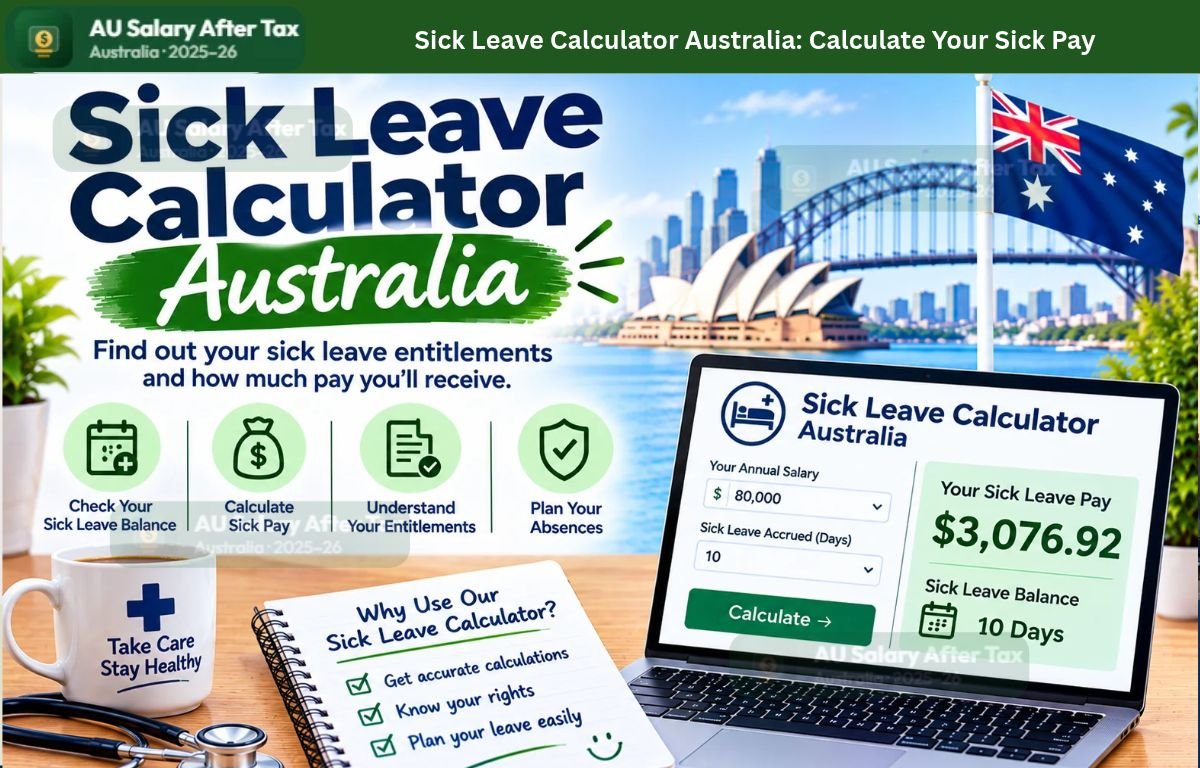
| Annual Salary | Your gross yearly salary before tax | $80,000.00 |
| Sick/Personal Leave Days | The number of accrued sick days you want to value | 10 days |
It returns a four-row breakdown:
| Output | What it means |
|---|---|
| Daily Rate | Your annual salary ÷ 260 |
| Leave Payout Value | Your daily rate × your sick days |
| Sick/Personal Leave Days | The days you entered |
| Typical Annual Accrual (10 days) | Ten days at your daily rate |
With the default inputs — $80,000 a year and 10 days — the calculator shows a daily rate of $307.69, a leave payout value of $3,076.92, and the same $3,076.92 as the typical annual accrual. That arithmetic is correct. Whether $3,076.92 is money you will ever see is the most important question in this guide.
Sick Leave Calculator Australia: How to Use It
Using the calculator takes less than a minute, but the number you type in — and the work pattern behind it — decide what its answer is worth.
- Enter your gross annual salary. Use your salary before tax. If you are part-time, enter your actual part-time salary, not the full-time equivalent for the role.
- Enter your accrued sick days. Use the balance from your payslip or HR system. If your balance is shown in hours, convert it first: divide your hours by the hours in one of your working days.
- Read the payout value as a “taken” value. The figure is what those days are worth if you use them while employed. It is not a resignation payout.
Use it with these limitations in mind:
- It values days, not hours. Your real balance is measured in hours under the NES. A “day” means different hours for different workers.
- It uses ÷ 260 for everyone. For part-time workers it understates the daily rate — badly.
- It does not know your award. It cannot apply your award’s evidence rules, or the way your award treats shift penalties during leave.
- It shows gross figures only. Tax and super are not shown, and the leave is taxed as ordinary income when you take it.
- It calls the result a payout. For most workers there is no payout.
Read more: Best Annual Leave Calculator Australia: Complete Guide 2026
How Sick Leave Is Calculated
Three steps turn your salary and your balance into a dollar value, and the Sick Leave Calculator Australia workers use follows exactly these steps:
Daily rate = annual salary ÷ 260
Leave value = daily rate × sick days
Hourly rate = annual salary ÷ (52 × weekly hours)
The 260 figure is the number of weekdays in a working year: 52 weeks × 5 days.
There is a second method, and for many employees it is the more accurate one: value leave in hours. Your leave balance in hours, multiplied by your hourly rate, always gives the correct value — whatever your work pattern. A full-time balance of 76 hours on an $80,000 salary is worth $3,076.92, whether you take it as ten short days or two full weeks.
Your NES Entitlement: 10 Days, Accrual and Carry-Forward
Sick leave and carer’s leave are one entitlement under the National Employment Standards, and the rules are simpler than most people think.
Ten days a year for full-time employees. The NES gives 10 days of paid personal/carer’s leave for each year of service, pro-rata for part-time employees. The entitlement is really measured in hours: 1/26 of your ordinary hours of work in a year. For a 38-hour week that is 76 hours — ten days of 7.6 hours. The High Court confirmed this hours-based method in Mondelez v AMWU [2020] HCA 29.
It accrues from day one. Leave builds up gradually, pay period by pay period, from your first day of work — including during probation. You do not have to wait a year to use what you have accrued.
It keeps accruing on paid leave. Personal leave keeps building while you are on annual leave, paid personal leave, community service leave and long service leave. It generally stops on unpaid leave.
Unused leave carries over forever. There is no use-it-or-lose-it deadline — your balance rolls forward with no cap while you stay with the same employer.
| Employee | Leave per year | Per week |
|---|---|---|
| Full-time, 38 hrs/week | 76 hours (10 days) | 1.462 hrs |
| Part-time, 19 hrs/week | 38 hours (5 days) | 0.731 hrs |
| Part-time, 30.4 hrs/week (4 days) | 60.8 hours (8 days) | 1.169 hrs |
| Part-time, 22.8 hrs/week (3 days) | 45.6 hours (6 days) | 0.877 hrs |
The Fair Work Ombudsman’s own example: Suzanne works 38 hours over five days and gets 76 hours a year; Rebecca works 19 hours a week and gets 38 hours — exactly half.
The Fair Work Ombudsman’s sick and carer’s leave page sets out the full entitlement, including how leave accumulates. (Fair Work Ombudsman – Paid sick and carer’s leave)
Part-Time Workers: Where the Calculator Gets the Daily Rate Wrong
This is the calculator’s biggest dollar error.
The calculator divides your salary by 260 — the working days in a five-day year. For a part-timer, that spreads the salary over days they never work. The correct divisor is your own working days per year: 52 × the days you work each week.
Take a worker on four days a week, earning $56,000 a year (a $70,000 full-time equivalent). She accrues 8 days of personal leave a year — 60.8 hours. Her day is worth:
- Calculator method: $56,000 ÷ 260 = $215.38 a day
- Correct method: $56,000 ÷ (52 × 4) = $56,000 ÷ 208 = $269.23 a day
That is $53.85 a day apart. Over her 8 accrued days, the calculator values the balance at $1,723.08. The correct value is $2,153.85. The calculator understates her leave by $430.77 — a fifth of its value.
The page’s own explanation is muddled: it says the value is “$56,000 ÷ 260 × working days fraction”. That formula gives $172.31 — neither the calculator’s figure nor the correct one. Gross pay for one ordinary day is $269.23.
The fix: divide your salary by your own working days per year (52 × your days per week), or value your balance in hours at your hourly rate.
Sick Leave Calculator Australia: Worked Examples
Every example uses 2026–27 figures. Where an example is the page’s own, the page’s figure is stated alongside the correct one.
Example 1: $80,000 salary, 10 days (the calculator default)
- Daily rate: $80,000 ÷ 260 = $307.69
- Leave value: $307.69 × 10 = $3,076.92
- Typical annual accrual: 10 days = $3,076.92
The Sick Leave Calculator Australia workers check their balances with shows exactly this figure, and its arithmetic is correct. But it is the value of ten days taken while employed, not a payout on leaving.
Example 2: $85,000 salary, 15 days
- Daily rate: $85,000 ÷ 260 = $326.92
- Leave value: $326.92 × 15 = $4,903.85
The page says fifteen days are worth “about $4,903” — right: $4,903.85.
Example 3: $78,000 salary, 12 days
- Daily rate: $78,000 ÷ 260 = $300.00
- Leave value: $300.00 × 12 = $3,600.00
The page’s own example, and it is exactly right.
Example 4: $90,000 salary — the whole leave package
- Daily rate: $90,000 ÷ 260 = $346.15
- Ten sick days: $346.15 × 10 = $3,461.54
- Twenty annual leave days: $346.15 × 20 = $6,923.08
- Combined paid leave value: $3,461.54 + $6,923.08 = $10,384.62
The page says the combined figure is “roughly $10,400”. That is fair — $10,384.62 rounds to it. But only the $6,923.08 of annual leave is paid out if you resign — the $3,461.54 of sick leave is not.
Example 5: Part-time, 4 days a week on $56,000 — the calculator’s error
- Correct daily rate: $56,000 ÷ 208 = $269.23
- Correct value of 8 days: $269.23 × 8 = $2,153.85
- Calculator’s figure: $215.38 × 8 = $1,723.08
- Understatement: $430.77
Run the Sick Leave Calculator Australia workers use with these inputs and it shows $1,723.08. The right answer is $2,153.85.
What the Calculator Gets Wrong
The Sick Leave Calculator Australia workers use gets its arithmetic right. Its assumptions are wrong. These are the errors this guide corrects.
- “Leave Payout Value” is misleading. The headline output is labelled a payout, but personal leave is generally never paid out on termination. The $3,076.92 is the value of leave taken while employed — $0 on resignation.
- ÷ 260 understates every part-timer’s daily rate. A 4-day-a-week worker on $56,000 has a day worth $269.23, not $215.38 — the calculator understates 8 days by $430.77.
- “Sickness allowance” no longer exists. Sickness Allowance ceased on 20 March 2020 and was folded into JobSeeker Payment. There is no sickness allowance to claim.
- Shift penalties are not paid during personal leave. Under the NES, personal leave is paid at the base rate of pay (Fair Work Act s 99), which expressly excludes penalty rates. An award or agreement can pay more, but the NES default is base rate only.
- The “2 consecutive days” medical-certificate rule is not the law. Section 107 of the Fair Work Act sets no day threshold — an employer can ask for evidence for one day or less. The 2-day convention comes from workplace policy and some enterprise agreements.
- The page is labelled 2025–26. This guide uses 2026–27 figures, including the 15% second bracket from 1 July 2026. The page’s arithmetic is correct; the year is not.
- The 365-day divisor is not a leave method. No standard Australian payroll method values leave days on a 365-day divisor — leave is paid per ordinary hour or day.
- The annual-leave cash-out limit is misattributed. The page says annual leave cash-out is “limited to two weeks per year under the NES”. The 2-week cap is the model term in most modern awards, not the NES itself, which requires a 4-week retained balance and a separate written agreement.
Is Sick Leave Paid Out When You Leave?
In most cases, no. Unlike annual leave, accrued personal/carer’s leave is not paid out when employment ends — not on resignation, dismissal or redundancy. The Fair Work Act does not require it.
That is why the calculator’s headline figure is this guide’s central warning. The Sick Leave Calculator Australia workers use labels it a payout — the label is the problem. Ten days banked on an $80,000 salary is worth $3,076.92 while you are employed, and $0 in your final pay.
Cashing out during employment is also generally not possible. The NES provides no cash-out mechanism for personal leave, unlike annual leave (ss 92–94). Some enterprise agreements claim to allow it, but such clauses generally conflict with the NES.
Sick Leave vs Annual Leave
The two leave types look similar on a payslip and behave very differently. Run the Sick Leave Calculator Australia workers use alongside the annual leave calculator to see both balances at once.
| Sick / personal leave | Annual leave | |
|---|---|---|
| Full-time entitlement | 10 days (76 hours) a year | 4 weeks (152 hours) a year |
| Part-time | Pro-rata on ordinary hours | Pro-rata on ordinary hours |
| Casuals | No paid leave (25% loading) | No paid leave (25% loading) |
| Paid out on termination | No (generally) | Yes — in full, at base rate plus loading where it applies |
| Cash-out while employed | Generally not permitted | Yes, if your award or agreement allows it, keeping 4 weeks |
| Paid at | Base rate of pay | Base rate, plus 17.5% loading where your award provides it |
| Public holiday inside it | Not deducted from the balance | Not deducted from the balance |
If you fall sick during annual leave, you can use paid personal leave instead and your annual leave is credited back. A public holiday inside either type of leave is treated as a public holiday, not a leave day.
Read more: Best Overtime Calculator Australia: Complete Guide 2026
Notice, Evidence and Medical Certificates
Section 107 of the Fair Work Act sets two obligations.
Notice. Tell your employer as soon as practicable that you are taking leave, and how long you expect to be away. That notice can come after the leave has started — a 7am text is fine.
Evidence. If your employer asks for it, you must provide evidence that would satisfy a reasonable person that you were unfit for work, or caring for an immediate family or household member. A medical certificate usually does the job. So does a statutory declaration.
Three points catch people out. There is no 2-day rule in the law — your employer can ask for evidence for one day or less. No evidence can mean no pay if evidence was reasonably required. A certificate does not need a diagnosis — only that you were unfit for work, and for which dates. Your employer cannot demand to know the illness or call your doctor.
Your award or agreement may set its own evidence rules, as long as they are reasonable. The Sick Leave Calculator Australia workers use cannot tell you what evidence your employer will ask for — check your award.
How Sick Leave Pay Is Taxed in 2026–27
Sick leave pay is ordinary income, taxed at your marginal rate like every other dollar you earn. There is no sick leave tax concession and no separate leave tax bracket. The Sick Leave Calculator Australia workers use shows gross figures only, so here is what the tax does to them.
The 2026–27 tax brackets
| Taxable income | Tax on this income |
|---|---|
| $0 – $18,200 | Nil |
| $18,201 – $45,000 | 15c for each $1 over $18,200 |
| $45,001 – $135,000 | $4,020 plus 30c for each $1 over $45,000 |
| $135,001 – $190,000 | $31,020 plus 37c for each $1 over $135,000 |
| $190,001 and over | $51,370 plus 45c for each $1 over $190,000 |
The only change from 2025–26 is the second bracket: 16% became 15% on 1 July 2026, saving at most $268.00 a year. These rates exclude the 2% Medicare levy, which applies on top for most taxpayers above the low-income thresholds.
Take the default worker: $80,000 taxable income, ten sick days worth $3,076.92. On $80,000 the income tax is $14,520.00 and the Medicare levy is $1,600.00. The sick leave dollars sit in the 30% bracket, so they attract 30% income tax plus 2% Medicare: $3,076.92 × 32% = $984.61 of tax, leaving $2,092.31 in hand.
Sick leave pay also counts towards HELP repayment income — the 2026–27 threshold is $69,528.
Read more: Income Tax Calculator Australia: Complete Guide to Income Tax, Brackets and Take-Home Pay
Superannuation on Sick Leave
The superannuation guarantee rate is 12% in 2026–27. From 1 July 2026, Payday Super applies: contributions must reach your fund within 7 business days of payday, and the base is now “qualifying earnings” — which includes paid sick, personal and carer’s leave.
Paid personal leave taken while employed is ordinary time earnings, so super is payable on it — the opposite of overtime. The $3,076.92 of sick leave in Example 1 attracts $369.23 of super; the $3,461.54 in Example 4 attracts $415.38. The Sick Leave Calculator Australia workers use does not show super at all — the figure it displays is gross pay only. Unpaid leave attracts no super, because there are no earnings.
Casual Workers
Casual employees get no paid personal leave under the NES. Instead, they receive a 25% casual loading on their ordinary hourly rate, which partly compensates for the lack of paid leave entitlements — annual leave, personal leave and public holidays alike.
On a $35 base rate, a casual earns $43.75 an hour — $1,662.50 over a 38-hour week against a permanent employee’s $1,330.00. A casual who is unwell simply does not work and is not paid for those hours. The Sick Leave Calculator Australia workers use has no casual option — it assumes a salaried permanent worker.
Casuals still get 2 days of unpaid carer’s leave and 2 days of unpaid compassionate leave per occasion, plus 10 days of paid family and domestic violence leave each year.
Public Holidays, Compassionate and Family Violence Leave
A public holiday inside paid personal leave is not a leave day. Under Fair Work Act s 98, the day is paid as a public holiday and your balance is not reduced for it. The same rule applies to annual leave. A public holiday during unpaid leave is not paid at all.
Compassionate leave is separate from personal leave. Every employee gets 2 days per occasion when a member of their immediate family or household dies or suffers a life-threatening illness or injury. It is paid at the base rate for permanent employees and unpaid for casuals, does not accrue, and is not paid out on termination.
Family and domestic violence leave is 10 days of paid leave a year for every employee, including casuals. It is available in full from the start of employment and paid at the employee’s full rate of pay. For confidential support, call 1800RESPECT on 1800 737 732.
Long-Term Illness: When Your Balance Runs Out
A full-timer accrues 76 hours a year. Three weeks off work uses 114 hours — a year and a half of accrual.
Unpaid personal leave comes next. After paid balances are exhausted, an employee with a serious medical condition can take unpaid personal leave. The job is not protected indefinitely — get advice if a long absence is likely.
Income protection insurance pays a portion of salary during extended illness after a waiting period, typically 30 to 90 days. Some employers provide it; many workers hold it inside super.
Workers’ compensation covers work-related injuries and illnesses regardless of personal leave balances, under state and territory schemes.
JobSeeker Payment is the safety net for those without enough leave. The page’s “sickness allowance” no longer exists — Sickness Allowance was folded into JobSeeker Payment on 20 March 2020. A person temporarily unable to work because of illness, with no paid leave left, claims JobSeeker Payment through Services Australia, with a medical certificate and an exemption from mutual obligations. The Sick Leave Calculator Australia workers use cannot value unpaid leave — only the paid balance you hold.
Practical Tips
- Find your balance in hours, not days. Convert hours to days using your own hours per day.
- Run the Sick Leave Calculator Australia workers use twice. Once with its ÷ 260 method, and once with your own divisor (52 × your days per week), so you can see how far its figure is from the right one.
- Use your leave while you are employed. A large balance is worth nothing in a final pay.
- Keep a medical certificate for any absence over a day, and for single days if your employer asks.
- Check the public holiday rule before a long absence. A public holiday inside sick leave is not deducted.
- If you are a shiftworker, check what your award pays during leave. The NES pays the base rate only.
- Do not rely on the calculator page’s year. It is labelled 2025–26 — use the 2026–27 figures in this guide.
How many sick days do Australians get per year?
Full-time employees accrue ten days of paid personal/carer’s leave per year under the National Employment Standards — 76 hours for a 38-hour week, or 1/26 of ordinary hours. Part-time workers accrue pro-rata. Unused leave carries forward indefinitely, and the Sick Leave Calculator Australia workers use values those days at your daily rate.
Is unused sick leave paid out when I resign?
Generally no. Unlike annual leave, accrued personal/carer’s leave is not paid out when you leave — not on resignation, dismissal or redundancy. The “Leave Payout Value” is the value of the leave if you take it while employed. For most workers the balance is worth $0 in a final pay.
How is sick leave payout calculated?
The value equals your daily pay rate multiplied by your accrued days. The calculator divides your annual salary by 260 working days: on $78,000 the daily rate is $300.00 and twelve days are worth $3,600.00. Part-timers should divide by 52 × your days per week instead, or value the balance in hours — use the Sick Leave Calculator Australia workers use with your own working days per year.
Do casual workers get sick leave?
No. Casual employees do not accrue paid personal leave under the NES. Instead, they receive a 25% casual loading on their ordinary hourly rate. A casual on a $35 base rate earns $43.75 an hour. Casuals still get 2 days of unpaid carer’s leave and 2 days of unpaid compassionate leave per occasion, plus 10 days of paid family and domestic violence leave a year.
Are sick leave payments taxed?
Yes. Sick leave pay is ordinary taxable income, taxed at your marginal rate. On an $80,000 salary, ten sick days worth $3,076.92 attract $984.61 of income tax and Medicare levy in 2026–27, leaving $2,092.31 in hand. The Sick Leave Calculator Australia workers use shows gross pay only.
Can my employer refuse sick leave?
Not if you have an accrued balance, give notice as soon as practicable, and provide evidence if reasonably required. Your employer can ask for evidence — a medical certificate or statutory declaration — even for a single day.
Do I need a medical certificate for one day off?
Not automatically — but your employer can ask for one. Section 107 of the Fair Work Act sets no minimum number of days before evidence can be requested. The popular “two days without a certificate” idea is workplace convention, not law.
Does sick leave include public holidays?
If a public holiday falls during paid personal leave, it is not deducted from your balance — it is treated as a public holiday under Fair Work Act s 98. The Sick Leave Calculator Australia workers use does not model public holidays.
Is superannuation paid on sick leave?
Yes, on paid sick leave taken while employed — it is ordinary time earnings, so the 12% superannuation guarantee applies. On $3,076.92 of sick leave, $369.23 of super is payable. No super is payable on unpaid leave, because there are no earnings.
What should I do if my sick leave runs out?
Check whether you have income protection insurance — through your employer or inside your super fund — which pays a portion of salary after a waiting period. Work-related injuries are covered by workers’ compensation regardless of your leave balance. If you have no paid leave left and cannot work because of illness, you can claim JobSeeker Payment through Services Australia. The old Sickness Allowance no longer exists — it was folded into JobSeeker Payment on 20 March 2020.
Final Takeaway
Sick leave is the most misunderstood leave in Australia. The calculator’s headline “Leave Payout Value” describes money most workers will never receive. Its ÷ 260 daily rate understates every part-timer’s leave by a fifth. Its sickness allowance has not existed since 2020. Its shift-penalty and medical-certificate rules are workplace convention dressed up as law.
The Sick Leave Calculator Australia workers use is a good estimator once those four errors are corrected. Value your balance in hours, divide by your own working days, and remember the one rule that matters most: use your leave while you are employed, because on the day you resign it is worth nothing.
Daily rate = annual salary ÷ 260 (full-time, five-day week)
Daily rate (part-time) = annual salary ÷ (52 × days worked per week)
Leave value = daily rate × sick days
Hourly rate = annual salary ÷ (52 × weekly hours)
Accrual = 1/26 of ordinary hours per year — 76 hours for a 38-hour week
Tax on sick leave pay: ordinary income at marginal rates — $80,000 salary, ten days $3,076.92, tax and Medicare $984.61, keeps $2,092.31
Super on sick leave: 12% on paid leave taken while employed
Check your balance in hours, run the numbers with your own divisor, and take the days when you need them. Ten days a year is worth $3,076.92 on an $80,000 salary — and nothing at all if you never use it.