Knowing the minimum wage is one thing. Knowing how much of that money you actually take home is another.
If you work in Australia on minimum wage, the hourly rate you see on a job advertisement or payslip is usually the gross rate—the amount you earn before income tax and other deductions.
For example, if you earn the minimum wage and work a standard full-time week, your weekly income can look quite different after income tax and the Medicare levy are taken into account.
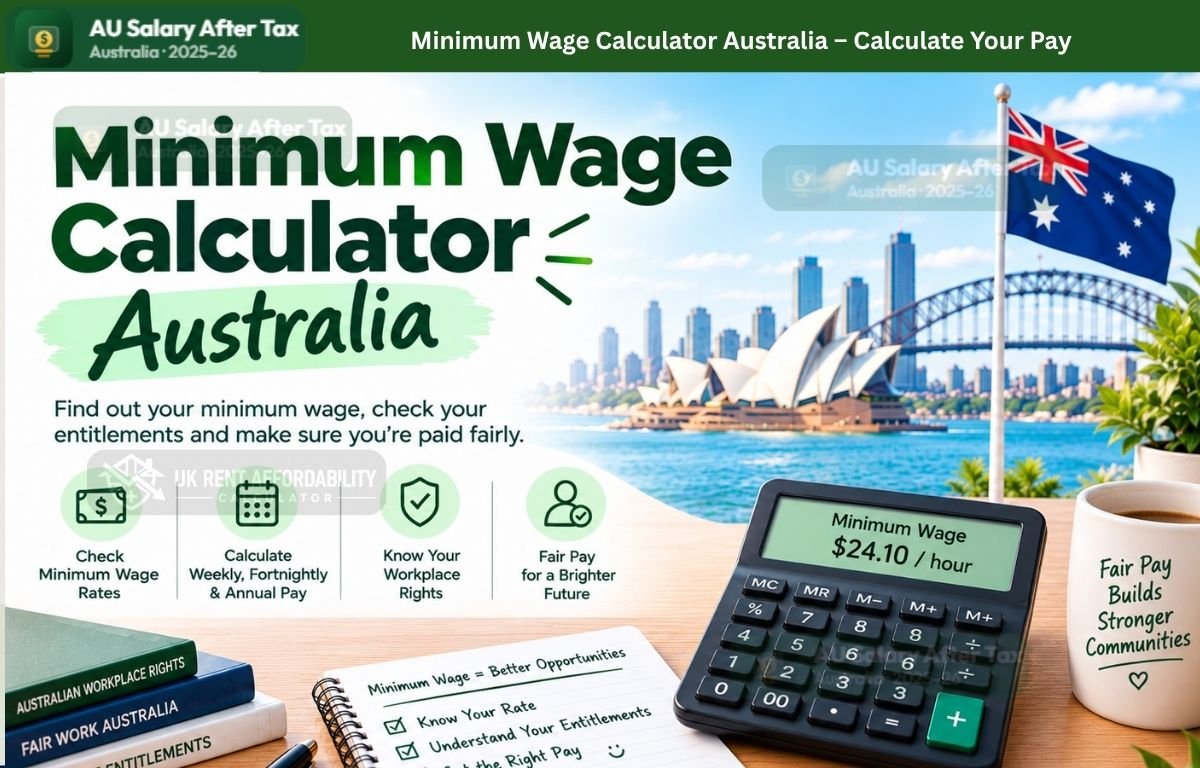
That is why a Minimum Wage Calculator Australia can be useful.
Our calculator shows both sides of the calculation. Enter the minimum hourly wage and your hours per week, and it estimates your gross annual salary, estimated annual tax, annual take-home pay, weekly take-home pay, fortnightly take-home pay, monthly take-home pay and your effective hourly rate after tax.
This guide explains how Australia’s minimum wage works, how hourly minimum wage becomes weekly and annual income, how tax affects minimum-wage workers, what happens with casual loading, why award rates can be higher, how superannuation fits into the calculation, and how to use the calculator to understand your actual take-home pay.
Table of Contents
| Important |
|---|
| Minimum wages and tax rules can change each financial year. The calculator currently displays 2025–26 rates, while Australia’s National Minimum Wage increased again from 1 July 2026. Always check the current Fair Work rate for the relevant pay period. |
Visit Here:Can You Rent Without a Guarantor UK? Complete Guide (2026)
What Is the Minimum Wage in Australia?
The National Minimum Wage is the minimum amount that applies to eligible employees who are not covered by an award or registered agreement, using the Minimum Wage Calculator Australia.
| 2025–26 National Minimum Wage | Amount |
|---|---|
| Hourly rate | $24.95 per hour |
| Weekly rate | $948 per week |
| Standard working week | 38 hours |
| Tax | Before tax |
However, the National Minimum Wage is not automatically the correct rate for every Australian employee.
Most employees are covered by an award, enterprise agreement or another workplace instrument that can set a higher minimum rate depending on the occupation, industry, classification, age, employment type, working hours and other factors.
| From 1 July 2026 – National Minimum Wage | Amount |
|---|---|
| Hourly rate | $26.44 per hour |
| Weekly rate | $1,004.90 per week |
| Standard working week | 38 hours |
That distinction is extremely important when using an online minimum wage calculator.
A calculator can tell you what a particular hourly rate produces in gross and after-tax income, but it does not determine whether that rate is legally correct for your particular job.
What Does a Minimum Wage Calculator Do?
A minimum wage calculator takes an hourly wage and converts it into different forms of income.
The calculator on this page allows you to work with:
- Minimum hourly wage
- Hours worked per week
- Gross hourly rate
- Gross annual salary
- Estimated annual tax
- Annual take-home pay
- Hourly take-home rate
- Weekly take-home pay
- Fortnightly take-home pay
- Monthly take-home pay
The current calculator is configured around the 2025–26 Australian tax year and displays a standard 38-hour example.
This is useful because an hourly wage alone does not tell you how much you will receive over a week, month or year.
| Example |
|---|
| $24.95 per hour |
doesn’t immediately tell you how much you will have available for rent, groceries, transport, and other expenses each month.
Once you calculate the annual gross income and estimate tax, the number becomes much easier to understand.
How Is Minimum Wage Calculated?
The basic calculation is straightforward.
Weekly gross pay
Hourly rate × hours worked per week
| Example Calculation |
|---|
| $24.95 × 38 = $948.10 |
The official Fair Work weekly National Minimum Wage figure for 2025–26 is published as $948 per week, with the weekly rate set by the relevant minimum wage order.
Annual gross pay
For a simple 52-week annualisation:
Hourly rate × hours per week × 52
Using the calculator’s displayed 2025–26 hourly rate:
$24.95 × 38 × 52 = $49,301.20
| Example |
|---|
| This is why the calculator currently shows an annual gross result of approximately $49,301.20 for $24.95 per hour and 38 hours per week. |
The important point is that annual salary is simply the hourly rate converted into the number of hours worked across the year.
What Is Gross Pay?
Gross pay is your income before tax and other deductions.
| Example Calculation |
|---|
| If your hourly rate is $24.95 and you work 38 hours: |
| $24.95 × 38 = $948.10 |
That is your approximate gross weekly earnings using the hourly multiplication.
Your employer may show your pay differently depending on the applicable workplace instrument, pay cycle, and rounding rules.
Gross pay is not the same as the money you receive in your bank account.
After tax and applicable deductions, your take-home amount will be lower.
That is why the calculator provides both gross and after-tax figures.
Minimum Wage After Tax
This is usually the number people actually want to know.
If you earn minimum wage, how much will you keep?
| 2025–26 Calculator Example | Amount |
|---|---|
| Hourly gross | $24.95 |
| Hours per week | 38 |
| Annual gross | $49,301.20 |
| Annual tax | $6,564.38 |
| Annual take-home | $42,736.82 |
| Estimated after-tax hourly rate | $21.63 per hour |
| Weekly take-home | $821.86 |
| Fortnightly take-home | $1,643.72 |
| Monthly take-home | $3,561.40 |
in take-home pay.
These figures are estimates rather than a guaranteed payslip amount.
Your actual result can vary depending on your personal circumstances, tax residency, deductions, offsets, Medicare levy circumstances, HELP debt and other factors.
Read more:Contract Day Rate Calculator Australia: Complete Guide to Contractor Pay, Tax and Take-Home Income
Why Is the Take-Home Rate Lower Than the Minimum Wage?
The difference comes primarily from taxation.
The minimum wage is quoted as a gross rate.
| Example |
|---|
| $24.95/hour gross |
| does not mean: |
| $24.95/hour in your bank account. |
Once applicable income tax and Medicare levy amounts are considered, your effective after-tax hourly income can be lower.
| 2025–26 Example | Amount |
|---|---|
| Gross hourly rate | $24.95 |
| After-tax hourly rate | $21.63 |
under the calculator’s assumptions.
The exact difference depends on your annual taxable income and personal tax circumstances.
Do Minimum Wage Workers Pay Income Tax?
Yes.
Being on minimum wage does not automatically mean you pay no tax.
Australia has a tax-free threshold, and income above that threshold can be taxed.
For Australian residents, the 2025–26 income tax rates include:
| Taxable income | Marginal tax rate |
| 0–18,200 | 0% |
| 18,201–45,000 | 16% |
| 45,001–135,000 | 30% |
| 135,001–190,000 | 37% |
| Over $190,000 | 45% |
These are marginal rates, which means a higher tax rate does not apply to your entire income simply because you cross into a higher bracket.
Only the portion falling into each bracket is taxed at that rate.
For someone earning around the full-time minimum wage, the taxable income is above the tax-free threshold, so some income tax can apply.
The calculator uses the relevant tax assumptions to estimate the annual tax and take-home amount.
What Is the Medicare Levy?
The Medicare levy is another reason your take-home pay can be lower than your gross income.
For many Australian taxpayers, the standard Medicare levy is 2% of taxable income, although reductions and exemptions can apply depending on circumstances.
The calculator takes the Medicare levy into account in its after-tax estimate.
This is important because someone looking only at the income-tax brackets could underestimate the total amount deducted from their pay.
The calculator’s purpose is to provide a practical estimate of what remains after the relevant tax assumptions rather than showing gross salary alone.
Minimum Wage for a 38-Hour Week
A standard full-time week in Australia is generally based around 38 hours.
| National Minimum Wage Calculation | Amount |
|---|---|
| 2025–26 hourly rate | $24.95 per hour |
| 2025–26 weekly calculation | $24.95 × 38 = $948.10 |
| Official 2025–26 weekly figure | $948 per week |
| Annual calculation | $24.95 × 38 × 52 = $49,301.20 |
| Annual gross result | $49,301.20 |
| From 1 July 2026 hourly rate | $26.44 per hour |
| From 1 July 2026 weekly rate | $1,004.90 per week |
So anyone using the calculator for a current 2026–27 employment situation should make sure the calculator has been updated to the current rate.
What If You Work Part-Time?
Minimum wage is not only relevant to full-time workers.
If you work part-time, your weekly and annual income will depend on the number of hours you actually work.
For example, using the 2025–26 rate of $24.95:
| Hours Per Week | Calculation | Weekly Pay |
|---|---|---|
| 20 hours | $24.95 × 20 | $499/week |
| 25 hours | $24.95 × 25 | $623.75/week |
| 30 hours | $24.95 × 30 | $748.50/week |
| 38 hours | $24.95 × 38 | $948.10/week |
The hourly minimum rate does not simply become lower because you work fewer hours.
Instead, your total weekly and annual earnings are lower because you work fewer hours.
Your actual employment conditions can depend on the applicable award, agreement and employment arrangement.
What About Casual Minimum Wage?
Casual employees are treated differently from permanent employees.
| Casual Employee Minimum Wage | Rate |
|---|---|
| National Minimum Wage | $26.44 per hour |
| Casual loading | 25% |
| Casual employee rate | $33.05 per hour |
| Loading included | 25% loading on the $26.44 base rate |
The reason the casual hourly rate is higher is that casual employees generally do not receive the same paid annual leave and paid personal/carer’s leave entitlements as permanent employees.
Using the 2025–26 adult National Minimum Wage as an illustration:
$24.95 × 1.25 = $31.1875
or approximately:
$31.19 per hour
However, the exact casual rate for a particular employee can depend on whether the employee is covered by an award or another industrial instrument.
Do not assume that every casual worker in Australia should simply be paid 25% above $24.95.
The applicable award or agreement may provide a different minimum rate or additional penalty rates.
Why Award Rates Can Be Higher Than the National Minimum Wage
The National Minimum Wage is a legal floor for employees who are not covered by an award or registered agreement.
Many Australian workers are covered by awards.
An award sets minimum pay and conditions for particular industries and occupations.
For example, a worker may be covered by an award that provides different rates depending on:
- Classification level
- Experience
- Age
- Ordinary hours
- Weekend work
- Public holidays
- Overtime
- Shift work
- Employment type
Fair Work states that employees covered by an award or registered agreement are entitled to the applicable minimum pay rates under that instrument, which can be higher than the National Minimum Wage.
This means the National Minimum Wage calculator should not be used as proof that a particular worker is legally entitled to exactly the National Minimum Wage.
It is a calculation tool.
To check your legal minimum rate, you need to identify the award or agreement covering your job.
Read more:Pro-Rata Salary Calculator Australia: Complete Guide to Part-Time Pay, Tax and Take-Home Salary
Minimum Wage vs Award Wage
It helps to think of the two as separate concepts.
National Minimum Wage
A general legal minimum for eligible employees who are not covered by an award or registered agreement.
Award minimum wage
A minimum rate that applies under a specific modern award.
An award rate may be higher because the award takes into account the nature of the work and employment conditions.
For example, someone working on weekends, nights or public holidays may receive penalty rates under the applicable award.
Therefore, if your job is covered by an award, simply multiplying the National Minimum Wage by your hours may underestimate what you should actually be paid.
Does Minimum Wage Include Superannuation?
The minimum wage and superannuation are separate concepts.
The National Minimum Wage is the minimum pay rate for the applicable ordinary hours.
Eligible employees can also have superannuation entitlements.
The Superannuation Guarantee rate is currently 12% for the relevant 2025–26 and 2026–27 financial years.
| Example | Calculation | Amount |
|---|---|---|
| Eligible ordinary earnings | $50,000 × 12% | $6,000 |
This is a simple illustration of the contribution rate.
However, you should not automatically add 12% to every figure without checking how the employment contract and applicable super rules work.
One important question when comparing job offers is:
“Is the quoted salary or wage plus super, or does it include super?”
That distinction can materially change the total value of an employment package.
Minimum Wage and Annual Leave
Permanent employees can have paid annual leave entitlements under the National Employment Standards.
Casual employees generally do not receive paid annual leave, which is one reason casual loading exists.
Part-time employees generally receive annual leave based on their ordinary hours.
This means two workers earning the same base hourly amount can have different overall employment arrangements depending on whether they are full-time, part-time or casual.
Therefore, comparing only the hourly wage does not always give you the complete financial picture.
Minimum Wage and Overtime
Minimum wage is generally the starting point for ordinary hours.
It does not necessarily represent the rate you should receive for every hour or every type of work.
Overtime can attract higher rates.
The same can apply to:
- Saturdays
- Sundays
- Public holidays
- Night shifts
- Early-morning shifts
- Certain roster arrangements
The applicable award or agreement determines the relevant minimum rates.
This is particularly important in industries such as hospitality, retail, healthcare, construction, and other sectors where employees regularly work outside standard weekday hours.
How to Use the Minimum Wage Calculator
Using the calculator is straightforward.
Step 1: Enter the Minimum Wage
Enter the hourly minimum wage you want to calculate.
| Calculator’s 2025–26 Setup | Rate |
|---|---|
| Hourly rate | $24.95 |
The page currently displays this as the adult National Minimum Wage from 1 July 2025.
Step 2: Enter Your Hours Per Week
Enter how many hours you work.
| Example |
|---|
| 38 hours |
This represents a standard full-time weekly calculation.
You can also enter a lower number if you work part-time.
Step 3: Review Gross Pay
The calculator converts your hourly rate into:
- Annual gross salary
- Gross hourly rate
Step 4: Review Tax
The calculator estimates your annual tax using the relevant tax assumptions.
Step 5: Review Take-Home Pay
You can then see:
- Annual take-home
- Weekly take-home
- Fortnightly take-home
- Monthly take-home
- Hourly after-tax rate
These are the key numbers for personal budgeting.
Read more:Pay Rise Calculator Australia: Complete Guide to Calculating Your New Salary and Take-Home Pay
Example: Minimum Wage at 38 Hours Per Week
Let’s use the calculator’s 2025–26 example.
| Details | Amount |
|---|---|
| Hourly rate | $24.95 |
| Hours per week | 38 |
Gross weekly income
| Weekly Pay |
|---|
| Approximately $948.10 |
Gross annual income
Using 52 weeks:
$49,301.20
Estimated annual tax
| Annual Tax |
|---|
| Approximately $6,564.38 |
Estimated annual take-home
Approximately:
$42,736.82
Estimated weekly take-home
| Weekly Take-Home Pay |
|---|
| Approximately $821.86 |
Estimated fortnightly take-home
| Fortnightly Take-Home Pay |
|---|
| Approximately $1,643.72 |
Estimated monthly take-home
Approximately:
$3,561.40
Estimated hourly take-home
| After-Tax Hourly Rate |
|---|
| Approximately $21.63 per hour |
These are the figures currently displayed by the calculator.
Why Your Payslip May Be Different
An online calculator can provide a useful estimate, but your actual payslip can be different.
For example, your final tax position can be affected by:
- Tax residency
- Tax-free threshold selection
- HELP debt
- Tax offsets
- Deductions
- Medicare levy circumstances
- Other income
- Salary sacrifice
- Employment type
- Pay frequency
- Award conditions
The calculator therefore should be used as a planning tool.
Your employer’s payroll system, your income statement and your eventual tax return determine your actual financial position.
Minimum Wage and Take-Home Pay for Different Hours
Using the 2025–26 rate of $24.95, you can quickly see how working hours affect gross income.
| Hours per week | Approx. gross weekly pay | Approx. annual gross at 52 weeks |
| 15 | $374.25 | $19,461 |
| 20 | $499.00 | $25,948 |
| 25 | $623.75 | $32,435 |
| 30 | $748.50 | $38,922 |
| 35 | $873.25 | $45,409 |
| 38 | $948.10 | $49,301.20 |
These figures are simple gross calculations using the calculator’s $24.95 hourly rate and 52-week annualisation. Your actual pay can differ where awards, overtime, penalty rates, unpaid breaks or other conditions apply.
Why the Number of Hours Matters So Much
Someone earning minimum wage at 20 hours per week is in a very different financial position from someone working 38 hours.
The hourly rate is the same, but the total annual income is significantly different.
| Hours Worked | Calculation | Weekly Pay |
|---|---|---|
| 20 hours | 20 hours × $24.95 | $499/week |
| 38 hours | 38 hours × $24.95 | $948.10/week |
That difference becomes substantial over an entire year.
This is why the calculator allows you to enter your actual weekly hours instead of assuming every worker is full-time.
What If You Work More Than 38 Hours?
Working more than 38 hours does not automatically mean every additional hour is paid at the ordinary minimum rate.
Depending on your employment arrangement, award or agreement, additional hours may attract overtime rates.
For example, an award may specify:
- When overtime starts
- How overtime is calculated
- Different rates for different periods
- Minimum engagement periods
- Penalty rates
So if you regularly work 40, 45 or 50 hours per week, you should not simply multiply all hours by the ordinary National Minimum Wage without checking your applicable employment conditions.
| Important |
|---|
| The calculator is most useful for estimating ordinary hourly income. It is not a replacement for the Fair Work Pay and Conditions Tool when you need to determine your legal award rate. |
Minimum Wage for Young Workers
Not every employee is automatically entitled to the adult National Minimum Wage.
Junior employees can have different minimum rates.
| 2026–27 Junior Rates | Details |
|---|---|
| Award and agreement-free juniors | Age-based rates |
| Junior rate | Relevant percentage of the adult rate, depending on age |
Apprentices and trainees can also have different minimum rates.
Employees with disability can have special minimum wage arrangements in certain circumstances.
| Important |
|---|
| Therefore, if you are under 21, an apprentice, trainee or covered by a special wage arrangement, do not assume the adult National Minimum Wage is automatically your correct legal rate. |
Minimum Wage for Visa Holders
Visa status does not mean an employee can simply be paid below the legal minimum.
| Fair Work Rights |
|---|
| Fair Work states that employees working in Australia are entitled to minimum rates of pay, and migrant workers and visa holders have workplace rights and entitlements. |
The applicable rate still depends on the employee’s occupation, award, agreement and other circumstances.
If an employer offers a rate below the applicable legal minimum, it is worth checking the situation with Fair Work.
Minimum Wage and Public Holidays
Public holidays can affect your pay.
Depending on the applicable award or employment arrangement, you may receive:
- Public holiday penalty rates
- Alternative arrangements
- Different ordinary-hour rules
- Minimum engagement requirements
This means a simple minimum-wage calculation may underestimate actual earnings for workers who regularly work public holidays.
Again, the National Minimum Wage is a baseline. Award conditions can provide additional entitlements.
Common Minimum Wage Calculation Mistakes
| Common Mistake | Explanation |
|---|---|
| Mistake 1: Confusing gross and net pay | $24.95/hour is a gross figure, not necessarily what reaches your bank account. |
| Mistake 2: Assuming the National Minimum Wage applies to everyone | Most employees are covered by awards or agreements that can provide higher minimum rates. |
| Mistake 3: Forgetting casual loading | Eligible casual employees can receive a 25% loading, although the exact applicable rate depends on the relevant employment instrument. |
| Mistake 4: Forgetting penalty rates | Weekend, evening, overnight and public holiday work can attract different rates. |
| Mistake 5: Treating super as part of the hourly minimum wage | Superannuation is a separate employment consideration. |
| Mistake 6: Using an outdated minimum wage | Minimum wage rates are reviewed each year. The rate that applied in 2025–26 is not the same as the current rate from 1 July 2026. |
Read more:Salary to Hourly Calculator Australia – How to Convert Your Salary to an Hourly Rate
What is the minimum wage in Australia?
For 2025–26, the adult National Minimum Wage was $24.95 per hour or $948 per week for a standard 38-hour week.
From 1 July 2026, it increased to $26.44 per hour or $1,004.90 per week.
What is the minimum wage after tax?
There is no single after-tax amount because take-home pay depends on your taxable income and personal circumstances.
Using the calculator’s 2025–26 example of $24.95 per hour for 38 hours per week, the estimated take-home pay is approximately $821.86 per week.
How much is the minimum wage per year in Australia?
Using $24.95 per hour and 38 hours per week for 52 weeks:
$24.95 × 38 × 52 = $49,301.20
This is the calculator’s 2025–26 annual gross calculation
Do minimum wage workers pay tax?
Yes.
Workers earning above the tax-free threshold can have income tax and Medicare levy obligations.
The exact amount depends on their circumstances.
Do casual workers get a higher minimum wage?
Eligible casual employees receive a 25% casual loading on the applicable base minimum rate under the National Minimum Wage. The current 2026–27 National Minimum Wage casual rate is $33.05 per hour.
Award-covered casual employees should check the rate in their applicable award.
Does minimum wage include super?
Superannuation should be considered separately from the wage rate.
Eligible employees can have employer superannuation obligations, with the Superannuation Guarantee rate currently 12%.
Is the National Minimum Wage the same as the award minimum wage?
No.
The National Minimum Wage applies to employees who are not covered by an award or registered agreement.
Employees covered by an award can have higher minimum rates based on their classification and employment conditions.
What happens if I work weekends?
You may receive penalty rates depending on your applicable award or agreement.
Do not assume the ordinary National Minimum Wage applies to every hour worked.
Can an employer pay less than minimum wage?
Employees generally cannot be paid below their applicable legal minimum rate.
However, different minimum rates can apply to juniors, apprentices, trainees and certain other categories.
The correct rate depends on the applicable workplace rules.
How often does Australia’s minimum wage change?
The Fair Work Commission reviews minimum wages each year through the Annual Wage Review.
Changes generally begin from the first full pay period on or after 1 July.
Final Takeaway
The hourly minimum wage is only the beginning of the calculation.
If you earn an hourly rate, your actual income depends on how many hours you work, how your employment is classified, and which workplace instrument applies to your job.
For a straightforward calculation, the basic formula is:
Hourly Rate × Hours Per Week = Gross Weekly Pay
and:
Hourly Rate × Hours Per Week × 52 = Approximate Annual Gross Pay
For example, using the calculator’s 2025–26 rate:
$24.95 × 38 × 52 = $49,301.20
But your gross salary is not the same as your take-home salary.
Income tax and the Medicare levy can reduce the amount you receive, while your actual employment arrangement can introduce other factors such as casual loading, overtime, penalty rates, annual leave, superannuation and award-specific conditions.
That is why the Minimum Wage Calculator Australia gives you more than an hourly number. It converts your wage and working hours into estimated annual, monthly, fortnightly and weekly take-home figures, while also showing the estimated after-tax hourly rate.
If you are using the calculator to understand your own pay, start by entering your actual hourly rate and weekly hours. Then compare the gross and after-tax results.
| Important |
|---|
| If you are checking whether an employer is paying you the correct legal minimum, however, go one step further. Find out whether your job is covered by an award or registered agreement, because your actual minimum rate may be higher than the National Minimum Wage. |
And always check the financial year.
| National Minimum Wage | Rate |
|---|---|
| 2025–26 | $24.95 per hour |
| From 1 July 2026 | $26.44 per hour |
| Current weekly rate | $1,004.90 per week |
| Standard working week | 38 hours |
So the best use of a minimum wage calculator is not simply asking:
“What is the minimum wage?”
It is asking:
“Based on my hourly rate and working hours, what could my gross pay and estimated take-home income actually look like?”
That is the number that is much more useful when planning your weekly budget, comparing jobs or understanding your payslip.
Calculator results are estimates for general information and budgeting purposes. Your actual pay and tax position depend on your employment arrangement and personal circumstances. For employment rights and current minimum rates, check Fair Work Australia; for your individual tax position, check the ATO or speak with a qualified tax professional.