Four weeks of paid holiday a year sounds simple — until you try to put a dollar value on it. How much is one leave day worth on your salary? What is your accrued balance worth if you resign next week? Does the 17.5% leave loading apply to you, and is super paid on a leave payout? This annual leave calculator Australia guide answers each of those questions with checked figures, and shows you exactly how the calculator on this page turns your salary and leave days into a payout value.
Important: Annual leave is a legal entitlement under the National Employment Standards (NES), not a favour from your employer. Every employee except casuals accrues paid annual leave from their first day of work. Unused leave never expires under the NES, it must be paid out in full when your employment ends, and it is paid at the same value as if you had taken it — including leave loading where your award provides it.
Table of Contents
What Is Annual Leave?
Annual leave (often called holiday leave) is paid time off that employees build up as they work. Under the NES, which covers almost all Australian employees:
- Full-time employees get 4 weeks of paid annual leave per year — 20 working days, or 152 hours for a 38-hour week.
- Part-time employees get the same 4 weeks, calculated pro-rata on their ordinary hours. Work 20 hours a week and you accrue 80 hours of leave a year.
- Shiftworkers get 5 weeks where an award or agreement defines them as a shiftworker for NES purposes (190 hours a year for a full-timer).
- Casual employees get no annual leave. Their 25% casual loading compensates for it instead.
Your award or enterprise agreement can give you more than the NES minimum, never less. Leave starts accruing from your first day — including during probation — and it accrues on your ordinary hours of work only, never on overtime.
Read more: Income Tax Calculator Australia: Complete Guide to Income Tax, Brackets and Take-Home Pay
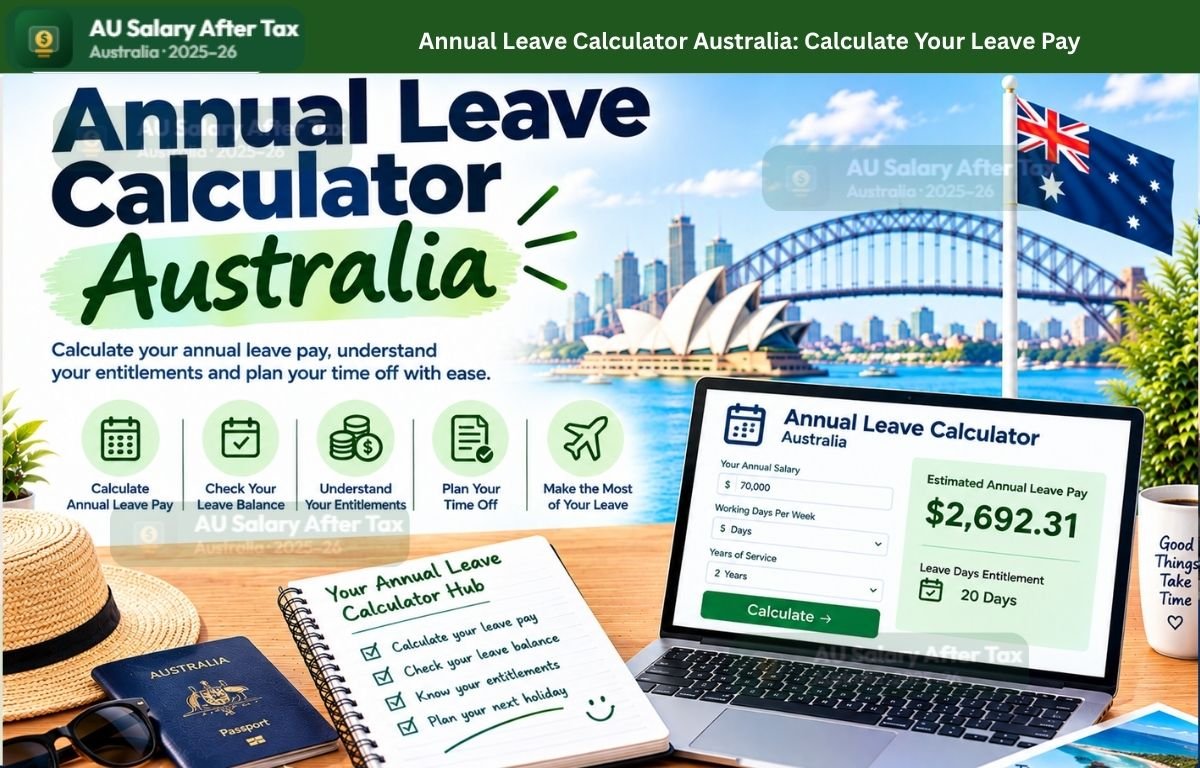
Annual Leave Calculator Australia: How to Use It
The annual leave calculator Australia employees use on this page takes two inputs and applies the standard valuation method instantly:
- Annual Salary — your gross yearly salary before tax (default $80,000).
- Leave Days — the number of leave days you want to value (default 20, the standard full-time yearly entitlement).
It returns a headline Leave Payout Value, your daily rate, your weekly rate, and the value of a standard 20-day entitlement for comparison. With the default inputs the payout value is $6,153.85.
Read the results with these limitations in mind:
- It uses the 260-day method. Your daily rate is your salary divided by 260 (52 weeks × 5 days). That is exact for a full-time employee on a five-day week — and misleading for part-timers, as Example 5 below shows.
- It does not add leave loading. The 17.5% loading many awards pay when leave is taken is not included, so the value of leave you actually take can be higher than the calculator shows.
- It does not calculate tax or super. The figure is a gross value. Tax on a termination payout and super on leave are covered in their own sections below.
- It values days, not your live balance. Your real balance sits in your employer’s payroll system, measured in hours. Convert hours to days using your own hours per day before entering a number.
How Annual Leave Is Valued
The formula behind every figure in this guide is:
Daily rate = annual salary ÷ 260
Leave value = daily rate × leave days
Weekly rate = annual salary ÷ 52
The 260 figure is simply the number of weekdays in a working year. Dividing your salary by it spreads your pay evenly across every working day, leave days included.
There is a second method, and for many employees it is the more accurate one: value leave in hours. Your leave balance in hours, multiplied by your hourly rate, always gives the correct value — whatever your work pattern. A full-time balance of 152 hours at $40 an hour is worth $6,080, whether you take it as 20 short days or four full weeks.
Both methods agree for a standard full-time employee. They part company for part-time and variable-hours workers, whose “day” is not a 7.6-hour full-time day. If your hours are irregular, work in hours.
Annual Leave Calculator Australia: Worked Examples
Every example below uses the same method as the annual leave calculator Australia workers check their balances with, and each one has been re-calculated independently.
Example 1: $80,000 salary, 20 days (the calculator default)
- Daily rate: $80,000 ÷ 260 = $307.69
- Weekly rate: $80,000 ÷ 52 = $1,538.46
- Leave value: $307.69 × 20 = $6,153.85
This is the gross value of one full year of leave entitlement on an $80,000 salary — and also roughly what a 20-day balance pays out if you resign.
Example 2: $60,000 salary, 10 days
- Daily rate: $60,000 ÷ 260 = $230.77
- Leave value: $230.77 × 10 = $2,307.69
- A full 20-day entitlement on this salary is worth $4,615.38.
Example 3: $100,000 salary, 20 days
- Daily rate: $100,000 ÷ 260 = $384.62
- Leave value: $384.62 × 20 = $7,692.31
Example 4: The same leave with 17.5% loading added
Take a $91,000 salary. The daily rate is $350, so 20 days of leave is worth $7,000 at the base rate. If your award pays 17.5% annual leave loading when you take the leave:
- Loading: $7,000 × 17.5% = $1,225
- Total value of the leave taken: $7,000 + $1,225 = $8,225
- Each leave day is worth $350 × 1.175 = $411.25 instead of $350.
The calculator shows $7,000 for this worker. The loading is real money on top — one reason taking your leave is usually worth more than cashing it out or carrying it for years.
Example 5: Part-time — why you should value leave in hours
A part-time employee works 24 hours a week (three 8-hour days) and earns $49,920 a year. Their hourly rate is $49,920 ÷ (52 × 24) = $40 an hour. They have 48 hours of leave accrued — six of their working days.
- Hours method (correct): 48 hours × $40 = $1,920
- Calculator method: daily rate $49,920 ÷ 260 = $192, × 6 days = $1,152
The calculator understates this balance by $768, because dividing by 260 pretends the salary is spread over five days a week when this employee only works three. Part-timers: convert your balance to hours and multiply by your hourly rate — or divide your salary by your own working days per year (52 × your days per week) instead of 260.
How Annual Leave Accrues
Leave does not arrive in one lump on your work anniversary. It accumulates progressively, pay period by pay period, based on the ordinary hours you work:
| Employee | Leave per year | Per week | Per fortnight | Per month |
|---|---|---|---|---|
| Full-time, 38 hrs/week | 152 hours (4 weeks) | 2.923 hrs | 5.846 hrs | 12.667 hrs |
| Part-time, 20 hrs/week | 80 hours (4 weeks) | 1.538 hrs | 3.077 hrs | 6.667 hrs |
| Part-time, 25 hrs/week | 100 hours (4 weeks) | 1.923 hrs | 3.846 hrs | 8.333 hrs |
| Shiftworker, full-time 38 hrs/week | 190 hours (5 weeks) | 3.654 hrs | 7.308 hrs | 15.833 hrs |
The quick rule: your yearly leave hours equal your weekly ordinary hours × 4 (× 5 for a shiftworker). A full-timer therefore has about 10 days banked after six months (76 hours).
Two traps hide in accrual:
- Some websites say leave accrues at “1/13th of your entitlement per month”. That is wrong. Per month you accrue one-twelfth of your yearly entitlement — 12.667 hours for a full-timer. The 13 figure belongs to a different sum (4 weeks ÷ 52 weeks, per week worked).
- Leave keeps accruing while you are on paid leave — annual leave, paid personal leave, paid family and domestic violence leave, long service leave and community service leave all count. It generally stops while you are on unpaid leave, including unpaid parental leave, and no leave accrues on a period you have cashed out. Accrual during workers compensation depends on your state or territory compensation law.
Unused leave rolls over indefinitely. There is no use-it-or-lose-it deadline in the NES.
Annual Leave Loading Explained
Annual leave loading is an extra percentage paid on top of your base rate when you take leave. The standard figure in awards that provide it is 17.5%.
The most misunderstood point in this whole guide: leave loading is not an NES entitlement and it is not law for everyone. The Fair Work Ombudsman’s position is plain — loading “doesn’t apply to all employees” and depends entirely on what your award, enterprise agreement or contract says. Many award-covered workers get 17.5%; many salaried professionals on contracts get nothing.
Key facts about loading:
- It is paid when leave is taken, not on the balance sitting in your account. Your accrued balance is valued at the base rate until you use it.
- Some awards pay shiftworkers the higher of 17.5% or the shift loading they would have earned — the Fair Work Ombudsman gives the example of a 15% afternoon-shift loading losing to the 17.5% leave loading.
- On a $35 hourly rate, two weeks of leave (76 hours) pays $2,660 at the base rate. With 17.5% loading, add $465.50 for a total of $3,125.50.
- Loading you would have received on leave taken must be included in a termination payout (see below).
The Fair Work Ombudsman’s full annual leave guidance, including payment rules, is at fairwork.gov.au — Annual leave.
Taking Annual Leave
You can take leave as soon as it has accrued, in any amount you and your employer agree on — a day, a week, or your whole balance. The rules that protect both sides:
- Timing is by agreement, and your employer must not unreasonably refuse a request to take annual leave.
- A public holiday inside your holiday is not a leave day. If a public holiday falls on a day you would normally have worked during your leave, that day is treated as a public holiday — your leave balance is not reduced for it and you are paid under the public holiday rules.
- If you fall sick on annual leave, you can use paid personal (sick) leave instead for the days you are unwell, and your annual leave is credited back. Your employer can still ask for the usual notice and evidence, such as a medical certificate.
- Leave is paid at your base rate for the ordinary hours you would have worked, at the rate current when the leave is taken — excluding overtime, penalties, allowances and bonuses, unless your award or agreement pays more.
Directing Leave, Shutdowns and Excessive Balances
Your employer cannot order you to take leave whenever it suits them — but there are two situations where direction is allowed:
- Shutdowns. Many awards let an employer direct staff to take accrued leave during a temporary shutdown (the Christmas–New Year close is the classic case), typically with written notice — one month’s written notice is common in award clauses. Check your award for the exact period.
- Excessive balances. A balance is generally considered excessive once it passes 8 weeks (304 hours for a full-timer), or 10 weeks (380 hours) for a shiftworker. Many awards then require a genuine attempt to agree on a plan first; only if that fails can the employer direct leave in writing.
For award-free employees, a direction is only lawful if it is reasonable — an excessive balance or a business shutdown are the Fair Work Ombudsman’s own examples of reasonable grounds.
Cashing Out Annual Leave
Cashing out means swapping accrued leave for a cash payment while staying in the job. The rules are stricter than most people think — and one common claim about them is backwards:
- You can cash out only if your award or enterprise agreement allows it. Most awards cap cashing out at 2 weeks in any 12 months.
- Award-free employees are not banned — they may cash out by agreement with their employer at any time, under the same safeguards. (Some websites claim award-free staff can never cash out; that is wrong.)
- For everyone, three safeguards apply: you must keep at least 4 weeks of leave after the cash-out; you need a separate written agreement for each occasion; and the payment must be at least what you would have been paid for taking the leave, including loading where it applies.
- Your employer cannot force you to cash out — or pressure you not to.
- Leave does not accrue on a cashed-out period.
Think before you cash out even where it is allowed: leave you take is worth base rate plus loading where it applies, and a week off has a value no payslip measures.
Annual Leave on Termination
When your employment ends — resignation, dismissal or redundancy — your employer must pay out all accrued, untaken annual leave in your final pay. This cannot be contracted out of, even if your contract says otherwise.
How much: the same amount you would have received if you had taken the leave — at your current base rate, including leave loading if you would have received it. Example: 76 hours (two weeks) unused at $30 an hour pays $2,280; with 17.5% loading the payout is $2,280 + $399 = $2,679.
How it is taxed: the ATO’s Schedule 7 table governs withholding on unused leave payments, and the treatment depends on why you left and when the leave accrued:
| Situation | Withholding | Reported as |
|---|---|---|
| Normal exit (resignation, retirement) — leave accrued after 17 August 1993 | Marginal rates | Salary and wages |
| Normal exit — leave accrued before 18 August 1993 | Flat 32% | Lump sum A |
| Genuine redundancy, invalidity or approved early retirement scheme | Flat 32% | Lump sum A |
So the everyday case — you resign with leave you accrued recently — is withheld at marginal rates and taxed exactly like salary. There is no special lump-sum tax break, and the payment is not an employment termination payment (ETP). One comfort: no HELP repayment withholding is taken from these lump sums under Schedule 7.
Read more: Tax Refund Estimator Australia: Complete Guide to Tax Refunds, PAYG Withholding and Your Tax Return
Annual Leave and Superannuation
Super treats leave two very different ways, and mixing them up is expensive:
- Leave you take is ordinary time earnings, so the 12% super guarantee applies to it exactly as on normal pay — including on leave loading, which the ATO treats as earnings unless it is demonstrably paid for lost overtime opportunity. On Example 1’s $6,153.85 of leave pay, that is $738.46 of super.
- Leave paid out on termination is excluded from ordinary time earnings by law, so no super guarantee is payable on your unused-leave payout — even though the identical balance would have attracted super had you taken the leave before leaving.
Since 1 July 2026, Payday Super means super on leave taken is paid on payday and must reach your fund within 7 business days, like all other super.
Common Mistakes When Valuing Annual Leave
- Believing everyone gets 17.5% loading by law. Loading exists only where an award, agreement or contract provides it. Plenty of employees get none.
- Repeating the “1/13th per month” accrual figure. You accrue one-twelfth of your yearly entitlement each month — 12.667 hours a month for a full-timer.
- Dividing a part-time salary by 260. The 260 method assumes a five-day week. Part-timers must value leave in hours at their real hourly rate, as Example 5 shows.
- Assuming unused leave expires. It rolls over indefinitely under the NES. Only award-based direction rules can force an excessive balance down.
- Expecting super on a termination payout. None is payable — unused-leave lump sums are excluded from ordinary time earnings.
- Expecting a tax break on a resignation payout. A normal resignation payout is taxed at marginal rates like salary. The flat 32% lump sum A treatment is reserved for genuine redundancy, invalidity and early retirement scheme exits (and pre-1993 accruals).
- Cashing out below a 4-week balance. Never allowed, whatever your award says — the 4-week floor, a written agreement each time, and payment at the full take-the-leave value are non-negotiable safeguards.
Final Takeaway
Your annual leave is worth real money, and valuing it takes one formula: daily rate = salary ÷ 260, leave value = daily rate × days. Used with the hours method where your work pattern is not a standard week, the annual leave calculator Australia employees rely on gives a figure you can trust for planning a holiday, checking a payslip or sizing up a resignation payout.
Just remember what the headline number leaves out: 17.5% loading on top if your award pays it when you take the leave, super at 12% on leave you take but none on leave paid out, and marginal-rate tax on a termination payout. Four weeks a year, accruing from day one and never expiring — it is one of the most valuable entitlements you have.
How many days of annual leave do full-time employees get in Australia?
Full-time employees get 4 weeks of paid annual leave per year under the National Employment Standards — 20 working days, or 152 hours for a 38-hour week. Shiftworkers defined as such in their award or agreement get 5 weeks. Part-time employees get 4 weeks pro-rata on their ordinary hours, and casual employees get no annual leave.
How do I calculate the dollar value of my annual leave?
Divide your annual salary by 260 to get your daily rate, then multiply by your leave days. On an $80,000 salary the daily rate is $307.69, so 20 days of leave is worth $6,153.85. That is the method used by the annual leave calculator Australia guide on this page. If you work part-time or irregular hours, multiply your leave balance in hours by your hourly rate instead — it is more accurate for non-standard weeks.
How much annual leave do I accrue each month?
A full-time employee on a 38-hour week accrues 12.667 hours per month — one-twelfth of the 152-hour yearly entitlement. That works out to 2.923 hours per week or 5.846 hours per fortnight. Claims that leave accrues at 1/13th of the entitlement per month are incorrect.
What is annual leave loading, and does everyone get it?
Annual leave loading is an extra payment on top of your base rate when you take annual leave, set at 17.5% under many modern awards. It is not part of the National Employment Standards, so it does not apply to all employees — only those whose award, enterprise agreement or contract provides it. It is paid when leave is taken, not on your accrued balance.
Is annual leave paid out when I resign?
Yes. When your employment ends for any reason, your employer must pay out all accrued, untaken annual leave in your final pay, at the same amount you would have received if you had taken it — including leave loading where it would have applied. This obligation cannot be removed by a contract or agreement.
How is a leave payout taxed when I resign?
For a normal resignation, unused leave accrued after 17 August 1993 is withheld at your marginal tax rates under the ATO’s Schedule 7 table and reported as salary and wages — there is no special lump-sum rate. The flat 32% lump sum A treatment applies only to genuine redundancy, invalidity or approved early retirement scheme terminations, and to leave accrued before 18 August 1993.
Do I get super on my annual leave payout?
No super guarantee is payable on unused annual leave paid out when your employment ends, because those lump sums are excluded from ordinary time earnings. Super at 12% is payable on annual leave you actually take, and generally on leave loading as well.
Can I cash out my annual leave?
Only if your award or enterprise agreement allows it — most awards cap cashing out at 2 weeks per 12 months. Award and agreement-free employees can cash out by agreement with their employer. In all cases you must keep at least 4 weeks of leave after the cash-out, sign a separate written agreement each time, and be paid at least what you would have received for taking the leave.
Can my employer force me to take annual leave?
Only in limited circumstances. Employers can direct leave during a business shutdown, such as Christmas–New Year, where an award or agreement allows it and reasonable notice is given, and many awards allow directions once a balance becomes excessive — more than 8 weeks, or 10 weeks for a shiftworker. For award-free employees, any direction must be reasonable. An employer must not unreasonably refuse your own request to take leave.
What happens if a public holiday falls during my annual leave?
The day is treated as a public holiday, not an annual leave day. If it falls on a day you would normally have worked, your leave balance is not reduced for that day and you are paid under the public holiday rules instead — effectively giving you an extra day off without using your leave.
Pingback: Best Redundancy Pay Calculator Australia: Complete Guide 2026