Stay back late, start before dawn, or pick up hours beyond your roster — and the extra work should pay extra. But how much extra? Australia has no single overtime rate written into law, which is exactly why overtime is one of the most underpaid entitlements in the country. This overtime calculator Australia guide explains where overtime rates actually come from, how the calculator on this page works, what the common award structures pay, and the traps that catch casuals, part-timers and salaried staff.
Important: There is no overtime rate in the National Employment Standards or the Fair Work Act. The Act only caps maximum weekly hours (38 for full-time staff, plus reasonable additional hours) and gives you the right to refuse unreasonable extra hours. Your overtime rate — time and a half, double time, or something else — comes from your award, enterprise agreement or contract. An award-free employee has no automatic right to a higher rate for extra hours at all.
Table of Contents
What Is Overtime?
Overtime is work performed outside the ordinary hours set by your award or agreement. The Fair Work Ombudsman defines it that way, and adds that the details “are different under each award and registered agreement.”
In practice, hours usually become overtime when you work:
- More than your maximum ordinary hours — commonly 38 hours in a week (or the average over your roster cycle where your award averages hours).
- Beyond your daily ordinary hours — many awards cap ordinary hours at 8, 9, 10 or 11 hours in a day depending on the day and the award; hours past the cap are overtime.
- Outside the spread of ordinary hours — the band of times (for example 7am to 7pm) within which ordinary hours can be rostered. Work before or after the spread is often overtime even within a 38-hour week.
- Beyond your agreed hours, if you are part-time — a part-timer’s extra hours are generally overtime once they pass the pattern of hours agreed in writing, not only after 38 hours.
Two protections sit above all of this in the Fair Work Act. Your employer must not require more than 38 hours a week (for a full-timer) plus reasonable additional hours — and you may refuse additional hours if they are unreasonable, weighing things like health and safety risks, your family responsibilities, the notice given, and whether you are paid overtime rates for them.
Overtime is also different from penalty rates. Penalties are higher rates for ordinary hours worked at inconvenient times — weekends, nights, public holidays. Overtime is about how much you work beyond the ordinary pattern; penalties are about when. Sometimes both apply to the same hour, and how they combine is set by your award.
Read more: Income Tax Calculator Australia: Complete Guide to Income Tax, Brackets and Take-Home Pay
Overtime Calculator Australia: How to Use It
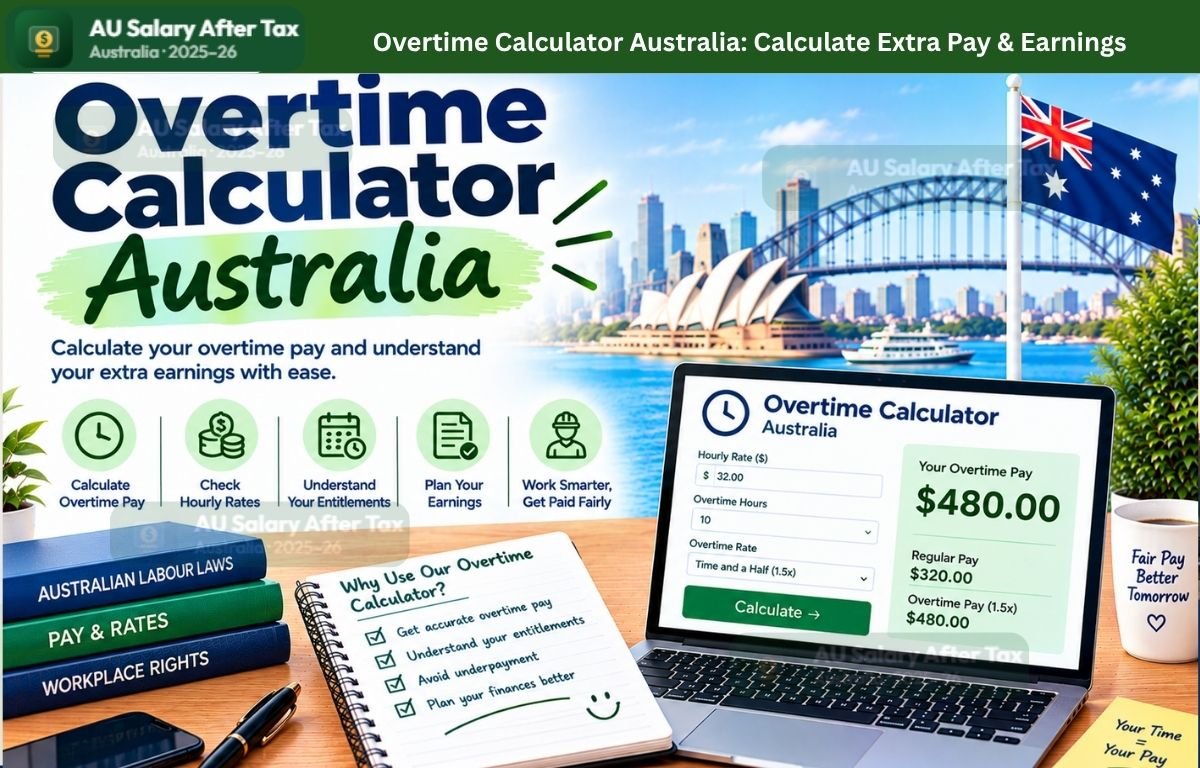
The overtime calculator Australia employees use on this page takes three inputs:
- Base Hourly Rate — your ordinary hourly rate before any multiplier (default $35).
- Overtime Hours — the number of overtime hours you want to value (default 10).
- Overtime Rate — a dropdown with three multipliers: time and a half (1.5×), double time (2×) and double time and a half (2.5×).
It returns your overtime hourly rate, the total overtime pay, what the same hours would pay at your standard rate, and the extra earnings the overtime generates. With the default inputs — $35 an hour, 10 hours at 1.5× — overtime pay is $525, which is $175 more than the $350 those hours pay at the standard rate.
Use it with these limitations in mind:
- One multiplier per calculation. Most awards are tiered — the first 2 or 3 hours at 1.5×, the rest at 2×. For a tiered shift, run the calculator twice (once per tier) and add the results, as Example 3 shows.
- It does not know your award. It cannot apply your award’s daily caps, minimum engagement periods, or the way your award treats casual loading on overtime.
- Everything is before tax. There are no tax, super or take-home outputs — overtime is taxed as normal income and generally attracts no super, as the sections below explain.
- It values the hours you enter. Whether those hours legally count as overtime depends on your award’s triggers — daily, weekly, or outside the spread of hours.
How Overtime Pay Is Calculated
Overtime hourly rate = base hourly rate × multiplier
Overtime pay = overtime hourly rate × overtime hours
Extra earnings = overtime pay − (base rate × overtime hours)
The multiplier is the only variable, and your award sets it. The most common pattern in modern awards is 150% for the first 2 or 3 hours, then 200% — but the tier length, the Sunday rate and the public holiday rate all vary, which is why the worked examples below use real award structures rather than a made-up national rate.
Overtime Calculator Australia: Worked Examples
Every example below has been checked against the overtime calculator Australia workers use on this page, or built directly from the award clauses cited.
Example 1: $35 an hour, 10 hours at time and a half (the calculator default)
- Overtime rate: $35 × 1.5 = $52.50 an hour
- Overtime pay: $52.50 × 10 = $525.00
- Same hours at the standard rate: $350.00
- Extra earnings: $175.00
Example 2: $40 an hour, 10 hours at double time
- Overtime rate: $40 × 2 = $80.00 an hour
- Overtime pay: $80 × 10 = $800.00
- Same hours at the standard rate: $400.00
- Extra earnings: $400.00
Example 3: A tiered award shift — run the calculator twice
Under the Retail and Manufacturing awards, a full-timer’s first 3 overtime hours on a weekday pay 150% and the rest pay 200%. On a $30 base rate, a 5-hour overtime shift pays:
- First 3 hours: 3 × ($30 × 1.5) = 3 × $45 = $135
- Next 2 hours: 2 × ($30 × 2) = 2 × $60 = $120
- Total overtime pay: $255 (against $150 at the standard rate — $105 extra)
The calculator reaches the same answer in two runs: 3 hours at 1.5× ($135), then 2 hours at 2× ($120).
Example 4: One casual, two awards — a $18.75 difference
Take a casual on a $30 base rate working the same 4 weekday overtime hours under two different awards:
- Retail Award: casual overtime rates are published inclusive of loading — 175% of the base rate for the first 3 hours, then 225%. Pay: 3 × $52.50 + 1 × $67.50 = $225.00
- Manufacturing Award: the overtime percentage applies to the loaded casual rate of $37.50. Pay: 3 × $56.25 + 1 × $75.00 = $243.75
Same worker, same hours, same base rate — $18.75 apart purely because the awards treat casual loading differently. The casual overtime section below explains the three patterns behind this.
Example 5: Overtime as a weekly habit
A worker on $38 an hour regularly works 5 hours of double-time overtime a week. Each week pays 5 × $76 = $380 in overtime pay, of which $190 is extra above the standard rate. Across a year that is $19,760 of overtime pay — $9,880 of it extra earnings. Regular overtime at this level is also a warning sign: the Fair Work Act’s “reasonable additional hours” test weighs how often it happens, and a permanent pattern may mean the role is really a longer-hours job.
Overtime Rates Under Common Awards
These four structures are taken directly from current award clauses. They are illustrations of how much awards differ — your own award is the only one that decides your pay.
| Award | First overtime hours | After that | Sunday | Public holiday |
|---|---|---|---|---|
| General Retail | 150% for first 3 hrs | 200% | 200% | 250% |
| Manufacturing | 150% for first 3 hrs | 200% | Award-specific | Award-specific |
| Security Services | 150% for first 2 hrs | 200% | 200% | 250% |
| Fitness Industry | 150% for first 2 hrs | 200% | 200% | Award-specific |
Three details in this table catch people out:
- The first tier lasts 2 hours in some awards and 3 in others. On a long shift, that single clause difference changes the whole day’s pay.
- Each day usually stands alone. Daily overtime is calculated per day or shift; running past midnight can even reset the rate under some awards (the Security Award resets to 150% after midnight unless the next day is a Sunday or public holiday).
- Public holiday work at 250% is usually a penalty rate structure rather than pure overtime — but for the employee the practical result is the same: two and a half times the base rate.
Since 30 August 2025, the Protecting Penalty and Overtime Rates Act has also required the Fair Work Commission to protect penalty and overtime rates in awards from being reduced — the rates in your award cannot simply be traded away in a modern award review.
The Fair Work Ombudsman’s overtime guidance, including how to check your own award, is at fairwork.gov.au — Overtime pay.
Casual Overtime and the 25% Loading
Casuals do get overtime under modern awards — the idea that casuals miss out entirely is outdated folklore. What genuinely differs is how the 25% casual loading interacts with the overtime rate. There are three award patterns:
- Loading added into the rate (Retail pattern). The award publishes a separate casual overtime column: the permanent percentage plus 25 points — 150% becomes 175%, 200% becomes 225%, 250% becomes 275% — all calculated on the unloaded base rate. Note carefully: this is addition, not multiplication. 175% of a $30 base rate is $52.50; 150% of the loaded $37.50 rate would be $56.25. They are not the same number.
- Percentage applied to the loaded rate (Manufacturing pattern). The award applies the overtime percentage to the casual ordinary hourly rate, which by definition includes the loading — so the loading is effectively compounded into every overtime hour (Example 4).
- No loading on overtime at all (Fitness pattern). The award states expressly that casual loading is not paid for overtime hours, so a casual’s overtime is paid at the same percentages of the minimum rate as a permanent employee’s.
There is no way to guess which pattern your award uses. Check the overtime clause and the rate tables of your award — or run your exact classification through the Fair Work Ombudsman’s Pay and Conditions Tool, which applies the right pattern automatically.
Part-Time Overtime: It Starts Before 38 Hours
A stubborn myth says overtime only begins after 38 hours in a week. For part-time employees under most modern awards, that is wrong: overtime generally starts once you work beyond the ordinary hours agreed in your part-time agreement (or outside the daily cap or spread in your award).
A part-timer contracted for 20 hours who works 24 has typically worked 4 overtime hours — paid at the award’s overtime rates from the first extra hour under awards like Retail, Manufacturing and Fitness. Read your part-time clause carefully, though: a small number of awards and older arrangements treat agreed extra hours differently, and almost all require the variation to your regular pattern to be recorded in writing to be safe.
Overtime for Salaried Employees
A salary does not erase overtime rights — and it does not create them either. The position depends on coverage:
- Award-covered employees paid a salary are still entitled to the award’s overtime and penalty rates unless the award contains an annualised salary clause that properly covers them, or a lawful offset arrangement applies. The salary must leave the employee better off overall than the award for every pay period — “the salary covers everything” fails if the hours actually worked say otherwise.
- Annualised salary clauses in some awards add their own safeguards, including outer limits on the ordinary and overtime hours the salary can cover, and reconciliation against the award at least every 12 months.
- High-income employees earning over the high income threshold — $190,100 for 2026–27 ($183,100 in 2025–26) — can be given a guarantee of annual earnings that makes the award stop applying, including its overtime terms. The NES and the contract still apply.
- Award-free employees have no statutory overtime rate at all. Whatever their contract says — extra pay, TOIL, or nothing beyond the salary — is the deal, subject to the maximum-hours and reasonableness rules.
If your salary regularly absorbs big overtime hours, do the maths in Example 5 in reverse: value your actual hours under the award and compare them with your salary. Underpayments can be claimed for up to 6 years.
TOIL: Time Off Instead of Paid Overtime
Many awards let you take time off instead of overtime pay (TOIL), under a model term the Fair Work Commission inserted into modern awards. Its rules are more generous than most people expect:
- TOIL requires a written agreement for each occasion — your employer cannot simply roster it.
- The time off must be equivalent to the overtime payment, not hour-for-hour. Work 2 hours at time and a half and you are entitled to 3 hours off (Example: 4 hours at 1.5× on a $35 rate is $210 of pay, which converts to 6 hours off).
- The time must be taken within 6 months, at a time you both agree on.
- You can ask to be paid instead at any time, and any untaken TOIL is paid out automatically after 6 months — and on termination — at the overtime rate that applied when the overtime was worked.
- Your employer must not put undue pressure on you to take TOIL instead of pay.
Some enterprise agreements use hour-for-hour TOIL instead — another reason the document that covers you matters more than any general rule.
Overtime and Tax
There is no overtime tax rate and no overtime tax concession in Australia. Overtime is ordinary salary and wages, taxed at your marginal rate like every other dollar you earn.
Two things follow from that:
- A big overtime week looks over-taxed. PAYG withholding treats each pay on its own and effectively annualises it, so a fortnight loaded with overtime is withheld as though you earned that all year. If your real annual income is lower, the difference comes back as a refund at tax time. It is a timing effect, not extra tax.
- Only the dollars above a bracket threshold are taxed at the higher rate. Take Example 1’s $525 of overtime for a worker whose income sits in the 30% bracket: the tax and 2% Medicare levy on that overtime is about $168, leaving about $357 of it in hand. Overtime never pushes your whole income into a higher bracket — only the slice above the threshold.
One related item: an overtime meal allowance paid under an award is assessable income, but your employer does not have to withhold from it (and you do not have to show it in your return) up to the ATO’s reasonable amount — $40 per meal for 2026–27. Amounts above that, or allowances not spent on overtime meals, are treated like normal pay.
Read more: Tax Refund Estimator Australia: Complete Guide to Tax Refunds, PAYG Withholding and Your Tax Return
Overtime and Superannuation
Here the rule is short and absolute: superannuation guarantee is not payable on genuine overtime pay.
The ATO’s ruling (SGR 2009/2) puts it directly: payments for work performed in hours outside an employee’s ordinary hours of work are not ordinary time earnings (OTE). It does not matter whether the overtime component is dissected out of a lump sum or paid under an award — if it is genuinely payment for overtime hours, no 12% SG applies to it.
Two qualifications matter in practice:
- The undissected salary exception. If you are paid a single annual salary that does not separately identify any overtime component, the ATO treats the whole salary as OTE — your employer cannot carve out a notional “overtime” slice afterwards to reduce super.
- What counts as “overtime” follows your ordinary hours. Hours paid at an overtime rate that fall inside the ordinary hours defined by your award or contract may still be OTE. The label on the payslip does not decide it; the hours do.
Payday Super (from 1 July 2026) changed when super is paid, not what it is paid on — overtime remains outside OTE.
Breaks, Rest Periods and Safety
Overtime interacts with breaks in ways awards spell out and payslips often miss:
- Meal and rest breaks are set by your award — there is no single national rule. Working through a required break, or past a set number of overtime hours, commonly triggers extra breaks, meal allowances, or payment at overtime rates until a break is given.
- Minimum break between shifts: many awards require a minimum break — 10 consecutive hours under the Fitness Award, for example. If you are required to start again without it, the Fitness Award pays 200% for all time worked until you have had the full 10-hour break. Other awards have their own periods and penalties, so check yours.
- Reasonableness and safety override rosters: fatigue risk is one of the express factors in deciding whether additional hours are “reasonable” under the Fair Work Act, and work health and safety duties apply to overtime exactly as to ordinary hours.
Common Mistakes When Checking Overtime Pay
- Assuming the law guarantees time and a half. No statute sets an overtime rate. Your award, agreement or contract does — and award-free staff may have no higher rate at all.
- Using one multiplier for a whole shift. Most awards tier the rate (first 2 or 3 hours, then the rest). A single-rate estimate overstates or understates the shift.
- Multiplying the casual loading into overtime. Depending on the award, the loading is added as points, compounded into the rate, or not paid on overtime at all (Example 4). Never assume.
- Waiting for 38 hours as a part-timer. Overtime usually starts beyond your agreed hours, not at 38.
- Expecting super on overtime. Genuine overtime pay is not ordinary time earnings — no SG is payable on it.
- Believing overtime is taxed at a special higher rate. It is taxed at your marginal rate; only withholding makes a big week look worse than it is.
- Trading TOIL hour-for-hour without checking. Under the model award term, TOIL equals the overtime payment value — 2 hours at 1.5× converts to 3 hours off, and untaken TOIL must be paid out within 6 months.
What is the standard overtime rate in Australia?
There is no single standard overtime rate set by law. The National Employment Standards and the Fair Work Act do not set overtime rates at all. The most common pattern in modern awards is 150% of the ordinary rate (time and a half) for the first 2 or 3 overtime hours, then 200% (double time), with 200% on Sundays and 250% on public holidays in many awards — but your own award, enterprise agreement or contract is the only source that decides your rate.
How is overtime pay calculated?
Multiply your base hourly rate by the overtime multiplier to get the overtime rate, then multiply by the overtime hours. At time and a half on a $35 base rate, the overtime rate is $52.50 an hour, so 10 hours of overtime pays $525. For tiered award rates, calculate each tier separately and add the results.
Do casual employees get overtime pay?
Yes — casuals get overtime under modern awards, but the 25% casual loading is treated differently by different awards. Some awards add the loading into the overtime rate as extra percentage points (150% becomes 175% of the base rate), some apply the overtime percentage to the loaded casual rate, and some pay no loading at all on overtime hours. Check your award’s overtime clause.
Is overtime taxed at a higher rate?
No. Overtime is taxed as ordinary income at your marginal tax rate — there is no overtime tax rate or concession in Australia. A heavy overtime pay can look over-taxed because PAYG withholding annualises each pay period, but any excess withholding is refunded when you lodge your tax return.
Is superannuation paid on overtime?
Generally no. Under the ATO’s super guarantee ruling, payments for work performed outside your ordinary hours of work are not ordinary time earnings, so the 12% super guarantee does not apply to genuine overtime pay. The main exception is an undissected salary that does not separately identify an overtime component — the whole salary is then treated as ordinary time earnings.
Can my employer make me work overtime?
Your employer can require additional hours beyond 38 per week only if they are reasonable. You may refuse additional hours if they are unreasonable, taking into account health and safety risks, your personal and family circumstances, the notice given, workplace needs, and whether you are paid overtime rates. What counts as overtime, and its rate, come from your award or agreement.
When does overtime start for part-time employees?
Usually once you work beyond the ordinary hours agreed in your part-time agreement — not only after 38 hours in a week. Under awards such as Retail, Manufacturing and Fitness, hours beyond your agreed pattern are overtime hours paid at overtime rates, as are hours beyond the award’s daily cap or outside its spread of ordinary hours.
What is TOIL and how is it calculated?
TOIL is time off instead of paid overtime, available where an award or agreement allows it, under a written agreement for each occasion. Under the model award term, the time off must equal the overtime payment you would have received — 2 hours at time and a half converts to 3 hours off, not 2. It must be taken within 6 months; untaken TOIL is paid out at the original overtime rate, including on termination.
Do salaried employees get overtime?
Award-covered employees remain entitled to award overtime rates even if they are paid a salary, unless a valid annualised salary clause or a guarantee of annual earnings (for employees above the high income threshold, $190,100 in 2026–27) applies. Award-free employees have no statutory right to overtime pay — it depends entirely on their contract.
What is the difference between overtime and penalty rates?
Overtime is paid for working beyond your ordinary hours — past the weekly maximum, the daily cap, or your agreed pattern. Penalty rates are paid for ordinary hours worked at inconvenient times, such as weekends, nights and public holidays. The two are set separately by your award and can apply to the same hour in different combinations depending on the award.
Final Takeaway
Overtime pay is simple arithmetic wrapped in award-specific rules: overtime rate = base rate × multiplier, overtime pay = rate × hours. Used with your own award’s tiers, the overtime calculator Australia employees check their shifts with gives a reliable figure in seconds — just run tiered shifts in two parts, and treat casual overtime with special care, because the loading can be added, compounded or absent depending on the award.
Remember the frame around the numbers: no overtime rate exists in the Fair Work Act itself, extra hours beyond 38 must be reasonable, overtime attracts no super and no special tax, and TOIL must be worth the payment it replaces. Check your award’s overtime clause once, and you will never have to guess at an overtime payslip again.